A DEX suits a project that needs to launch on its own schedule, build a trading record cheaply and keep failure recoverable; a CEX suits a project whose buyers arrive from a bank and need fiat access, or whose partners require an exchange. That is the real answer to dex or cex first, and for most teams it points to the pool, then the application.
Most launch plans treat the choice as a sequencing question, as though a decentralised pool is the cheap rehearsal before a real exchange listing. It is not. The two venues put a token in front of different people, under different constraints, with different costs of being wrong, and picking the wrong one first is expensive in a way that is hard to undo.
Short answer
Start on chain, build a real record, then apply. A pool costs less, it can happen on your schedule, it produces the evidence an exchange application needs, and its failure mode is recoverable.
Go to a centralised exchange first only in a few situations:
- fiat access is the product, because your buyers will move money in from a bank rather than from a wallet;
- a partner or investor requires an exchange listing as a condition of the deal;
- you already have demand you can prove without a trading record;
- you can fund a market maker and the legal paperwork a venue asks for before it reviews you.
Those cases are real, and they are rarer than launch plans assume. Whichever comes first, the venue does not create demand. Getting buyers to the pair in the window it matters is a separate problem, covered on our crypto traffic acquisition page.
When a DEX is the better choice
A pool exists the moment you create it, needs no permission and costs gas plus the liquidity you seed. That makes it the default for any team that is still proving demand, that cannot fund deep liquidity yet, or that has a date it must trade by.
1. You cannot demonstrate demand yet
Exchanges say yes when they believe a pair will trade enough to cover integration, custody, surveillance and regulatory exposure. The most persuasive evidence is a trading record, and the cheapest place to build one is on chain. With no volume history, applying first means asking a committee to take your word for it. That is the weakest version of the application, and the process is described in how to apply for a CEX listing.
- Best for: new tokens with no trading history
- Why it matters: reviewers like a series more than a snapshot
- Watch out: a large first day alone is not a record
- Check: weekly volume and holder growth, logged from day one
2. Your liquidity budget is limited
On a decentralised exchange, depth is whatever you supply, and a thin pool prices badly the moment anyone trades size. On a centralised exchange, depth is whatever your market maker commits to, and most venues require one as a condition of listing. Either way the capital requirement is real. A team that cannot fund meaningful depth should choose the venue where thin depth is survivable, and that is the pool. What the mechanics look like in practice is in how to add liquidity to a pool the first time, and the pool setup itself in how to list a token on a DEX.
3. You have a date you must trade by
An exchange listing runs on the exchange’s calendar, which routinely means months from application to trading, with silence in between. If there is a date you must trade by, the decentralised route is the only one you control. Planning a launch around a listing that has not been agreed is the most common way launch schedules collapse.
4. What the pool teaches your application
The months you spend on chain are not a holding pattern, they produce the exact figures an exchange asks for. Record weekly volume, the depth at which a mid-sized buy moves the price by a few percent, the number of holders and how that number grew, and the share of volume arriving through aggregator routing rather than from your own community. Keep that record in one place from day one rather than reconstructing it later from explorer pages. A project that can show six months of steady routed volume is making a different argument from one that can only show a large first day.
The same data tells you when to stop waiting. If volume has been flat for a quarter and holder growth has stopped, another quarter on chain will not improve the application, and the constraint is something other than time. If both are still rising, applying later simply means applying with better numbers. Keep the incident record as well: a short honest note on any chain halt, contract pause, bridge outage or exploit near your token is received far better than a gap that a reviewer fills in.
5. Keeping the pool after a listing
Teams often let the pool go thin after a centralised listing, on the assumption that the exchange now carries the volume. That is usually a mistake. The pool is where the aggregators route, where a holder without an exchange account trades, where any integration can read a price, and where that price comes from when the exchange pauses withdrawals for maintenance or a chain upgrade. It is also your fallback: exchanges delist pairs that stop trading, and a project whose only venue disappears has nowhere to send holders.
Say publicly what you are doing with the pool. Holders read a shrinking position as the team withdrawing, and they are not wrong to. If part of that capital moves to the exchange side, publish the amount and the reason first.
When a CEX is the better choice
A centralised venue puts the token in front of the exchange’s existing user base, usually with fiat access, and that is the real difference between the two routes. The price is an application, a review and a decision you do not control.
1. Your audience does not hold crypto yet
A decentralised pool is only reachable by someone with a funded wallet on the right chain who knows how to swap. If your buyers are existing DeFi users, that is no barrier at all. If they are people who will move money in from a bank, the pool is invisible to them and a centralised venue is doing work nothing else can do. This single question resolves a large share of cases on its own. Fiat access is not a nice-to-have for a consumer-facing product; it is the entire funnel.
- Best for: consumer products whose buyers start from a bank account
- Why it matters: the exchange brings its own users and the fiat route
- Watch out: the venue sets the calendar, not you
- Check: where your first buyers actually hold money today
2. Regulation and legitimacy matter to your buyers
Exchanges serve specific jurisdictions and apply their rules to you. That brings compliance obligations and identity requirements, and it also brings the legitimacy some buyers and partners require before they will engage at all.
Treat that as a feature or a cost depending on who you are selling to. For a project courting institutional attention it is the point. For a permissionless protocol it may be a constraint without a matching benefit.
3. You can carry the paperwork early
Applying to a centralised venue pulls legal and corporate work forward by months. Company registration, beneficial ownership disclosure, founder identity documents and an opinion on how the token is classified in the jurisdictions the venue serves are all required before anyone at the exchange looks seriously at your volume history. If that work has not started, you are not ready to apply yet, whatever the traction says. The upside is that the package is reusable: it serves the next venue and most of the trackers.
4. You can source market maker inventory cleanly
Market makers quote from inventory, and the inventory has to come from somewhere. Either you lend tokens to the firm, you fund an arrangement that gives it an option over them, you sell it a position outright, or you supply the quote asset and let it source the token itself, and each has a different effect on circulating supply. Reconcile the choice with the supply table you filed: a tranche that moves to a market maker without appearing in the published breakdown reads on chain as a quiet sale by the team. Put the notice period and the return terms in the same document as the spread commitment.
DEX or CEX first side by side
| DEX first | CEX first | |
|---|---|---|
| Permission needed | None. You can list today | An application, a review, and a decision you do not control |
| Cost to launch | Gas plus the liquidity you seed | Terms vary by venue and are rarely published |
| Who finds you | People already on chain, looking | The exchange’s existing user base |
| Depth on day one | Exactly what you provide | Whatever the market maker commits to |
| Fiat access | None | Usually yes, and this is the real difference |
| What failure looks like | A thin pool nobody trades | A dead pair the exchange can delist |
| Reversibility | High. Adjust and continue | Low. A failed listing is part of your record |
The last row is the one most teams underweight. A shallow pool on a decentralised exchange is a problem you can fix quietly next week. A pair that lists on a centralised exchange and stops trading in four days is visible to every other exchange you will ever apply to.
Both routes get inspected, but by different people at different speeds. On chain, the first buyers check the contract, the holder distribution and the exit depth within minutes, and they say what they find in public. At an exchange, a reviewer checks the same things privately and simply declines. A verified contract, a reconciled supply table and a locked liquidity position are the price of entry for both, covered in how to verify a token contract and how to prepare a tokenomics page.
How to decide for your project
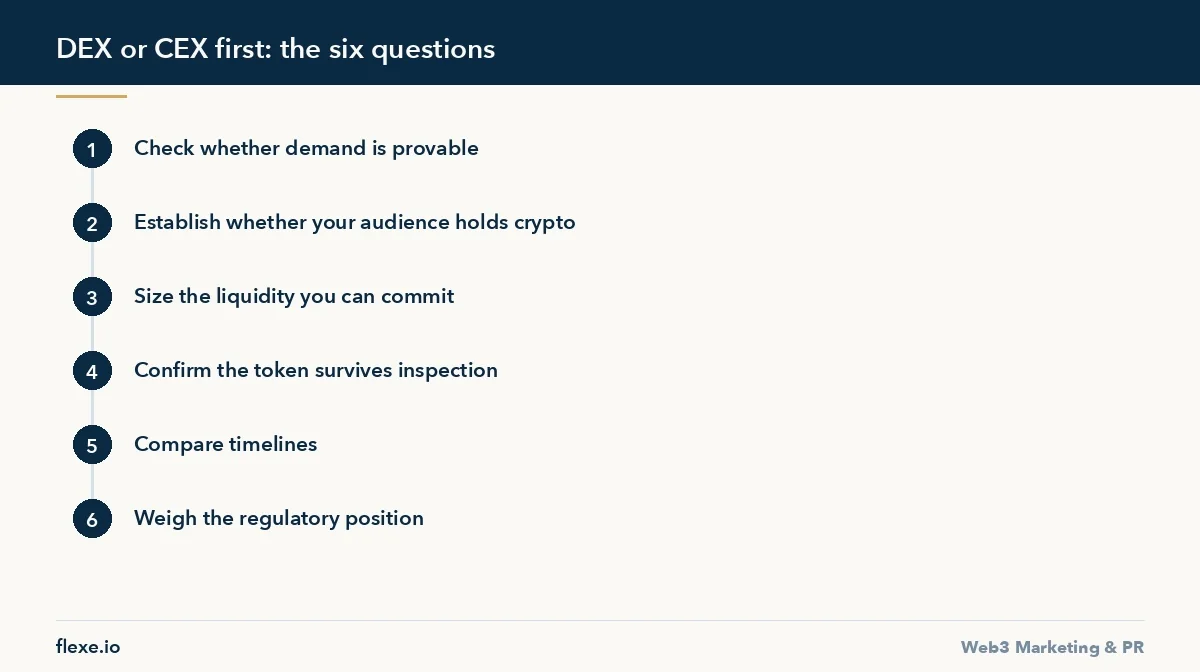
Answer six questions in order.
- Can you demonstrate demand yet? No trading record points to the pool.
- Does your audience already hold crypto? Buyers coming from a bank point to the exchange.
- How much liquidity can you commit? Thin depth is survivable only in the pool.
- Is the token ready to be examined? Neither route forgives an unverified contract.
- What is your timeline? A fixed date points to the route you control.
- Where does regulation put you? Weigh compliance cost against the legitimacy it buys.
Price discovery across two venues
Once both venues are live they quote the same asset, and arbitrage keeps them close. The pool is the price the exchange lists against, so a thin pool exports its bad pricing straight into the new pair. Deepen the pool before the listing date rather than after it. Wide gaps between venues attract bots rather than buyers, and they close in seconds at your expense, so the tokens have to be in the right place the day before, not on the morning itself. Decide in advance who supplies the first quotes on each side and from which wallet, because a new asset is sometimes credited slowly on its first day.
Sequencing the announcement across both venues
Exchanges usually want to publish first and on their own schedule, and a team that posts ahead of them can lose the promotion that made the listing worth having. The pool is yours to announce whenever you like. Buyers who read the news and cannot trade yet will go to the pool, which is fine if the pool is deep and embarrassing if it is not, so publish the contract address and the pool link in the same post. Staff the first week on both sides, pin the real addresses where newcomers will find them, and keep one person watching the pair on the first day who is not answering messages.
Revisiting the choice later
The answer is not permanent. A project that chose the pool because it had no record should reopen the dex or cex first question the moment that record exists, and a project that listed on a centralised venue first should still build the on-chain side. Set a trigger rather than a date: a volume level, a holder count, a partner that requires an exchange, or a market maker willing to quote your pair. Write down why you chose what you chose, what you expected, what it cost and what would change your mind, so the next review is a comparison rather than a fresh argument.
Frequently Asked Questions
Should a new token launch on a DEX or a CEX first?
For most projects, launch on a DEX first. A pool costs less, goes live on your own schedule, produces the trading record an exchange application asks for, and fails in a recoverable way: a thin pool you can deepen next week rather than a dead pair that every future exchange reviewer can see.
When should a CEX listing come first?
A CEX should come first when fiat access is the product, when a partner or investor makes an exchange listing a condition, or when you can already prove demand without a trading record. These cases are real, but they are rarer than most launch plans assume, and each still needs a market maker and the legal paperwork.
How much does it cost to launch on a DEX compared with a CEX?
A DEX launch costs gas plus the liquidity you seed, and nothing else is required to start. CEX terms vary by venue and are rarely published, and most venues also require a market maker as a listing condition, so the real cost includes the inventory and terms of that arrangement as well.
Does listing on a small exchange help with a larger one?
Only if the pair trades genuinely. Volume on a small venue that anyone can see is manufactured proves nothing to a reviewer, and a listing that stops trading within days becomes part of the record the next exchange reads. A steady series of routed on-chain volume is usually the stronger evidence.
Can a project launch on a DEX and a CEX at the same time?
Yes, and large launches often do. It means funding depth in two places at once, coordinating a market maker and planning the announcement order, because the pool is the price the exchange lists against. It suits teams with capital and staff for both venues rather than teams still choosing where to start.