Instagram crypto ads are a retargeting service for Web3 projects, and a focused single channel campaign starts at $4,000: you get Meta permission checks, pixel and event repair, audience build, policy safe creative and reporting against one agreed conversion event. They bring back people who opened your site, read the documentation or started a sign-up and stopped. Cold reach for a new token is a different job, and it is rarely worth buying here.
What follows is the buyer side: what Meta demands before a single advertisement runs, what you hand over, how the money splits, what the reports contain, and the briefs where we send the budget elsewhere.
Available on request. This runs at a substantial budget only. It is worth doing when you already have an audience to retarget; for cold reach on a smaller budget, crypto ad placements gets more for the same money.
Flexe.io runs Instagram crypto retargeting campaigns aimed at people who visited your website but did not finish the action that matters – signing up, linking a wallet or funding an account. Talk to us on Telegram at https://t.me/flexe_io_agency.
Why Instagram Is Key for Crypto Marketing
Instagram is among the largest social platforms worldwide by monthly visits, though published traffic figures vary by measurement source. The audience skews younger, technically confident and financially curious, and the format rewards projects that can explain themselves in pictures rather than in paragraphs.
The limit is policy. Crypto promotion on Instagram sits under strict rules, so our Instagram crypto work is built around what Meta actually approves rather than around what reads best.
Why Retargeting Works for Instagram Crypto Ads
Retargeting works here for three reasons that stack. The audience already knows the project, so the creative has less explaining to do and converts at a higher rate. The format is visual, so a wallet flow or a product screen can be shown rather than described. And spend goes only to people with demonstrated intent, which is where the cost per result comes down.
Benefits of Flexe.io
Our tailored Instagram crypto campaigns are designed to help your blockchain project thrive:
- Precise targeting and creative built for the surface: ads go only to people who visited your site, cut for Stories and Reels rather than resized into them.
- Integrated marketing: retargeting combined with services like Web3 Ads or Google Ads in one funnel.
Why Choose Flexe.io
We have run campaigns since 2018 across 800+ Web3 projects. Our Instagram crypto campaigns suit projects with real budgets, because retargeting needs steady traffic to the site before it can perform at all.
Want this channel running on your project? Message us on Telegram at https://t.me/flexe_io_agency.
If the placement is still an open question, crypto traffic acquisition sets out every option side by side – explorers, media, ad platforms – with monthly visits and what each platform allows.
What this channel is for, and what it is not
Instagram is a retargeting channel for crypto, not a prospecting one. Meta’s policies restrict what can be promoted and to whom, so cold campaigns aimed at people who have never heard of a token are expensive, slow to approve and frequently rejected outright.
Where it works is bringing back people who already visited. Someone who read the documentation or started a sign-up and left is a different audience at a different cost, and Meta finds that person again reliably.
The channel has a precondition: existing traffic to retarget, and a budget large enough for the auction to leave the learning phase. Projects with neither are better served by the channels on our crypto traffic acquisition page, and we say so rather than run a campaign that cannot work.
What has to exist before the first campaign
- Tracking that fires. A correctly installed pixel plus server-side events, verified on a real device before spend starts. Most retargeting failures are measurement failures.
- An audience with volume. Retargeting pools below a workable size deliver almost nothing, and the platform will spend the budget reaching the same few people.
- A defined conversion event. Wallet connected, application submitted, deposit made. Optimising towards a page view teaches the system to buy page views.
- Compliant creative. No return claims, no price charts implying performance, no language framing a token as an investment.
How moderation behaves
Approval is inconsistent and appeals are slow. The practical approach is conservative creative first, several variants prepared in advance, and no attempt to argue a rejection back through the interface. An asset account restriction costs weeks, and it is a materially worse outcome than a rejected advertisement.
Certain categories will not run at all regardless of how they are worded. Knowing which before the creative is produced is most of the value here.
How we report
Spend, reach, frequency, cost per result and the conversion event, split by audience and by creative. Frequency is the number to watch on a retargeting campaign: past a certain point you are paying to annoy the same people, and the correct response is to pause rather than to raise the budget.
We report against the event that was agreed at setup. Where the campaign delivered impressions and no conversions, that is what the report says.
How a campaign gets set up
Setup runs two to four weeks in most cases, and the long pole is permission rather than production. The order matters, because each step depends on the one before it, and skipping ahead usually means producing the creative twice.
- Week one, access and permission. You grant partner access to the Business Manager, the advertising account and the pixel, and we check the cryptocurrency advertising permission on file, the domain verification and the payment method.
- Week one to two, measurement. Pixel and server-side events are installed or repaired, then fired by hand on a real device so the event names in the reporting match the ones the campaign is optimising towards.
- Week two, audiences. Visitor pools are built by recency, existing customers are excluded, and each pool is checked for enough volume to deliver before any money is committed to it.
- Week two to three, creative and submission. Several variants go in at once, written against the policy rather than against a rejection you are hoping to appeal later.
- Week three to four, live and learning. Spend starts low while the auction settles, and the first read worth anything arrives only after the campaign has produced enough conversions to leave the learning phase.
What you supply before launch
None of this is work we can do on your behalf, and a missing item stops the calendar rather than slowing it.
- Partner access to the Meta Business Manager, advertising account and pixel, granted as partner access rather than by sharing a login.
- A verified domain and working landing pages, including the page the conversion event fires on.
- The list of countries you want reached, with any that your own counsel has ruled out.
- Product wording your counsel has already signed off, since the policy question and the securities question are usually the same question.
- Brand assets in the sizes each placement needs, or a production line in the budget for us to build them.
Account and verification requirements
Meta requires written permission for cryptocurrency advertising, and the set of products it allows differs by country. Permission granted for one market does not carry to the next, and an exchange, a wallet and a token are treated as separate categories rather than as one industry. Confirming what your permission actually covers, market by market, comes before any creative brief.
Restriction of the advertising account is the expensive outcome here, not a rejected advertisement. Recovery takes weeks with no guaranteed result, which is why we submit conservative creative first and treat repeated appeals as a cost rather than a fix. An account already restricted has to be cleared before we have anything to run.
Placements and audience windows
Instagram crypto ads are bought inside Meta, so Feed, Stories, Reels and Explore compete in one auction and the split is settled by delivery rather than by your preference. A video cut for Stories rarely reads well in Feed, so each variant is produced for the surface it is meant to win, and placement is reported separately so a weak surface can be switched off.
- Short recency windows for people who reached a sign-up or wallet screen, where intent is still warm.
- Longer windows for documentation readers and blog traffic, who need more exposure before they act.
- Exclusion lists for anyone who already converted, so the budget stops paying to reach existing users.
- Frequency caps per pool, because a small retargeting audience is used up quickly and the cost per result climbs well before the report starts to look bad.
How budget and fees work
Media spend is paid by you directly to the platform. We do not take a percentage of advertising spend, so nothing in our fee grows when your budget does, and we have no reason to argue for a larger number than the audience can absorb.
A focused single-channel campaign starts at $4,000. Where this sits inside a full launch across several channels, that work runs from $50K to $500K over three to six months and Instagram is one line in it. There is a floor below which retargeting simply does not function: a thin pool and a small budget together produce repeat impressions against a few hundred people and no result anyone can read.
How we judge the result
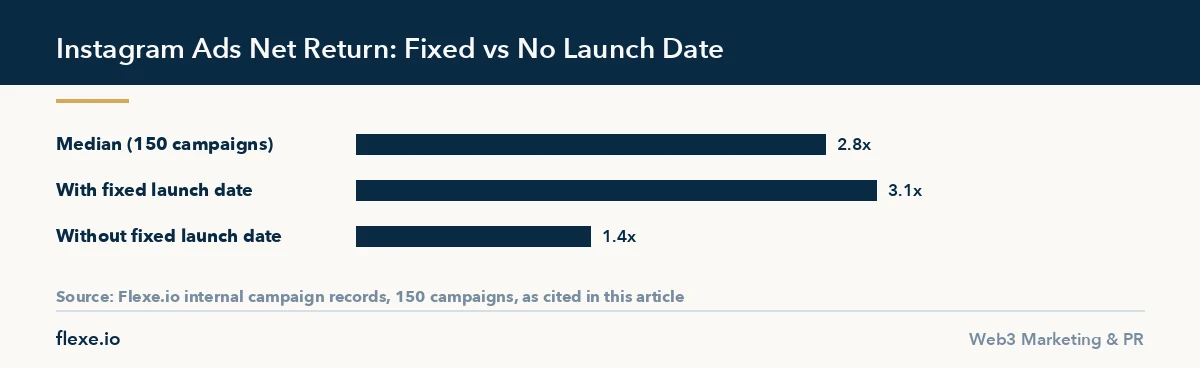
Across 150 campaigns our median net return was 2.8x within 90 days, with a range from 1.4x to 7.0x and a failure rate of 12 percent that we publish rather than bury. Those are first-party figures from our own client base covering full engagements, not an industry average and not a promise about this one channel.
Two things move that median more than creative does. A fixed launch date lifts it from 1.4x to 3.1x, because every other piece of work can be timed against a date that will not move. Spreading a single budget thinly across many channels at once correlates with a 34 percent failure rate, which is the argument for running this channel inside a sequence rather than as one more line in a wide plan.
Failure modes we see repeatedly
- Events firing on the wrong page, so the system optimises towards a visit while the report claims conversions.
- A retargeting pool fed by too little fresh traffic, which empties within days of launch.
- Creative implying a return, a price movement or an investment, which is refused however carefully it is worded.
- Budget raised in answer to rising frequency, which buys more exposure to people who have already declined.
- A launch date that shifts after the creative is approved, leaving spend running against a page that is no longer accurate.
What a first engagement looks like
We have run more than 800 campaigns since 2018, and a first engagement has the same shape every time. A short scoping call, a written scope with the conversion event and the reporting fields named inside it, then a fixed fee for the work and a media budget you fund directly. Nothing starts before the measurement check passes, because a campaign reported against broken events is worse than no campaign.
You keep the advertising account, the pixel, the audiences and the creative files throughout. Partner access can be withdrawn the day you stop, and nothing makes leaving expensive. Reporting arrives on a fixed day, and a week with nothing to show is reported as one.
What we ask in return is somebody who can approve creative inside a working week. Moderation is slow on its own, and an internal approval queue on top of it is the most common reason a launch date slips.
Who this is not for
Instagram crypto ads are the wrong first move for a project with little site traffic, for a product that needs first-touch awareness, and for anything that cannot be described inside Meta policy. For the first two, crypto traffic acquisition compares the channels that create first visits, and crypto ad placements covers blockchain explorers, crypto media and data platforms with 12 audience segments, where the rules on token advertising are written for this industry rather than against it. We would rather send you there than spend three weeks getting an account restricted.
Frequently Asked Questions
Can you advertise a crypto project on Instagram?
Yes, with written permission from Meta, and only for the products it allows in that particular country. Permission granted for one market does not carry to the next, and an exchange, a wallet and a token count as separate categories rather than one industry. Confirming what your permission actually covers, market by market, comes before any creative brief.
Is Instagram better for retargeting or for cold reach?
Retargeting, by a wide margin. Cold campaigns aimed at people who have never heard of a token are expensive, slow to approve and frequently rejected, while someone who read your documentation or abandoned a sign-up can be reached again across Feed, Stories, Reels and Explore. Something else has to create that first visit.
How much do Instagram crypto ads cost?
A focused single channel campaign starts at $4,000, and inside a full launch across several channels the work runs from $50K to $500K over three to six months. Media spend is paid by you directly to the platform and we take no percentage of it. Below a certain pool size and budget, retargeting does not deliver at all.
How long does setup take before anything runs?
Two to four weeks in most cases, and permission is the long pole rather than production. Week one covers partner access and the advertising permission on file, weeks one and two the pixel and server side events fired by hand on a real device, week two the audiences, then creative goes in and spend starts low while the auction settles.
What results do you guarantee?
None, and we do not sell guaranteed views, followers or volume. Across 150 campaigns our median net return was 2.8x within 90 days, with a range from 1.4x to 7.0x and a failure rate of 12 percent that we publish. Those are first-party figures covering full engagements, not a forecast for this one channel.
Where it sits in a launch
Late. Something else has to create the first visit: coverage, creators, explorer placement or search. Instagram then recovers the share of those visitors who left without acting, which is usually the large majority of them.
Used in that order it is one of the cheaper conversions available. Used first it is one of the most expensive. Scope, minimum workable budget and terms are available on request.