Crypto Google Ads is paid search for licensed crypto and Web3 advertisers, and a focused single channel campaign starts at 4,000 dollars: you get verification and certification handled, a market by market account build, policy safe creative and a weekly performance note. It is a permissions problem before it is a media problem. Google decides which entity may advertise, in which countries, and for which products, and that decision is made months before anyone argues about bids or headlines.
This page sets out the buying side: the approvals in order, what you supply, how the account is built, what you receive, how money is handled, and when we would send the budget elsewhere.
Purpose of Crypto Google Ads
Crypto Google Ads Services campaigns are designed to help businesses in the cryptocurrency industry achieve various objectives, including:
- Lead generation
- Traffic growth
- Sales increase
- User acquisition
- Fundraising
What We Do
To make those campaigns work, we cover the whole build:
- Preparing keywords to target the right audience
- Getting your ads through moderation
- Linking ads with Google Analytics and Data Studio
- Optimizing campaigns for better performance
- Conducting A/B testing to improve results
- Delivering detailed performance reports
What Results You Get
By integrating Google Analytics with Google Ads, we optimize your campaigns for higher lead generation. Our service includes a complimentary Google Data Studio report, providing detailed performance insights. Most clients achieve a return on investment (ROI) of over 400%.
Preparation and Turnaround Time
- Preparation Time: 2-3 weeks
- Turnaround Time: 1 month
Verification Steps In Order
Google runs two separate gates and they are not interchangeable. The first is advertiser verification, where Google confirms the legal entity behind the account, its ownership, and the domain the ads point to. The name on the incorporation papers, the payment profile and the site footer all have to agree. The second gate applies to financial products: financial services certification, granted country by country, asking for proof that the advertising entity is authorised or registered in each market it wants to run in.
Crypto sits on top of both. Advertising is limited to certain product categories and to certified advertisers in supported countries, and both the category list and the country list differ from the general financial rules.
Order matters more than speed. Applying for certification from an unverified profile, or with documents that name a different entity, produces a rejection that is easy to collect and slow to reverse. A rejected account can take weeks to recover, and nothing runs during that time. We start the paperwork before creative production begins, because creative that cannot be served is wasted work and a wasted month.
What You Supply Before Launch
The slow part is never Google reading the file. It is the client assembling documents that agree with each other, and the engagement moves at the speed of the last item on this list.
- Incorporation documents and ownership records for the entity that will be named on the account
- Licence or registration references for every country on the target list, with the exact legal name they were issued to
- Domain control, meaning DNS or hosting access so ownership can be confirmed, plus administrator rights on existing Google Ads, Analytics and Tag Manager properties
- A named compliance contact with authority to approve a claims list once, instead of reviewing every headline separately
- Product facts we are allowed to state in public: supported countries, fee schedule, custody model, listing or eligibility conditions
- Historical performance data if the account has run before, including any policy strikes or suspensions, which we need to see rather than discover
If a licence is still in application, say so at the start. We can build landing pages and organic assets in the meantime, but we will not pretend that a certification date exists when it does not.
How The Account Is Built
Structure follows eligibility, not convenience. Campaigns are split by country because approval, allowed products and disclosure requirements are all decided per country, and a single mixed campaign means one refusal stops traffic everywhere. Brand terms sit in their own campaign so that defensive spend is never confused with acquisition performance.
Inside each market, ad groups are grouped by intent rather than by product page. Problem queries, comparison queries and alternative queries behave differently and deserve different copy and different bids. Head terms in this category are usually bid up by incumbents to a level where they lose money for a challenger, so they are used sparingly and watched weekly rather than left running.
Negative keyword lists are built before launch, not after the first invoice. In this category the standing negatives include job seekers, free and airdrop hunters, price prediction traffic, and the long tail of scam and recovery queries that produce clicks and nothing else. Conversion actions are defined on the same day: we count verified signups or funded accounts, and treat form submissions as a diagnostic step, not as the result being bought.
Creative And Policy Limits
Copy in this category is written against the policy first and the audience second, which is an unusual constraint and the main reason approvals fail. Returns cannot be promised or implied. Guarantees, price targets and countdown urgency are refused. Claims about safety, regulation or partnership have to match something a reviewer can check on your own site within one click.
The destination is part of the ad. Landing pages need the entity name, the jurisdiction, the risk disclosure your market requires, and working contact details, and the page has to describe the same product the ad describes. A redirect chain, a geo gate or an age gate between click and content is a common cause of disapproval that nobody looks for, because the ad itself reads as clean.
We keep an approved claims library per client, agreed with your compliance contact at the start. New ads are assembled from approved lines, which is what makes weekly iteration possible without sending every variation back for legal review.
Disapprovals are handled in one pass rather than by repetition. A rejected ad is usually a page problem, so we read the clause Google cited, change the destination, and resubmit once. You see the clause, the change and the outcome in the weekly note, not a status line saying under review.
Deliverables And Reporting Cadence
You receive artefacts, not only access, and everything below is yours to keep if the engagement ends or moves in house.
- A verification file per market: what was submitted, the current status, and the expected decision window
- An account build document covering campaign split, bidding approach, budget caps and the negative lists
- The keyword set with intent labels, plus the approved claims library
- A weekly performance note that names what changed, what was cut, and what is being tested next
- A monthly review with cost per qualified action by market, and a recommendation on where budget should move
Reporting is connected to analytics rather than screenshotted from the ads interface, so your own team can reproduce the numbers.
How Budget And Fees Work
Media spend is paid by you, directly to Google, on your own billing profile. We do not take a percentage of ad spend, because that model rewards spending more rather than spending well, and in a category where half the skill is knowing when to stop a campaign it points the agency the wrong way. Management is a monthly retainer scoped to the number of markets and the complexity of the build.
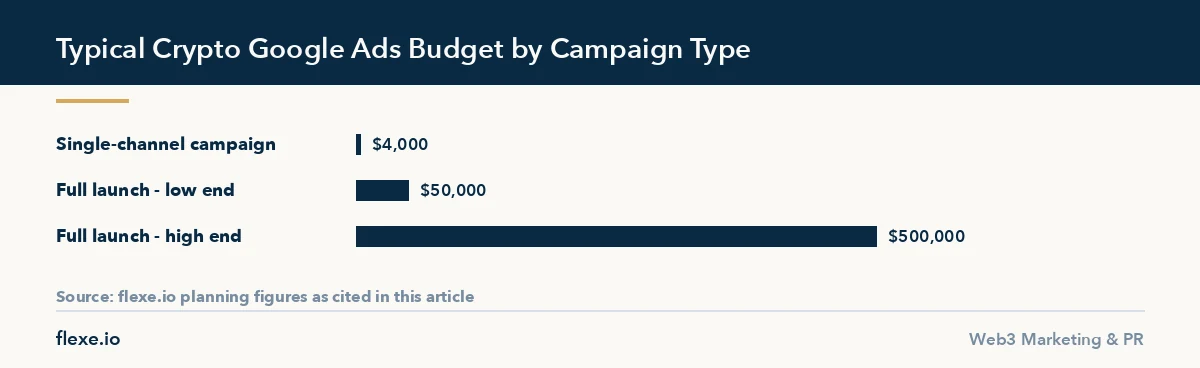
As a planning figure, a focused single channel campaign starts at 4,000 dollars, and a full launch across several channels over three to six months runs between 50,000 and 500,000 dollars. Owning the billing profile also means you keep the account, the history and the verification status, which matters more than it sounds: an aged, approved account in this category is an asset that is slow and painful to rebuild.
How Results Are Measured
Our own record across 150 campaigns gives a median net return of 2.8 times within ninety days, with a range from 1.4 times to 7.0 times, and a disclosed failure rate of 12 percent. We publish the failure number because an agency that claims none is either new or rounding. Across more than 800 campaigns run since 2018, one input moves the median more than any creative decision: a fixed launch date. Campaigns with one sit at 3.1 times, campaigns without one at 1.4 times.
Measurement is agreed before launch and not renegotiated. The primary number is cost per qualified action, read on a ninety day window, because approval delays and the learning period distort anything shorter.
Where These Campaigns Fail
The failures repeat, and almost none of them are about bidding.
- Entity mismatch between licence, account and site, which stalls certification for weeks
- Budget spread thin across too many channels at once, a pattern that correlates with a 34 percent failure rate in our own data
- No committed launch date, so spend starts before the product page, the tracking or the support team is ready
- Optimising to form fills while the real drop happens later, at identity and eligibility checks
- Rewriting ads that already convert, in the belief that movement is progress
Each of these is cheap to avoid at the planning stage and expensive to repair after a suspension.
Who This Is Not For
If you have no licence and no application in progress in any supported market, paid search on Google is not available to you yet, and the honest answer is to build demand elsewhere first. The same applies to products in categories Google does not accept at all, where the approval will not arrive no matter how the copy is written.
It is also a poor fit where search demand barely exists, where the sales cycle runs past a year with nothing to measure in between, or where the budget would go further on one deeper channel. We say that in the first call rather than bill for a channel we expect to disappoint.
Paid Search As One Layer
Search captures people who are already looking. For a token launch in a market that has never heard of you, that pool is small, and paid search alone will look weak through no fault of the account. We run press across more than 760 outlets and a KOL base of 11,859 X accounts, 85 of them in the active roster, so search sits alongside coverage and creator work rather than carrying a launch. Where the vertical is blocked, budget moves to placements that accept it, described on our Web3 advertising services page.
Case Studies and Samples
To see the success of previous campaigns, check out our case studies:
Crypto Google Ads Policy Limits
To run cryptocurrency-related ads on Google, you need to have a valid license. More details on Google’s policy can be found here: Google Ads Policy
If you do not have a license, we offer to create landing pages that will pass moderation for free. However, it may take up to 3 months to establish an effective marketing setup for you. During this period, there is a possibility that your ads may generate a negative ROI.
How to Maximize Your Campaign Success
Structure decides the result more than copy does. Target only the markets your certification covers, read performance weekly, test one variable at a time, and track the rules country by country, because Google updates its financial products and services policy without warning your account first.
For more details, feel free to reach out to us!
Comparing inventory before you commit? Our guide to crypto ad placements and crypto traffic acquisition set out explorers, media and ad platforms side by side, with monthly visits and what each accepts.
Beyond Search: Display and YouTube
A verified Google Ads account opens more than the search results page, and the extra surfaces are where most of the cheap reach sits.
| Surface | What it is good for | How often it makes sense |
|---|---|---|
| Search | People already looking for what you do | Almost always, where the vertical is allowed |
| Display & AdSense | Cheap volume across the wider web, useful for retargeting | Common, mostly for retargeting rather than cold reach |
| YouTube | Explaining something that cannot be explained in a text ad | Occasionally – strong when the product needs a demo, weak otherwise |
All three sit under the same certification and the same country restrictions. The bottleneck is never the surface, it is whether the product qualifies at all – and for fintech that is a licence question, covered on Google Ads for fintech.
Where Google will not take the vertical, the alternatives are on crypto ad placements: explorers, crypto media and the banner network.
Frequently Asked Questions
Can a cryptocurrency company advertise on Google Ads?
Yes, but only as a certified advertiser, in supported countries, and only for the product categories Google accepts. You clear advertiser verification first, then financial services certification market by market. A product that is eligible in one country can be refused in the next, and a country level restriction is not something an appeal will change.
How long does certification take before ads can run?
Preparation takes 2-3 weeks and the first month is the turnaround window. Most of that time goes on assembling documents that agree with each other: incorporation papers, licence references and domain control all naming the same legal entity. Applying for certification from an unverified profile is what turns a few weeks into a few months.
How much does a crypto paid search campaign cost?
A focused single channel campaign starts at 4,000 dollars, and a full launch across several channels over three to six months runs between 50,000 and 500,000 dollars. Media spend sits outside that and is paid by you, directly to Google, on your own billing profile. Management is a monthly retainer, never a percentage of ad spend.
What return can we expect from paid search?
Across 150 campaigns our median net return was 2.8 times within 90 days, ranging from 1.4 times to 7.0 times. We also publish a failure rate of 12 percent, because some engagements do not pay back. We do not sell guaranteed volume or a guaranteed return: the licence, the product and a fixed launch date move the number more than the account build does.
What happens when an ad is disapproved?
We read the clause Google cited, fix the destination page and resubmit once. Sending the same ad back untouched is the habit that turns one disapproval into an account level strike. Where a decision looks plainly wrong, we file one documented appeal with the licence reference attached and then wait, because a parallel second appeal restarts the queue.