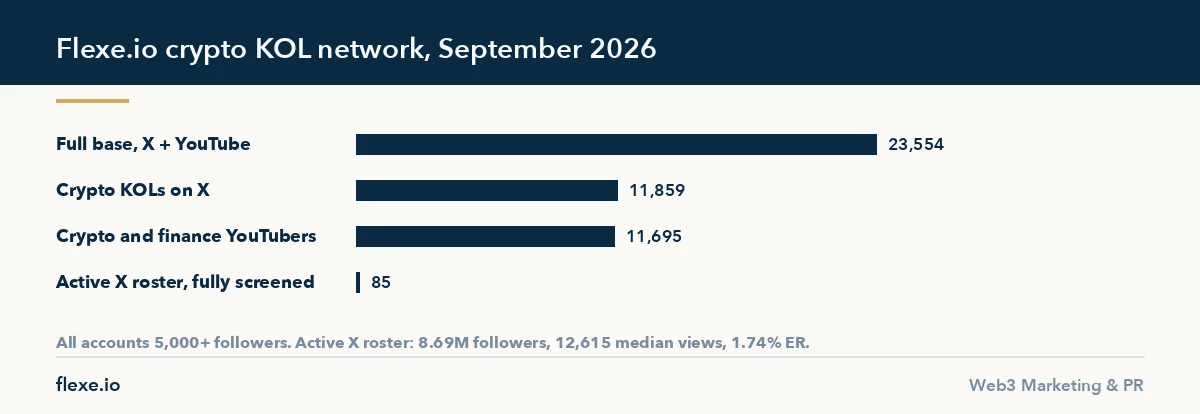
Flexe.io is a crypto influencer marketing agency with a network of 11,859 crypto KOLs on X and 11,695 crypto and finance YouTubers, all with 5,000+ followers, and more than 800 campaigns run since 2018. Budgets start from $4,000 for a single-channel campaign, and every account in the active X roster is screened on three independent services before any money goes behind it.
Figures on this page were last checked on 22 September 2026. The short version for a buyer comparing agencies:
- Best for: token launches, TGEs, listings and product releases with a fixed public date.
- Network: 23,554 crypto creators: 11,859 on X and 11,695 on YouTube, each with 5,000+ followers.
- Active X roster: 85 screened accounts with 8.69M combined followers, 12,615 median views per post and a 1.74% average engagement rate.
- Pricing: from $4,000 for one channel; full launch programmes run $50,000 to $500,000 over three to six months; community management from $2,000.
- Track record: 800+ campaigns since 2018, including VAIX and Margex.
- Channels: X, YouTube, Telegram and TikTok, planned as one campaign or bought one at a time.
What our crypto KOL campaigns include
Each service below can be bought on its own or combined into one launch. The numbering follows the order most projects buy them in.
1. KOL campaigns on X
- What you get: a shortlist from the screened X roster with views and engagement per account, negotiated slots, briefs, live checks and a closing report.
- Best for: launch days, listings and anything time-sensitive.
- From: $4,000 as a single-channel campaign.
- More: X crypto influencer campaigns.
2. YouTube creator integrations
- What you get: integrations and dedicated reviews with crypto and finance YouTubers from a base of 11,695 channels.
- Best for: long-form explanation that keeps earning views after the campaign ends.
- From: $4,000 as a single-channel campaign.
- More: YouTube crypto influencer campaigns.
3. Telegram channel placements
- What you get: posts and pinned posts in crypto channels chosen by audience region and language.
- Best for: communities that already hold tokens; the shortest path from a post to a wallet.
- From: quoted inside the campaign budget.
- More: Telegram crypto channel placements.
4. TikTok creator campaigns
- What you get: short videos from creators who explain crypto to a general audience.
- Best for: reach outside the existing crypto audience.
- From: quoted inside the campaign budget.
- Note: we recommend TikTok as a second channel, not as the first test.
5. Standalone KOL shortlist
- What you get: a researched list built to your brief: chain, region, audience size and budget shape, with metrics per account.
- Best for: teams that want to run outreach themselves.
- From: quoted per brief.
- More: crypto influencer list.
6. Community management
- What you get: moderation and daily management of Telegram and Discord, so launch traffic lands in an active room.
- Best for: projects whose community is quiet before the campaign starts.
- From: $2,000.
- More: crypto community management.
Network and screening
Follower counts are the least useful number in this business. A crypto account with 300,000 followers that averages 4,000 views a post reaches fewer people than one with 40,000 followers and 12,000 views, so every account is measured on what it delivers, not on what its profile claims.
Accounts are screened for bought engagement before they enter the active roster. We use three independent services, Wallchain, Sorsa and TwitterScore, and an account that passes one check but fails another does not go into a campaign. Roughly a third of the accounts that approach us are rejected at this stage. Creators from the wider base of 23,554 are screened per campaign, before the shortlist reaches you.
For a public view of the largest accounts, our guide to top crypto influencers lists verified X accounts with followers, median views and engagement rate.
How a campaign runs, step by step
Most projects reach us three to six weeks before a launch date, which is about the minimum that lets a campaign be built rather than assembled. The order below is the same at $4,000 and at $500,000; what changes is the number of accounts and the length of the publication window.
1. Week one: brief and shortlist
The brief we need is short: the chain, the product, the public date, the market you want to reach and the one action a reader should take. From that we pull a shortlist with average views and engagement rate per account, so you compare delivery, not follower counts. Accounts you veto for competitive or reputational reasons come off before any money moves. A shortlist for a $10,000 campaign usually carries twelve to twenty names for eight to ten slots.
2. Week two: pricing and booking
Every account is quoted individually. Creators price by format, exclusivity and how close the post sits to a listing or TGE, and the same account can cost twice as much in a busy week. We negotiate each slot and hold the whole set until you approve the final list. Briefs go out with the booking: what must be said, what must not, the disclosure wording and the tracked link.
3. Publication window and live checks
Posts are spread across a window rather than fired on one day, which reads less like paid coordination and earns a second wave through quote posts and replies. We check each placement within the first hour: format, link, disclosure in line with the FTC endorsement guides, and early engagement against the account’s own average. A placement running far below that average is flagged the same day.
4. Report after the last post
Reporting closes seven days after the final publication. Crypto posts collect a large share of their views in the days that follow, so a report written on publication day understates reach and overstates cost per view. The closing call covers what performed, what did not and which accounts we would book again, with a draft plan for the next wave if the numbers justify one.
Channels compared
Most launches use two channels at most. The table shows what each one is good for in our campaigns. Spreading a $4,000 budget across four platforms leaves no channel with enough posts to register, so the first test should be one channel: usually X for a dated launch and YouTube for a product that needs explaining.
| Channel | Best for | Typical format | Flexe network |
|---|---|---|---|
| X | Launch moments, listings, time-sensitive news | Posts, threads, quote posts | 11,859 KOLs; 85 in the screened active roster |
| YouTube | Long-form explanation that keeps working | Integrations, dedicated reviews | 11,695 crypto and finance YouTubers |
| Telegram | Holders and traders who act the same hour | Channel posts, pinned posts | Channels chosen per brief |
| TikTok | Reach beyond the crypto audience | Short explainer videos | Creators chosen per brief |
What it costs and what you receive
Budgets start at $4,000 for a focused single-channel campaign, which buys a real test of one platform rather than a gesture spread across four. Full launch programmes run $50,000 to $500,000 over three to six months. The price is driven by the cost of the accounts, not by an agency percentage, and we show account cost and our fee as separate lines, so a shortlist can be cut or extended without renegotiating the deal. Account cost tracks delivered attention: an account with a median of 12,615 views a post is priced against those views.
Whatever the budget, the same items arrive at the close of the campaign:
- the booked account list with followers, average views, engagement rate and the screening result for each name
- every brief sent to a creator, with the approved text or script for each placement
- a permanent link and a screenshot of every post, because creators do delete posts
- a performance sheet per placement: views, likes, reposts, replies, clicks and cost per result
- a closing summary that sets delivered numbers against the benchmarks quoted before booking
Results and how they are measured
- VAIX, token launch on X: 507,133 impressions in 18 days at a 1.61% engagement rate and +80 holders (+4.2%) on a $25,000 budget with 33 influencers. Full write-up: VAIX KOL campaign case.
- Margex, derivatives exchange: engagement up 270% through X engagement growth work.
- Benchmark across 150 campaigns: a median net return of 2.8x within 90 days, ranging from 1.4x to 7.0x by project type; 3.1x with a firm launch date against 1.4x without one.
- Failure rate: 12 percent of our own campaigns, published because the causes repeat.
The numbers we ask a client to hold us to are the ones that survive the week after publication: cost per thousand real views on the seven-day figure, click-through on a distinct link per account, wallet connections or signups inside the tracking window, and holder count before, on the last day and thirty days later. Impressions are easy to buy; wallets that hold after the campaign are not.
The causes of failure are usually visible before a slot is booked: no launch date or product change, so a reader has nothing to act on; a destination that loses the visitor, such as a wallet connect that breaks on mobile; a budget spread so thin across four platforms that no channel registers; and creator copy rewritten until it reads like an advertisement.
A second campaign built on your own first set of numbers reliably beats a first campaign of the same size, because the accounts that worked are already known. In a reputation programme we ran for a hedge fund manager, more than 700 publications went out across four waves between May and December 2025, and the client placed four repeat orders in eight months because each wave was priced from the results of the one before it.
Creator posts and press placements do different jobs and are usually bought in the same quarter. A creator post reaches an audience that already trades and can act the same hour; a placement in a trade outlet gives a due diligence reader something to find six months later. Our press inventory covers more than 760 crypto and finance outlets, 228 of which clear Majestic Trust Flow 30, and the two are planned together so neither pays twice for the same audience.
When a crypto influencer marketing agency is the wrong spend
We turn work down when it will not pay back. A crypto influencer marketing agency is a poor fit for a project with no working product and no dated milestone, for anyone who needs a guaranteed price per new holder, and for teams that want to approve every word of every post. A crypto audience recognises the voice of the account it follows, and a post edited into corporate language performs below that account’s own average almost every time. It is also the wrong first spend if your community room is empty: fill it first, so incoming traffic has somewhere to land.
If you are still comparing agencies, our independent ranking of the best crypto KOL agencies in 2026 sets eleven of them side by side, with the figures each one publishes on its own site.
Frequently Asked Questions
What does a crypto influencer marketing agency do?
It finds, vets and books crypto creators for a project, negotiates each slot, writes the briefs, checks every post as it goes live and reports on results. Flexe.io does this across X, YouTube, Telegram and TikTok from a base of 11,859 X KOLs and 11,695 crypto and finance YouTubers, with 800+ campaigns run since 2018.
How much does crypto influencer marketing cost?
At Flexe.io budgets start from $4,000 for a single-channel campaign. Full launch programmes run $50,000 to $500,000 over three to six months, and community management starts from $2,000. Account cost and our fee are shown as separate lines, and each account is priced against its median views rather than its follower count.
How are KOLs screened for fake engagement?
Every account in the active X roster passes three independent checks, Wallchain, Sorsa and TwitterScore, before it enters a campaign. An account that passes one and fails another is not booked. Roughly a third of the accounts that approach us are rejected at this stage, and creators from the wider base are screened per campaign.
How long does a crypto KOL campaign take?
Plan for three to six weeks before the public date. Week one covers the brief and a shortlist with views and engagement per account; week two covers pricing, booking and creator briefs. Posts then run across a window, and the report closes seven days after the last post, once the late views are counted.
Which projects do you work with?
We work with Web3 startups and protocols, DeFi platforms, NFT projects and marketplaces, exchanges and wallets, from early stage to scaling. The common thread is a working product and a dated milestone such as a TGE, listing or release. Without one, we usually advise waiting or building your own account reach first, since readers have nothing to act on.
How is a KOL campaign measured?
We report cost per thousand real views on the seven-day figure, clicks through a distinct link per account, wallet connections or signups in the tracking window, and holder count before, on the last day and thirty days later. Across 150 campaigns the median net return was 2.8x within 90 days.