Flexe.io, a fintech marketing company, provides fintech marketing services for fintech, trading and crypto companies across 4 channels: paid search and social with platform verification, PR and reputation in AI search, SEO and content, and community growth. A focused single-channel campaign starts from $4,000, and a full launch runs $50,000 to $500,000 over 3 to 6 months. It is not a fit if you need paid results within weeks and no platform verification has started. Checked 17 September 2026.
- We have run more than 800 campaigns since 2018, across crypto, trading and fintech products.
- For a hedge fund manager we secured more than 700 publications between May and December 2025 and got four repeat orders.
- For Margex, an exchange with more than 500,000 traders in 153 countries, our X work lifted engagement by 270 percent.
- Google requires a verification process before financial services can be advertised in some locations, so paid timelines start with paperwork.
- In our own data, a small budget spread across every channel at once failed 34 percent of the time, which is why we start with one channel.
What’s included in our fintech marketing services
Every engagement is built from the same six components, and most clients start with two of them. The mix depends on what stops growth today: nobody finds the product, nobody trusts the brand, or the paid channels are closed until verification clears. We scope the first quarter around that constraint instead of selling every service at once.
- Paid search with verification handled. We prepare advertiser and financial services verification, build campaigns inside each market’s rules and manage bids and reporting afterwards, as described on our Google Ads for fintech page.
- Paid social where the platform allows it. Campaigns on X and other networks with approved wording agreed before launch.
- PR and reputation in AI search. Coverage in financial and industry media planned so that ChatGPT, Copilot and Perplexity describe the company accurately.
- SEO and content. Pages built around the questions buyers ask, with every claim checked before publication; our approach is set out in the fintech SEO guide.
- Community and creator campaigns. Growth on X and Telegram for trading products, and influencer campaigns with disclosure built in.
- Reporting a compliance team can read. The same metrics every month, with approved wording and dates on record.
If you are choosing where to start: send us the product, the markets and the licences you hold, and we will reply with the one channel we would open first and the approval steps it needs. Talk to the Flexe.io team.
How a fintech engagement runs from brief to report
Brief and constraints
The first call covers the product, the target markets, the licences held and the growth number the board cares about. We also ask for the list of claims your compliance team has already rejected, because that list saves more time than any creative brief. If a market needs authorisation you do not have yet, we say so before scoping any spend there.
Audit of what already exists
We review ad accounts and their verification status, search visibility in Bing and Google, how AI assistants currently describe the company, existing press coverage and the state of owned channels. The audit ends with a short written list: what works, what is blocked, and what is missing. Most fintech teams find at least one blocked channel they assumed was live.
Plan and approval route
The plan names one lead channel, one supporting channel, the numbers we will report and who approves each piece of public wording. We agree the approval route with your compliance officer in writing before the first draft, including how long a review takes, so launch dates are realistic rather than optimistic.
Launch and weekly reporting
Campaigns go live only after approval. During the first month we report weekly, with spend, results and anything a platform flagged. From the second month reporting moves to monthly, using the same metrics each time so progress can be compared without reinterpreting the numbers.
Review and handover
At the end of each quarter we recommend what to scale, what to cut and what to hand to your in-house team. When a channel is stable, we document the setup, the approved wording and the reporting so your own people can run it without us. If that is the model you want, we plan the handover from the first month.
What fintech marketing costs and what moves the price
A focused campaign on one channel starts from $4,000. A full launch across PR, creators, paid media, community and content usually runs $50,000 to $500,000 over 3 to 6 months. Media spend on ad platforms is separate, paid directly by you, and we do not take a percentage of ad spend, because that rewards spending more rather than spending well.
| Factor | Keeps the cost lower | Pushes the cost higher |
|---|---|---|
| Number of markets | One market, one language | Several markets with different rules |
| Verification status | Ad accounts already verified | Verification and certification from scratch |
| Channels in the plan | One lead channel | Full stack running at the same time |
| Approval complexity | One reviewer, fast turnaround | Legal and compliance review on every asset |
| Reputation starting point | Neutral or no coverage | Negative coverage that needs to be outweighed |
Once we have the brief we send a figure and a timeline that includes verification. If the budget is small, we will recommend one channel done properly rather than five channels done thinly, because in our data that second pattern is where a third of campaigns failed.
The cheapest mistake to avoid is paying for channels your licence does not allow. Before quoting, we check which target markets permit the product to be advertised at all and which require verification or a specific authorisation first. When a market is closed to paid media, we say so and move that budget to PR, content or community work in the markets that are open, instead of spending weeks on campaigns that platforms will reject.
Compliance rules we plan around, by channel
Paid search is the channel where rules bite first. Google’s financial products and services policy says advertisers are required to complete a verification process to advertise financial services in some locations, and it treats cryptocurrencies and complex speculative products as separate restricted categories. We check which of those apply in each target market before building a single campaign.
For UK audiences the reference point is the FCA. Its guidance on financial promotions and adverts stresses that promotions must be fair, clear and not misleading so that consumers can make informed decisions. In practice that shapes headlines, risk wording and how results are described in every ad and article we produce for UK readers.
In the EU, crypto products fall under MiCA. ESMA describes MiCA as uniform EU market rules for crypto-assets not covered by existing financial services legislation, with provisions on transparency, disclosure, authorisation and supervision. Marketing for an EU crypto service therefore has to match what the firm is actually authorised to offer.
Creator campaigns carry their own rule. The FTC’s Disclosures 101 for Social Media Influencers tells creators to make a good disclosure of their relationship to a brand. We write disclosure into every creator brief and check the published post, because a missing disclosure becomes the brand’s problem as well as the creator’s.
Results from fintech and trading clients
A CFD trader and hedge fund manager came to us through a referral to rebuild his digital reputation in Google and in AI search. Across four waves between May and December 2025 we secured more than 700 publications, and he returned with four repeat orders over eight months. The full breakdown, including what each wave targeted, is in the hedge fund manager case study.
Margex, a crypto derivatives exchange serving more than 500,000 traders in 153 countries, used our X engagement growth work and saw engagement rise by 270 percent. More results from trading and crypto clients are collected on our case studies page.
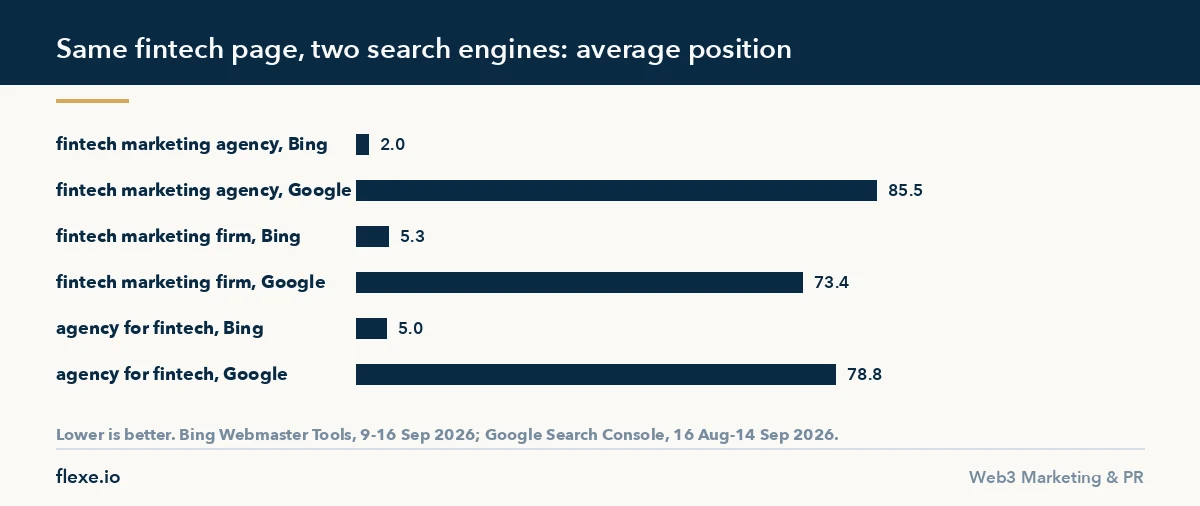
Now the result that does not flatter us. Our own guide to fintech marketing agencies holds position 2 in Bing for “fintech marketing agency”, yet the same page sits between positions 70 and 90 in Google for the same family of queries. Bing rewards the content; Google still wants more authority than our domain has. We tell clients this because search visibility in Google is the slowest part of any fintech plan, including our own.
Who this is for, and when an in-house team is better
This service fits fintech and crypto companies that are entering a new market, launching a product that needs platform verification, recovering from a reputation problem or testing a channel before hiring for it. It also fits teams whose compliance function is small and needs a partner that brings the approval process ready rather than inventing it on their budget.
It is a poor fit if the product is not yet authorised in the markets you want to reach, if you need paid results inside a month with no verification started, or if you expect guaranteed returns from any channel. An in-house team is also the better long-term answer once a channel is stable: they know the product best and keep the knowledge inside the company.
A fintech marketing firm earns its fee in the stages where experience of rejections, approvals and platform rules decides the timeline. Our work is done by strategists, media buyers and PR specialists who have run campaigns for crypto and trading products since 2018, with compliance review built into every stage. For how agencies in this space compare, see our fintech PR agencies guide.
If you are comparing proposals, ask each fintech marketing firm which of your claims it expects compliance to reject and how it handles platform verification, then compare what each one promises to report in the first month. Firms that have done this work answer the first question with examples from your own draft copy, not with a general reassurance.
What we measure and when results usually land
For paid search and social we report verified accounts, approved and rejected ads, cost per qualified lead and conversion to account opening or first deposit where tracking allows it. Results usually start within weeks of approval, but verification itself can take several weeks depending on the platform and market, so the first report often shows paperwork rather than leads.
For PR and reputation we report publications, the share placed in outlets your audience reads and how AI assistants describe the company when asked directly. Those shifts show over a few months rather than weeks, which the hedge fund case illustrates: its results came across four waves in eight months.
For SEO and content we report impressions, positions and clicks in Bing and Google separately, and citations in AI answers where the platform shows them. Bing tends to move first. Google is slower for competitive fintech terms, and we plan it as a long-term asset instead of promising early rankings we could not deliver for our own site.
For creator and community work we report reach from accounts we can verify, engagement rate against each account’s own median, clicks on tracked links and how many of those visitors took a qualifying action. Follower counts alone are never the success metric, because they can be bought, and a creator whose audience sits outside your licensed markets is a compliance risk rather than a reach win. We keep dated screenshots of every published post with its disclosure, so the record exists if a regulator or platform asks later.
Send the product, the markets and the licences you hold, and we will reply with the channel we would open first, the approval steps involved and a realistic figure. Contact the Flexe.io team.
Frequently Asked Questions
How much do fintech marketing services cost?
A focused single-channel campaign starts from $4,000. A full launch across PR, creators, paid media, community and content usually runs $50,000 to $500,000 over 3 to 6 months. Media spend is separate and paid directly by you, and we do not charge a percentage of ad spend. The final figure depends on markets, verification status and approval complexity.
Which fintech marketing channel should we start with?
Start with the channel that removes today’s biggest constraint. If nobody trusts or finds the brand, begin with PR and reputation. If demand exists but acquisition is slow, begin with paid search once verification is done. One lead channel with a clear metric teaches more in a quarter than five channels funded too thinly to show a result.
Do you work with regulated financial companies?
Yes, and regulated companies are the main reason this service exists. We agree the approval route with your compliance team before any draft, keep a record of approved wording with dates and adapt each campaign to the rules of its market, so nothing reaches the public without the sign-off your licence requires.
How long before fintech marketing shows results?
Paid channels can bring traffic within weeks of approval, but verification can take several weeks before that. PR and reputation work shows in search results and AI answers over a few months. Search visibility for competitive fintech terms is the slowest channel, especially in Google, and should be planned as a long-term asset rather than a launch tactic.
Why hire a digital marketing agency for fintech instead of a generalist?
The expensive mistakes in fintech marketing are compliance and platform mistakes, not creative ones. A digital marketing agency for fintech already knows which claims trigger rejections, which markets need verification and how a regulated business needs results reported. That means the first months go into growth instead of into learning rules on your budget.