A crypto market maker sells a quoting service, not a volume service: you pay a maker to hold a stated spread and real depth at the 2% band on the venues you name. A market maker in crypto posts two sided orders on an exchange so that someone who wants to buy or sell your token can do it without moving the price against themselves, and the deal comes in one of two shapes, a token loan with a call option or a monthly retainer. Anything else sold under that name is either a different product or a problem you will inherit.
Facts checked on 26 October 2026.
The sections below cover the part most proposals leave out: what the exchange asks for, what you have to fund, how long each stage takes, what the fee actually prices, and how to get out of an agreement that is not working.
Most tier-1 exchanges will not list a token without a designated market maker in place, and most projects sign their first market making agreement without understanding which of two very different deals they are signing. This page is about that decision.
The Two Deal Structures
| Loan and call option | Retainer | |
|---|---|---|
| You provide | A loan of tokens | A monthly fee plus working capital |
| Market maker earns from | A call option on the borrowed tokens | The fee |
| Their incentive | Token price rising above the strike | Meeting the agreed spread and uptime |
| Your exposure | Tokens leave your control for the term | Cash cost, tokens stay yours |
| Suits | Projects without cash | Projects that want control and measurable terms |
The loan model is the one offered most often because it costs the project nothing up front. It is also the one that ends badly most often. The market maker holds a call option, so their return depends on the price going up – and if it does not, they are holding your tokens with no obligation to support anything. Several well-documented cases of tokens collapsing after a “free” market making deal come down to exactly this structure.
The retainer model costs money and is almost always the better deal, because it is the only one where the market maker is paid for doing the job rather than for the token going up.
What to Measure
A market making agreement without numbers in it is not an agreement. These four belong in the contract, not in a monthly report:
| Metric | What it means |
|---|---|
| Spread | Gap between best bid and best ask, as a percentage. The headline number, and the easiest to game by quoting tiny size |
| Depth at ±2% | How much can actually be bought or sold before the price moves 2%. This is the number that matters |
| Uptime | Percentage of time two-sided quotes are live. Quotes pulled during volatility are worse than no quotes |
| Order book resilience | How fast depth returns after a large trade |
Spread alone is meaningless. A maker can quote a 0.1% spread on 200 dollars of size and report an excellent number while the book is empty. Depth is where the honesty lives.
Volume Is Not a Deliverable
Any market maker who guarantees a daily volume figure is describing wash trading, whatever the contract calls it. Real market making produces volume as a side effect of other people trading; it cannot be promised in advance because it depends on demand that the maker does not control.
This matters beyond ethics. Exchanges run wash trading detection, and the penalty is delisting – which costs more than the listing did. If a proposal contains a volume guarantee, that is the whole review complete.
How We Work
We do not run a trading desk. We place projects with crypto market making firms we have worked with, negotiate the structure, and hold the agreement to the metrics above – which is the part that is normally missing, because the project has no independent read on whether the maker is doing anything.
That independence is the point. A maker reporting on their own performance has an obvious conflict, and most projects have no one able to check the claim.
What Exchanges Require From a Crypto Market Maker
No venue publishes one universal standard, but the questions asked during listing review are close enough across tier one exchanges to be treated as a single list. The exchange wants to know who quotes the book, with what capital, under what obligation, and what happens when the quoting stops.
- Named counterparty. The legal entity of the market maker, not a brand name, and often the agreement itself or at least its key terms.
- Committed spread and size. A maximum spread and a minimum quoted size on each side, with the hours those obligations apply.
- Uptime obligation. The share of trading hours during which two sided quotes must be live, and the exceptions permitted during extreme moves.
- Inventory on the venue. Both the token and the quote currency have to sit in accounts at that exchange before the first day of trading.
- API access. Maker accounts usually need their own key, and some venues require the maker to be registered on a specific fee tier.
The inventory question nobody asks
The cost that surprises projects is not the fee. It is the working capital that has to sit on each exchange for the whole term, in the token and in the stablecoin or fiat side of the pair. That money is not spent, but it is not available either, and it carries exchange risk for as long as it sits there. Two venues means two sets of inventory. This is the real reason quoting four exchanges thinly ends worse than quoting two properly, and it is a decision to take before signing rather than after.
What we need from you
A proposal review moves quickly once these are on the table. Gathering them takes a day at most.
- Token details, the venues already live, and the venues targeted with their expected dates.
- The float genuinely available for quoting, kept separate from treasury holdings that are locked or committed elsewhere.
- Any current or expired market making agreement, loan agreements signed with an earlier partner included, since outstanding token loans limit what a new maker can do.
- The cash budget and the term you can commit to, because a three month engagement and a twelve month engagement are priced on different logic.
Order of steps and timing
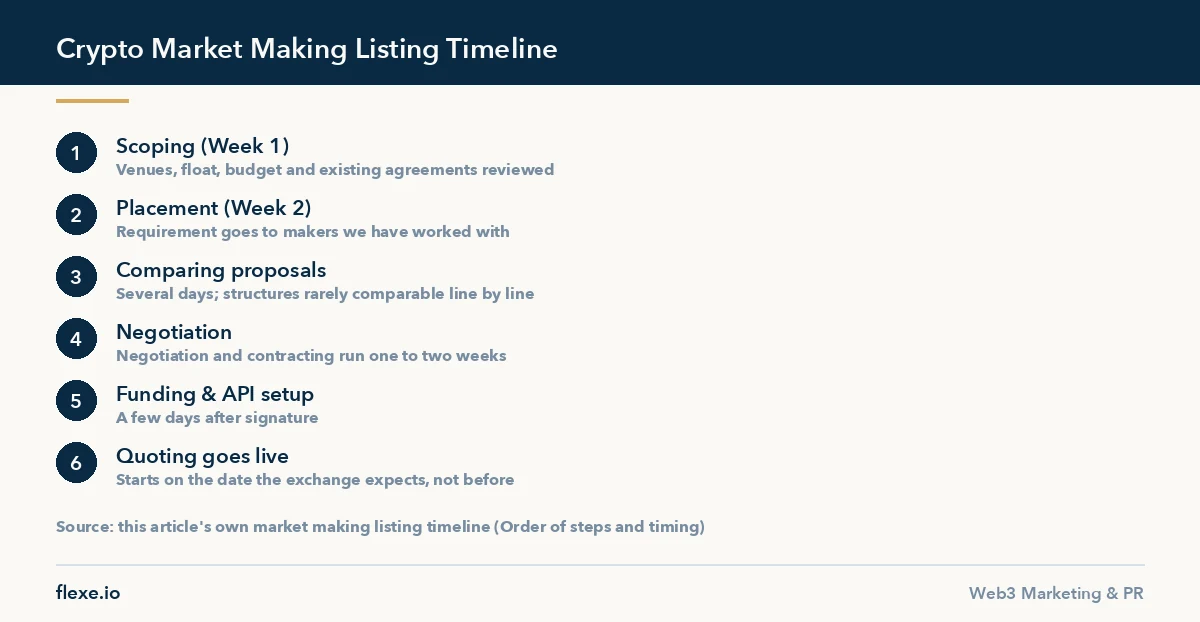
The sequence below assumes a listing that has not happened yet, which is the usual case. If the token already trades, the same steps run with the inventory stage moved to the front.
Week one is scoping: venues, float, budget, and a reading of any agreement already in hand. Week two is placement, where the requirement goes to makers we have worked with and proposals come back. Comparing those proposals properly takes several days, because the structures are rarely comparable line by line and the meaningful differences sit in the obligations rather than the headline fee. Negotiation and contracting run one to two weeks. Inventory funding and API setup take a few days after signature, and quoting starts on the date the exchange expects, not before. Four to six weeks from first conversation to live quotes is normal, and anything much faster usually means a step was skipped.
Fees, Term Length And Exit
Pricing in crypto market making follows a short list of variables, and a proposal that does not show them is hiding one of them. Our published budget ranges start from $4,000 for a focused single channel campaign, but placement work is quoted separately, because the money here sits with the maker and the inventory rather than with us.
- Number of venues quoted, since each one carries its own inventory and its own engineering time.
- Depth committed at the reference band, which is the actual product. Tighter spread across larger size costs more because it carries more risk for the maker.
- Term length, where a longer commitment lowers the monthly fee and raises the cost of being wrong about the partner.
- Volatility and free float, because a thin float on a volatile asset is expensive to quote and some makers decline it outright.
What a fair term looks like
Three to six months is a sensible first term, with a defined review point written into it. A twelve month lock signed before anyone has watched the maker perform is a bet on an untested relationship. If a maker insists on a long lock with no break clause, ask why. The honest answer is usually that setup cost is real, and a setup fee plus a shorter term solves that without moving the whole risk onto you.
Questions to put to any cryptocurrency market maker
Every proposal reads much the same until these are asked out loud. The answers separate a desk that quotes for a living from one that is really selling itself an option on your token, and they take ten minutes on a call.
- Which of our target venues do you quote today, and will the exchange confirm that independently?
- What spread and what minimum size will you commit to in writing, and during which hours of the day?
- What uptime do you commit to, what counts as an allowed exception, and who measures it?
- How much inventory do you need on each venue, in whose accounts does it sit, and who carries the exchange risk on it?
- What reporting do we receive, how often, and can we reconcile it against public exchange data without asking you?
A maker who answers all five in specific numbers is worth paying. A maker who answers with expected volume ranges is answering a different question, and it is the one question we do not sell. Keep the answers, because they are what a breach is later measured against.
How to end an agreement
Write the exit before you need it. The clauses that matter are the notice period, what happens to inventory sitting on exchanges, and how borrowed tokens come back if the structure includes a loan. The worst position a project can reach is wanting out of a loan deal while the maker holds its tokens and an option that is under water. Agree the unwind mechanics while everyone is still friendly, and keep the right to terminate on a documented breach of the quoted metrics rather than only at renewal.
Failure modes worth knowing
The same problems recur across engagements, and most of them are visible early if somebody is actually looking.
- Quotes pulled exactly when they were needed. Uptime averaged over a month can read well while the book was empty through every sharp move.
- Spread met on tiny size. The contract number is satisfied and the order book is still unusable.
- Inventory drift, where the maker finishes the term holding far more of one side than at the start and the project absorbs the difference.
- A loan structure inherited from an earlier agreement that blocks a new maker from quoting properly.
- Reporting produced only by the maker, with no independent reading, so none of the above is noticed for months.
How success is judged
The test is not how the chart looks. It is whether a buyer or a seller of realistic size can transact without an unpleasant surprise. Before the engagement starts, record the current spread, the depth at the reference band, and the slippage on a trade of the size your typical holder makes. Those numbers are the baseline, and without them there is nothing to compare against later.
Then measure the same figures monthly from exchange data rather than from the maker’s own report, and add uptime measured through the worst hours of the month instead of averaged across it. If depth and slippage improved and quotes held during volatility, the money is doing something. If only the volume number moved, nothing has been bought.
One practical note on measurement: pull the order book snapshots yourself, or have someone do it on a schedule, from the day quoting starts. Reconstructing what the book looked like three months ago is close to impossible after the fact, and a dispute about whether the obligations were met is unwinnable without a record that neither side wrote. A daily snapshot costs almost nothing and settles the argument before it starts.
Who this is not for
A project with no listing and no listing prospect does not need a market maker for crypto yet. A token whose free float is a fraction of a percent cannot be quoted honestly and should fix its distribution first. A team shopping for a volume figure to show investors is shopping for something we will not arrange at any price, and should know that exchanges run detection for it and delist on findings. If the goal is visibility rather than tradability, the budget belongs in tracker listings and outreach instead.
If you also handle block trades, our guide to crypto OTC desk marketing explains what institutional clients look for before their first ticket.
Frequently Asked Questions
When does a project need a crypto market maker?
Before the listing, not after. Most tier-1 exchanges ask who the designated market maker is as part of the listing process. Arriving without one delays the listing. See exchange listing for how the two run together.
How many exchanges does one crypto market maker cover?
Usually several, but each venue needs its own inventory and its own quoting. Adding a venue is not free, and thin quoting spread across many exchanges is worse than solid quoting on two. Before you add a third or fourth venue, ask what inventory it needs and who funds it, because that capital sits idle in an exchange account for the length of the term.
Can we do this in-house?
Technically yes, and it is a full-time engineering and treasury job. Projects that try it usually discover the cost is not the software but the working capital sitting idle in exchange accounts, plus the people who have to watch the book during every market hour. For most teams before a tier-1 listing it is the wrong place to spend engineering time.
What does it cost?
Three things set the price: how many venues you need quoted, how much depth is committed, and the length of the term. What is worth knowing before any conversation is that the cheapest-looking option, the token loan, is the one with the largest hidden cost. We do not sell guaranteed volume or a guaranteed price level, and any maker who quotes you either is selling a different product.
Tell Us About Your Listing
Send the token, the venues and the timeline. If you already have a proposal for crypto market making services in hand, send that too – the structure and the metrics in it usually answer most of the question by themselves.