Crypto Facebook ads put your product back in front of people who already visited your site, on platforms with 3.07 billion monthly users, and a focused single channel campaign starts at $4,000. You get the Meta permission application, business and domain verification, pixel and event setup, retargeting audiences and weekly reporting on cost per conversion.
Available on request. This runs at a substantial budget only. It is worth doing when you already have an audience to retarget; for cold reach on a smaller budget, crypto ad placements gets more for the same money.
With a reported 3.07 billion monthly active users (MAUs) on Facebook and 2.11 billion MAUs on Instagram, these two platforms dominate social media. Facebook alone accounts for 59.38% of the global social media population. Yet crypto marketers meet the same wall every year: Facebook and Instagram policies make launching direct crypto ads close to impossible.
There is a route through it, and it runs in a fixed order. Flexe.io has worked this channel since 2018; below is how the sequence runs for a Web3 or crypto company. Reach us on Telegram.
The Problem: Why Meta Crypto Ads Are So Hard to Launch
Meta platforms (Facebook and Instagram) have notoriously stringent policies against crypto advertising. Ads promoting wallets, exchanges, tokens, or blockchain projects are often flagged or outright rejected. Directly running such ads is either prohibitively complex or entirely unfeasible.
The audience behind that wall is large. India leads with 392.5M Instagram users and 378M Facebook users, the United States follows with 172.6M Instagram users and 193.8M Facebook users, and Brazil, Indonesia and Turkey each hold tens of millions of active users.
The Solution: Combining Display Ads with Meta Retargeting
To successfully advertise your Web3 brand on Facebook and Instagram, two critical steps are required:
Step 1: Start with Display Ads on Crypto Platforms
The first step is to generate initial traffic through banner (display) ads on leading crypto websites. These ads reach people already active in blockchain and cryptocurrency, so the visitors arriving on your site carry real intent.
Step 2: Retarget Interested Users on Meta Platforms
The key lies in retargeting users who visited your site but didn’t take the desired action – whether that’s registering, funding their account, or opening a wallet. By implementing Meta’s retargeting capabilities, we can show highly targeted ads to these users on Facebook and Instagram, nudging them back to your site to complete their journey.
This strategy creates a continuous funnel:
- Crypto platforms drive the initial traffic.
- Retargeting on Meta platforms captures high-value users who are already familiar with your brand.
The Competitive Advantage
Running Meta crypto ads gives your brand a distinct competitive edge in the Web3 space. These ads are a rarity, offering visibility few channels match on platforms with billions of users. However, this premium service requires proper budgets to execute effectively.
How Crypto Facebook Ads Are Set Up
The order of operations matters more than the media plan. Traffic and tracking come first, permission second, retargeting last. Teams that open the Meta side first spend two weeks arguing with a review queue before they have a single audience worth retargeting. A normal start is paperwork and assets in week one, display traffic and pixel events in weeks one to three, permission filed in parallel.
What You Send Us First
Nothing starts until the material below is in our hands. Missing items are the most common reason a launch date slips, and that is expensive: in our own campaign data a project with a fixed launch date reaches a median net return of 3.1x, while one without a date sits at 1.4x.
- Legal entity name, country of registration and the product you actually sell, written plainly.
- Site access or developer contact for pixel and conversion event installation.
- Brand assets: logo files, product screenshots, font and colour rules, and any wording your legal team insists on.
- A named owner on your side who can approve creative within one working day.
- Existing ad accounts, business manager IDs and any history of past rejections or bans.
- Your target countries in priority order, since the permitted product set is decided country by country.
Account And Verification Requirements
Meta treats cryptocurrency as a restricted category. Advertising it requires written permission tied to a specific business entity, and the application asks for licence or registration details, the exact product promoted, and the markets you want to serve. The permission is not global. An approval covering one country may not cover the next one on your list, and some products stay closed everywhere.
Business verification comes first. The business manager must be verified with documents matching the legal entity, the domain must be verified through the same account, and the payment method must belong to that entity. We prepare the application and the supporting answers, but the account stays yours, because an agency owned account is the structure that becomes a problem when a review goes badly. If an account is rejected or restricted, recovery is measured in weeks, and during that time the retargeting layer is off.
Pixel, Events And Audience Building
Retargeting only works if the events are real. We install or verify the pixel, define the events that matter for your funnel, and check that they fire on the actual user path rather than on a page load near it. Deduplication between pixel and server side events is checked before spend starts, since double counted signups make every later number meaningless.
- Page view and session quality events, used to separate real visitors from bounced traffic.
- Product intent events: wallet connect attempt, deposit page reached, form started.
- Completion events: registration, first deposit, trade, or whatever your revenue actually depends on.
- Custom audiences built by recency window, usually seven, thirty and ninety days, kept separate.
- Exclusion audiences for users who already converted, so you stop paying to reach your own customers.
A Realistic Launch Timeline
Two to six weeks from signature to the first crypto Facebook ads impression is the honest range. The floor assumes everything already in place; the ceiling assumes the opposite. Display traffic starts earlier, usually within days, because that side has no permission gate. We report the gap between the two dates rather than hiding it.
Creative And Policy Limits
Assume every frame will be read by a reviewer looking for a reason to say no. That is not cynicism, it is how restricted categories are moderated, and it shapes what we put in front of you. Creative here is plainer than creative for crypto media placements, and the same asset set rarely works in both.
What The Ad Cannot Promise
- Guaranteed returns, fixed yields, or any wording that reads as a promise of profit.
- Urgency framed around price movement, such as buy before it doubles.
- Token sales, presales and initial offerings, which stay outside the permitted set in most markets.
- Claims about regulation or licensing that the entity cannot document on request.
- Testimonials implying personal enrichment, including screenshots of trading balances.
- Anything that hides the product until after the click, which also reads badly to real users.
Landing Page And Compliance Checks
The destination is reviewed as part of the ad. A page that is fine for a crypto media reader can fail here because the risk wording is missing, the entity behind the product is not named, or the page redirects by geography. We check the landing page against the same list as the creative and will ask for edits before the ad goes in. Where your legal team requires disclosure wording, it goes on the page and in the ad body, because a mismatch between the two is itself a rejection reason.
Rejections And How We Respond
Single ad rejections are routine and usually fixed within a day by changing a claim or an image. Account level restrictions are treated as an incident: we stop the affected sets, file the appeal with evidence attached, and keep the display side running. We tell you the same day. What we will not do is open a second account to route around a restriction, because that ends with both accounts closed and your entity flagged.
Targeting, Placements And Audience Size
Meta is not used here as a prospecting channel. Cold interest targeting for crypto products is thin, expensive and easy to get wrong, so the money goes into audiences built from people who already reached your site. Cold reach is bought on the crypto side of the plan, across blockchain explorers, crypto media and data platforms, where twelve audience segments are available across the ad network.
Audiences We Can Actually Build
- Site visitors by recency window, split so that a seven day visitor never sees the ninety day message.
- Event based audiences, for example everyone who started a deposit and stopped.
- Lookalikes built from converters, useful only once the source audience is genuinely large.
- Customer lists you own and can lawfully upload, matched inside the platform.
- Suppression lists, which matter as much as the inclusion lists and are checked weekly.
Placements Worth Keeping On
Feed and Stories on both Facebook and Instagram carry most of the value. Audience Network is usually switched off for this category because the inventory quality is hard to verify and the clicks behave differently from the rest of the account. Reels work for a product with a simple visual explanation and fail for anything that needs reading. We start with placements separated rather than pooled, so after two weeks there is data on which surface produced the conversions. Splitting a thin audience pool across five placements produces five sets of noise.
Budget, Fees, Reporting And Results
Media spend is paid by you directly to the platforms. We do not take a percentage of ad spend, which removes the incentive to recommend a bigger budget than the plan needs. Our fee covers setup, permission work, creative production, daily management and reporting, and is agreed as a fixed amount before anything goes live.
How The Budget Is Set
A focused single channel campaign starts from four thousand dollars. A full stack launch, meaning paid placements, public relations and creator work running together over three to six months, sits between fifty thousand and five hundred thousand dollars. The budget for crypto Facebook ads is sized off the traffic the display side produces, not the other way around: if the display budget only puts a few thousand visitors on the site, there is nothing to retarget. One pattern from our own data is worth stating plainly: spreading a budget across too many channels at once correlates with a thirty four percent failure rate.
What Reporting Looks Like
- A weekly report with spend, reach, frequency, clicks and the conversion events you defined.
- Cost per event by audience and by placement, not a single blended number.
- Creative level breakdown showing which asset is carrying the account and which is being paused.
- Policy status: approvals, rejections, appeals filed and anything at risk.
- A running note of what we changed that week and why, so the account history is readable later.
How We Judge The Result
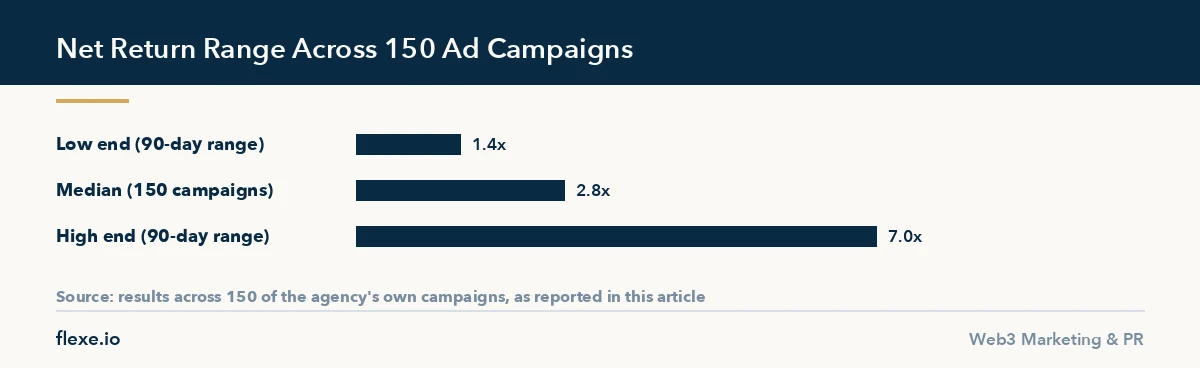
The benchmark we hold ourselves to comes from our own campaigns rather than from industry averages. Across one hundred and fifty campaigns the median net return within ninety days is 2.8x, with a range from 1.4x to 7.0x and a disclosed failure rate of twelve percent. Twelve percent is the number most agencies will not print. For a retargeting layer the measures are narrower: cost per completed conversion against the same cost on the display side alone, and whether the frequency needed to produce a conversion is rising week over week. Rising frequency with flat conversions means the pool is exhausted and the answer is more traffic.
Where This Goes Wrong
Four failure modes account for most of the trouble. The permission application is filed against an entity whose documents do not match the product, and it is refused. The pixel is installed but the conversion event fires on the wrong page, so the optimisation trains on nothing. The display budget is too small to build a retargeting pool, and the account sits half idle while the fee runs. Or the creative reads as a promise of profit to a reviewer who has never held a token. Each one is preventable.
Who This Is Not For
If you have no site traffic yet, crypto Facebook ads are the wrong first purchase. Read the banner and display inventory first, or the wider Web3 advertising service if the channel mix is still open. If your product is a token sale, this channel is closed in most markets and no budget changes that. If you need spend live next week, the permission timeline will not bend. And if your legal team cannot approve creative inside a working day, the review cycle alone will eat the first month.
Frequently Asked Questions
Can you run crypto ads on Facebook and Instagram?
Yes, with written permission from Meta tied to a specific business entity. The allowed product set is decided country by country, so an approval covering one market may not cover the next one on your list. Token sales and presales stay outside the permitted set in most markets, and no budget changes that.
How long does it take to get crypto Facebook ads live?
Two to six weeks from signature to the first impression. The floor assumes a verified business manager, a clean domain, permission already granted for your main market and a site that can take a pixel without a developer queue. Display traffic starts within days, because that side has no permission gate.
How much do Meta crypto ads cost?
A focused single channel campaign starts from $4,000. A full stack launch, with paid placements, public relations and creator work running together over three to six months, sits between $50K and $500K. Media spend is paid by you straight to the platforms and we take no percentage of it.
What happens if the ad account gets restricted?
We stop the affected sets, file an appeal with evidence attached, and keep the display side running so traffic continues. Recovery is measured in weeks and the retargeting layer is off during it. We disclose a 12 percent failure rate across 150 campaigns and sell no guaranteed reach, approval or conversion volume.
Why Flexe.io?
Flexe.io has run Web3 advertising since 2018, across 800+ campaigns. That history is why the permission work, the pixel setup and the appeal handling are routine here rather than a first attempt.
Ready to take advantage of Meta crypto ads? Contact us on Telegram to get started and give your brand the competitive edge it deserves.
Comparing inventory before you commit? Our guide to crypto ad placements sets out explorers, media and mainstream platforms side by side, and crypto traffic acquisition adds monthly visits and what each platform allows.