A crypto influencer list from Flexe is a market specific sheet of accounts we have checked, contacted and priced for you, usually 15 names, delivered about a week after the brief. It is built by hand rather than pulled from a database, because the accounts with genuine local reach rarely appear in any English language directory. Below is what buyers ask before commissioning one: how the pricing works, what arrives, how the result gets measured, why campaigns built on good lists still fail, and who should not order this at all.
The request usually arrives in one line: we need influencers in India, or Asia, or Turkey, or whichever market the project is actually trying to reach. Sometimes we already hold those accounts and send them the same day. When we do not, we build the list from scratch – found, filtered, verified and priced – and hand it over within a week.
What You Actually Receive
Not a scraped export. Every account on the list has been checked by a person and, in most cases, already contacted on your behalf.
| Column | What it tells you |
|---|---|
| Handle and platform | X, YouTube, TikTok, Telegram – whichever the audience actually uses in that market |
| Followers and average views | Views matter more; follower counts are the easiest number to inflate |
| Engagement rate | Measured on recent posts, not lifetime averages |
| Audience check | Whether the following is a real community or purchased volume |
| Quoted price | What they told us, after we negotiated |
| Contact status | Replied, negotiating, declined, or unreachable – including the ones that said no |
The declines are on the list deliberately. Knowing that four of the names you wanted will not work with your category is worth as much as the ones who will, and you would otherwise spend a fortnight discovering it yourself.
How the List Gets Built
1. Discovery
We pull candidates from every source available for that market – influencer platforms, our own base, adjacent-audience analysis, and the accounts that already appear around competitors in the region. Regional markets are where this matters most, because the well-known aggregators cover English-language Crypto Twitter and very little else.
2. Filtering
Most of what discovery produces gets thrown away. Accounts drop out for dead engagement, an audience in the wrong country, a following that does not survive inspection, or a content history that would put your project next to something you do not want to be next to.
3. Verification
Survivors are checked the same way we check accounts entering our own base: engagement quality, the composition of the follower network, and how many of those followers are people who matter in crypto rather than passers-by. An account that will not carry a disclosure comes off the list here, because the FTC rules for social media influencers and platform rules such as YouTube paid product placement apply to a paid crypto post like any other ad.
4. Outreach and pitch
We write to each account and pitch your project properly – what it is, why their audience would care, what the collaboration looks like. Response rates depend heavily on how the first message reads, which is most of why cold lists bought elsewhere convert so badly.
5. Prices and negotiation
We get their rate, then work on it. Volume across several accounts, longer engagements and flexible timing all move the number, and first quotes in this market are rarely final. You receive what they agreed to, not what they opened with.
Markets We Get Asked For Most
India and Southeast Asia come up most often, followed by Korea, Japan, Turkey and Latin America. These are the markets where a generic list fails hardest: audiences sit on different platforms, the language filters out most Western tooling, and the accounts with genuine local reach rarely appear in any English-language directory.
We have written separately about the Japanese and Korean crypto influencer markets if you want a sense of how they work before commissioning anything.
One week from brief to list, same day if we already hold that market
One week from brief to delivered list, including the outreach and the negotiation. If we already hold the accounts for that market, it is same-day – ask before commissioning anything, because often there is nothing to commission.
Most lists start from our verified base. The largest public accounts in it are ranked in our list of the top crypto influencers in 2026, and the full service is described on the crypto influencer marketing page.
What a Crypto Influencer List Costs
The research is priced on how hard the market is to cover, not on how many rows end up in the file. A brief for English language Crypto Twitter is cheap to serve, because most of those accounts already sit in our base with recent engagement checks against them. A brief for Korea, Japan, Turkey or Tier 2 India costs more, because discovery, the language work and the outreach all start from nothing, and most of what discovery produces is thrown away before anybody is contacted. Fifteen usable names in a Korean niche can mean two hundred candidates read and rejected first.
The same logic runs the other way. If we already hold the market, there is often nothing to commission, and the honest answer on the first call is that you should take the accounts we have and spend the research money on placements instead. That happens often enough that it is worth asking before you brief anybody, including us.
Placement Budgets Sit Separately
What you pay the accounts is a different number, and it is the one that decides whether the list is worth building at all. A focused single channel campaign starts at $4,000, which buys a small set of accounts and a clear read on whether that market responds to your category. A full launch across several channels runs $50K to $500K over three to six months, and at that size the list stops being a document and becomes a booking schedule.
Tell us the placement budget in the brief rather than after delivery. A list built for $4,000 and a list built for $80,000 contain different accounts, not the same accounts in a different order, and rebuilding one into the other costs a week we could have saved.
What Moves a Quoted Rate
First quotes in this market are opening positions, which is why negotiation is part of the build rather than something you inherit with the file. Four things move a number reliably:
- Volume. Several accounts booked in one order almost always drops the individual rate.
- Timing. Flexible dates cost less than a fixed publication day inside a launch week.
- Length. A three post engagement prices better per post than one paid mention.
- Format. A quote post, a dedicated thread and a pinned post are three different prices, so the brief should say which one you actually want.
Every price on the list carries the date it was quoted. Rates move with the market, and a number from two months ago is a starting position rather than a fact. If a list sits unused for a quarter, assume the quotes need reopening, and say so, because reopening them is far quicker than rebuilding the research underneath them.
What Happens After the Brief
The build itself is described above. What follows is the part that decides whether the money spent on it returns anything: the format the work arrives in, the way results are read, and the conditions under which we would rather you did not buy it.
What Arrives and In What Format
The deliverable is a spreadsheet plus a short written note, not a slide deck. The spreadsheet carries one row per account with the columns described above, and the verification evidence attached to each row, so you can look at the engagement sample and the follower composition and disagree with us if you want to. Nothing on that file asks you to take our judgement on trust.
The note is where the reading sits. It says which names to approach first and why, which to drop if the budget tightens, what the declines have in common, and which accounts quoted a rate we think is above what their audience is worth. That last column is the one clients argue with most, and it is also the one that has saved the most money.
Where a project wants the campaign run rather than the file handed over, the same rows feed straight into execution, and reporting then follows the format used on the YouTube influencer service or the TikTok creator service, depending on where that audience actually sits.
How the Result Gets Measured
A crypto influencer list is a research product, so its first test is narrow: how many of the names you approach reply, and how close the agreed price lands to the quoted one. Both are visible within a fortnight of delivery. Everything past that is campaign measurement, and it has to be set up before the first post goes out rather than reconstructed afterwards.
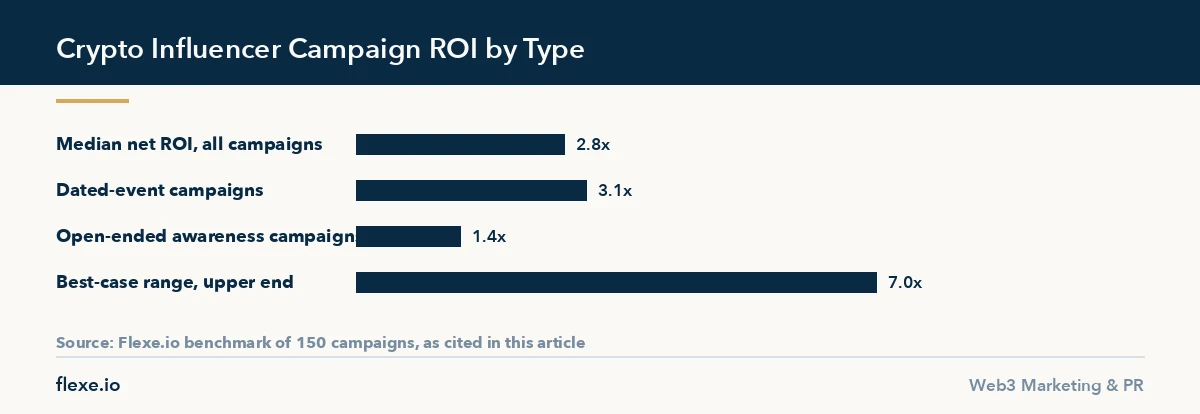
Our own numbers across 150 campaigns give a median net ROI of 2.8x inside 90 days, a range from 1.4x to 7.0x depending on project type, and a disclosed failure rate of 12 percent. The split that matters most in that data is the calendar. Campaigns attached to a dated event reach 3.1x median, against 1.4x for open ended awareness spending, which is why the brief asks what is on your calendar before it asks about budget.
To get a reading rather than an anecdote, four things need to exist before anything is published:
- A tagged destination per account, so traffic can be separated by source.
- An agreed view expectation per account, checked against that account’s recent average rather than its best post.
- A written definition of the action that counts, whether that is a wallet connect, a signup or a Telegram join.
- A baseline week of your own traffic, measured before the first placement runs.
Why These Campaigns Fail
The failures repeat, and almost none of them are about the names on the file. A list gets approved, then the budget is spread evenly across fifteen accounts so that no single one of them reaches the volume where anything happens. Or the posts go out with no date attached, so an interested reader has nothing to do next and does nothing. Or the market was chosen because a founder likes it rather than because the product is usable there, and the audience is real but cannot act on what it sees.
The other common one is content mismatch. An account with a genuine trading audience is handed a brand awareness clip written for a consumer app, and the engagement rate collapses in public. The account was fine. The brief was wrong, and the cost of learning that is the placement fee plus a public data point that competitors can read.
Twelve percent of campaigns in our own benchmark returned less than they cost. We publish that number because the projects that avoid joining it are usually the ones that argued with the plan early, changed the market or the date, and only then released the budget.
Who Should Not Order This
Projects with nothing to show yet get very little from it. With no product to open, no date and no reason for an audience to act, a list will tell you what a campaign would cost and nothing else. Wait until something sits on the calendar and the same money works considerably harder.
It is also the wrong purchase for anybody who wants a guaranteed cost per follower, a database they can resell, or names that will say anything for a fee. Every row is checked by a person and priced through a conversation, which makes this slower and more expensive than a scraped export, and better only if you intend to use it.
Frequently Asked Questions
How is this different from buying an influencer database?
A database is a snapshot of whoever was scraped when it was assembled, sold to everyone, and out of date on arrival. This is built for one brief, filtered against your category, and the accounts have already been contacted and priced. The useful part is not the names; it is knowing which of them will work with you and for how much.
Do you cover non-English markets properly?
That is most of what this service is for. English-language Crypto Twitter is well covered by tools anyone can buy. India, Korea, Japan, Turkey and Southeast Asia are not, which is why lists for those markets have to be built by hand.
What if the accounts turn out to be fake?
They get removed during filtering, which is where most of the candidates go. You see the verification signals for every account that survives, so you can disagree with our judgement rather than take it on trust.
Can you run the campaign as well, or only build the list?
Either. Some projects take the list and run it in-house, which is a perfectly reasonable outcome. Others hand the whole thing over – in that case the list feeds straight into a managed X KOL campaign or the equivalent on YouTube or TikTok.
How many accounts end up on a list?
Fifteen names is the usual answer. A specific market and niche might yield a dozen accounts worth approaching; a broader remit produces more. We would rather hand over fifteen names that answer the brief than eighty that pad the document.
What do you need from us to start?
The market, the audience you are trying to reach, the platform if you have a preference, and anything your project cannot be associated with. That last one saves the most time. If you already have names in mind we check those too and tell you which ones we would leave off, with the reason.
Tell Us Which Market You Need
Send us the market and the audience, and we will tell you first whether we already hold those accounts – if we do, you get them without commissioning anything. Message us on Telegram.