Flexe.io is a crypto advertising agency that buys paid media for token projects, exchanges and Web3 apps; the platform rules on this page were checked on 10 November 2026. We buy on Google, Meta, X, Reddit and Quora, on block explorers such as Etherscan, Solscan and BscScan, on 80+ crypto sites and in Telegram. You pay the platforms directly, our fee is quoted per brief, and we take no percentage of ad spend. It is not the right buy for cold reach on a small budget with no site traffic to retarget.
- We have run 800+ campaigns since 2018, and paid media is part of most of them.
- BSCScan for Freshcakeswap: 100,000 impressions in five days at 20,000 a day, with click-through around 0.32 percent.
- Reddit for 100xcoin: about 3,000 clicks at an average of about two dollars per click, on a platform that restricts crypto ads.
- X Ads into African markets: 650,000 impressions. Quora Ads for Tem-Coin: 2,550 new users before an ICO.
- In our benchmark of 150 campaigns, the median net return was 2.8x and 12% failed; campaigns under $30K failed to break even 34% of the time (our ROI calculator, checked 11 November 2026), so we start with one channel and add the next only after it pays back.
What a crypto advertising agency does
A crypto advertising agency buys paid placements for blockchain products on platforms that restrict them, and on crypto-native inventory that general agencies rarely buy. The work has two halves. One is permission: which entity may advertise, in which countries, for which product. The other is media buying: which placement reaches wallet holders at a price that pays back.
The permission half decides the calendar. Google lets certain crypto products advertise only after an application under its cryptocurrency ads policy and only in approved locations. Meta asks crypto trading advertisers for licences and an eligibility application. X and Reddit also restrict the category. Rules move during the year: in the UK the FCA opened its authorisation gateway for cryptoasset firms on 30 September 2026 and will close it on 28 February 2027, so a UK campaign has to be planned around where the client sits in that queue. An agency that skips this step gets ads rejected and accounts suspended, and a suspended account is harder to fix than a late launch.
Who hires us for advertising: exchanges and wallets entering new markets, token projects before and after a TGE, DeFi apps that need deposits, and fintech firms with crypto products. Who should not: a project that wants one ad to replace a community, or a team that cannot supply a working landing page and tracking.
Planning a launch? Send the product, target countries and licence status on Telegram, and we will tell you which channels you can use now and which need approval first.
Crypto ad channels we buy and what each needs
Each channel below lists who it suits, what the platform asks for, one result from our own campaigns where we have one, and the limit to plan around.
1. Google Ads search and display
Best for: licensed exchanges, wallets and fintech apps capturing people who already search for the product. Full process on our crypto Google Ads service.
Requirements: advertiser verification, crypto certification for each target country, and ads and landing pages that follow local law.
Proof: one of our Google campaigns passed moderation in a category the platform bans by default, which is described in our paid ads case studies.
Watch out: certification is decided by Google and can take weeks. Unlicensed tokens cannot run trading ads here at all. The country list keeps changing: from 21 October 2026 Google allows exchange and software wallet ads in the UAE for advertisers licensed by VARA, DFSA, FSRA or the CMA who also hold Google certification.
2. Meta ads on Facebook and Instagram
Best for: retargeting visitors who already reached your site or app. Meta no longer reports Facebook and Instagram users separately; its third quarter 2026 results, published on 21 October 2026, put daily active people across its apps at 3.64 billion for September 2026, up 3% year over year.
Requirements: an approved crypto advertiser application, business and domain verification, and a working pixel with conversion events.
Proof: Meta runs as one line inside larger launches rather than as a standalone plan in our work.
Watch out: cold reach on a small budget rarely pays back here. It earns its money when there is an audience to retarget.
3. X Ads
Best for: retargeting and reach among crypto readers on the platform where most token news breaks. See our X crypto ads service for targeting options.
Requirements: a verified advertiser account, conversion tracking installed before launch, and policy-safe creative.
Proof: a campaign into African markets delivered 650,000 impressions.
Watch out: X works at scale. Cold acquisition from a standing start rarely pays back, so we pair it with KOL posts or retargeting.
4. Reddit Ads
Best for: projects whose buyers research in subreddits before they commit.
Requirements: creative and targeting that pass Reddit rules on crypto, which usually takes several hypotheses before one is approved.
Proof: the 100xcoin campaign produced about 3,000 clicks at an average cost of about two dollars per click after repeated bid work.
Watch out: Reddit readers punish ads that read like hype. Plain copy with a clear product claim does better.
5. Quora Ads
Best for: presales and products that need an explanation before a sign-up.
Requirements: crypto-specific creatives and question targeting built around what buyers actually ask.
Proof: Tem-Coin gained 2,550 new users ahead of its ICO from campaigns in African markets and the United States.
Watch out: Quora is a narrow channel. It suits one kind of audience well and most others poorly.
6. Block explorer banners
Best for: reaching people with a wallet open, on Etherscan, Solscan and BscScan. Site-by-site inventory is on our crypto ad placements page.
Requirements: creative sized to each explorer and approval by the explorer itself. No licence is usually asked for.
Proof: Freshcakeswap ran 20,000 impressions a day for five days on BSCScan info and address pages, with click-through around 0.32 percent, above the average for the format.
Watch out: explorer inventory sells out around big launches, so dates need booking early.
7. Crypto media and display networks
Best for: steady reach across crypto news and data sites during and after a launch.
Requirements: banner sets in each size the network sells and a landing page that loads fast on mobile.
Proof: we buy across 80+ crypto-focused websites through networks such as AADS, Coinzilla, Bitmedia and Blockchain-Ads, and you pay networks and publishers directly. How we segment that traffic is set out on our crypto traffic acquisition page.
Watch out: display click-through is low by nature. Judge it on cost per conversion, not clicks.
8. Telegram channels and mini app ads
Best for: token launches and apps that live inside Telegram. Channel buying is covered on our Telegram crypto channels service.
Requirements: a verified channel shortlist, a fixed slot and fee per post, and creative in each channel owner’s format.
Proof: the mini app inventory we buy reaches 49 million users in more than 200 countries.
Watch out: channel audiences are easy to inflate, so every channel is checked before booking and reported against the view range we quoted.
Crypto advertising channels compared
The table sums up the choice. Approval status decides which rows you can use today; the audience decides which one goes first.
| Channel | Licence or approval needed | Best for | Our reference result |
|---|---|---|---|
| Google Ads | Yes, certification per country | Search demand for licensed products | Passed moderation in a banned category |
| Meta | Yes, eligibility application | Retargeting site visitors | Used inside larger launches |
| X Ads | Restricted, verified account | Retargeting and crypto reach | 650,000 impressions in Africa |
| Restricted, several reviews | Research-heavy buyers | About 3,000 clicks at about $2 | |
| Quora | Creative review | Presales that need explaining | 2,550 new users before an ICO |
| Explorer banners | Explorer approval only | Wallet holders during a launch | 100,000 impressions in 5 days |
| Crypto media display | Publisher approval | Steady reach after launch | 80+ crypto sites |
| Telegram | Channel owner approval | Launches inside Telegram | 49M users in mini app inventory |
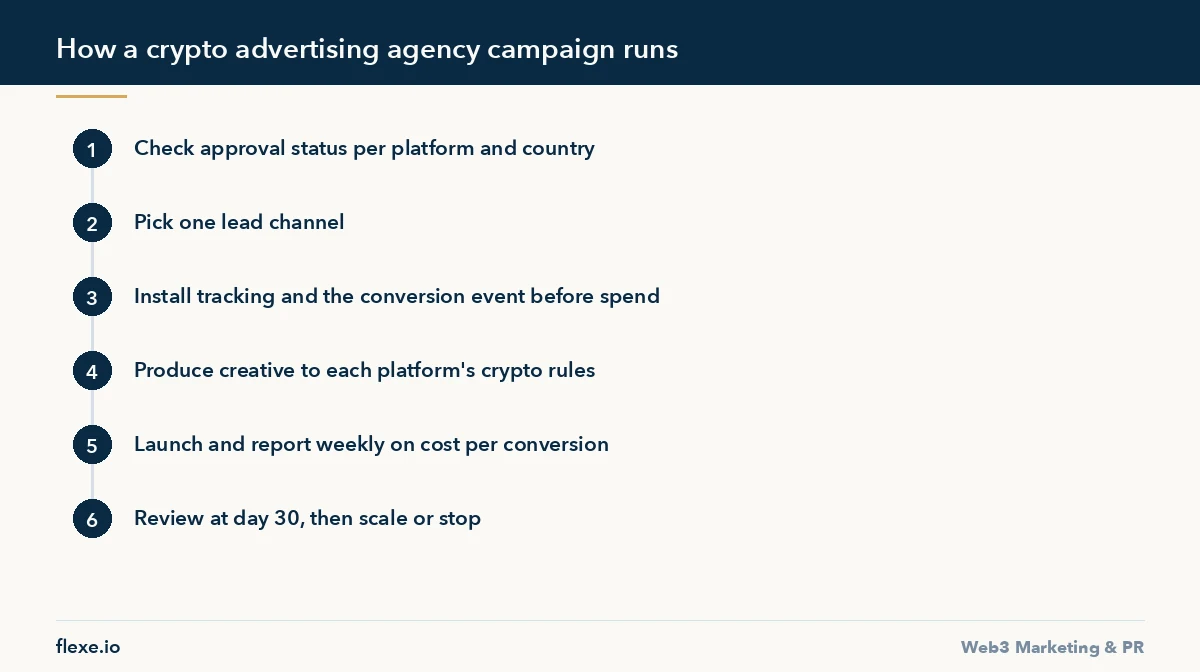
How we run a crypto ad campaign
- Check approval status. We map which platforms your licences allow in each target country.
- Pick one lead channel. The budget goes to the channel most likely to pay back before any second channel is added.
- Build tracking first. Pixels and the conversion event are installed and tested before any spend.
- Produce creative per platform. Each unit follows that platform’s crypto rules and size specs.
- Launch and report weekly. You get spend, reach, clicks and cost per conversion every week.
- Review at day 30 and scale or stop. Channels inside their range get more budget; the rest are closed with a written reason.
What you send us before launch: the licence or registration documents for each target country, the landing page or app link, the token contract address if there is one, brand assets, and the one conversion event that counts as success, such as a deposit, a wallet connection or a sign-up. Missing documents are the most common reason a Google or Meta start date slips, so we ask for them in the first week.
What the weekly report contains: spend by channel and placement, reach, clicks, cost per click, the number of conversion events and the cost of each one, plus a short note on what we changed and why. The report is written for the person who signs off the budget, not for a media buyer.
What we will not run: ads that promise returns or price growth, which every major platform rejects anyway, paid posts that hide the payment, and traffic from bot networks sold as engagement. If a channel can only hit its numbers that way, we drop the channel.
Paid media rarely works alone for a token. Most of our launches pair ads with KOL posts, PR and a staffed community, and the full list of our crypto marketing services shows how the channels fit together. The results behind the numbers on this page are in our crypto paid ads case studies.
What crypto advertising costs
Every crypto ad budget has two lines: our fee and the media. Ad spend goes from you to the platform, and our fee is quoted per brief after we know the channels, countries and approval status. A single-channel campaign costs less than a full launch where paid media sits next to PR, KOL work, community and content and is only one line of the plan.
Cost goes up with the number of countries, because each one can need its own certification, and with the number of channels running at once. It goes down when accounts are already verified and the site already has traffic to retarget. We do not take a percentage of ad spend, since that pays an agency for spending more rather than spending well.
The inconvenient part: not every campaign pays back. In our benchmark of 150 campaigns run between January 2024 and February 2026, 12% failed and returns ranged from 1.4x to 7.0x by project type. Small budgets are where we see waste most often: as published in our ROI calculator in November 2026, campaigns under $30K fail to break even 34% of the time against 12% overall, so if the budget only covers a thin test everywhere, holding it is usually better than spending it.
How to choose a crypto advertising agency
Ask four questions on the first call. Can the agency show certification or approval work on Google and Meta for a client like you? Does it explain what drives its fee before you sign? Who owns the ad accounts and pays the platforms? And does it take a cut of ad spend?
If the plan includes paid posts by creators, ask how disclosure is handled; the FTC endorsement guidance requires a clear label when a creator is paid. Our ranking of the best crypto advertising agencies compares agencies on these points using facts from their own websites.
Frequently Asked Questions
How much does a crypto advertising agency charge?
Our fee depends on the number of channels, the countries and whether accounts are already approved, and we quote it per brief within 24 hours on Telegram. Ad spend is paid by you directly to the platforms, so the budget always has two lines. We take no percentage of ad spend, which keeps the incentive on results rather than volume.
Can an unlicensed crypto project run ads?
Yes, but not everywhere. Google and Meta accept crypto trading and exchange ads only from approved advertisers in approved countries, and that approval depends on licences. Block explorers, crypto media, Telegram channels and most crypto ad networks do not ask for a licence, so an early token usually starts there and moves to Google and Meta once the paperwork exists.
Which crypto ad channel works best for a token launch?
For a launch with a fixed date, explorer banners and Telegram placements deliver volume fastest: our BSCScan run delivered 100,000 impressions in five days. X and Meta work best for retargeting people who already visited your site. Reddit and Quora suit narrower audiences that research before they buy. We pick one lead channel after reading your audience and your approval status.
How long does it take to launch crypto ads?
Explorer, media and Telegram placements can run within days once creative is approved by the publisher. Google and Meta take longer because verification and certification come first, and those reviews are set by the platforms, not by us. We schedule the paperwork before the launch date so paid media is ready when the announcement goes out.
Do you guarantee clicks or conversions?
No. We quote expected ranges from past campaigns, such as about two dollars per click on the 100xcoin Reddit run, and we report against the conversion event you chose. A guarantee would require control over platform auctions and moderation that no agency has. If a channel misses its range by the day 30 review, we say so and move the budget.
Can crypto exchanges run Google Ads in the UAE?
Yes, since 21 October 2026, if the exchange or software wallet is licensed by VARA, DFSA, FSRA or the Capital Market Authority and is certified by Google for the UAE. Ads and landing pages still have to follow local law. Without one of those licences, explorer banners, crypto media and Telegram placements remain the realistic start in the Emirates.
Who owns the ad accounts and data?
You do. Accounts are verified in your company name, you pay the platforms directly, and pixels, audiences and reports stay with you after the campaign. That also means approvals you earn with us keep working if you later bring advertising in-house, which matters on Google and Meta, where getting approved takes the most time.