A bitcointalk promotion service keeps a forum thread alive with long posts on a fixed cadence, and a focused single channel engagement starts at $4,000. One reference campaign ran 2 posts a day for 259 days and passed 100 pages. You get screened accounts, one writer per project, and a continuously updated post log.
What follows is the operating detail behind that: who writes the posts, what you supply before the first one, what never appears in a post, how criticism in the thread is handled, what the price is built from, and when a thread is the wrong purchase.
Bitcointalk threads do not die of old age – they die of silence. A thread that stops being posted in sinks off the front page within hours and stops being read. Keeping one alive is a maintenance job measured in months, not a launch.
Why Bitcointalk Still Matters
| Metric | Value | Source |
|---|---|---|
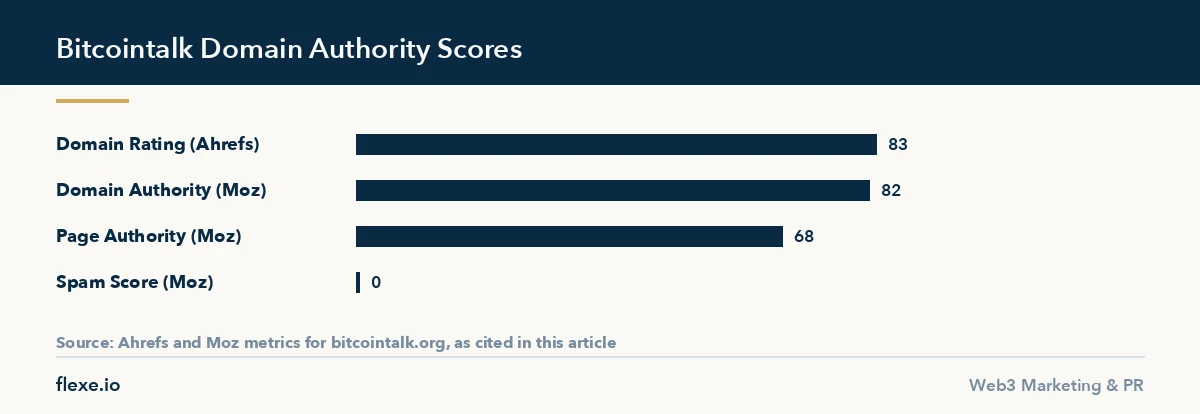
| Domain Rating | 83 | Ahrefs |
| Monthly visitors | ~212,000 | Similarweb |
| Traffic from the United States | 38% | Similarweb |
| Domain Authority | 82 | Moz |
| Page Authority | 68 | Moz |
| Spam Score | 0 | Moz |
| Backlinks | 579,469 | Moz |
| DoFollow links | 405,767 | Moz |
| Indexed pages | 101,932 | Moz |
| .edu backlinks | 159 | Moz |
| .gov backlinks | 13 | Moz |
Similarweb figures are from July 2026 (636.8K visits over the preceding three months). Moz and Ahrefs link metrics were last checked in August 2026.
A spam score of zero on a forum this old is unusual and it is the reason the domain still carries weight. Most crypto forums of that vintage have been abandoned to spam and are worth nothing.
A 259-Day Campaign
| Start | 27 June 2025 |
| End | 13 March 2026 |
| Duration | 259 days – 8 months, 14 days |
| Posting frequency | 2 posts per day |
| Account ranks used | Newbie, Copper, Junior |
| Thread length reached | Over 100 pages of discussion |
Two posts a day for eight and a half months is what a hundred pages costs. There is no shortcut version of this: a burst of activity followed by nothing produces a dead thread with a lot of pages, which is worse than a short live one.
Why Long-Form Only
We started with shorter posts and moderators removed them. Bitcointalk moderation treats brief replies as bumping, and bumping is against the rules – so the posts disappear and the money spent on them disappears with them.
Everything is now written long-form: a substantive contribution that answers something, adds information or responds to another poster in detail. It costs more per post and it is the only version that survives. Anyone offering high-volume cheap posting on this forum is selling posts that will be deleted.
AI Search Engines Read These Threads
An observation from the campaign above that turned out to matter more than the forum traffic itself. When users ask Perplexity for reviews of that project, Perplexity cites the client’s Bitcointalk thread among its sources.
That is a different kind of value from a backlink. Answer engines need somewhere to read what real users say about a project, and a long, active, unspammy forum thread is exactly the shape of source they reach for. A project with no such thread has nothing for them to cite, and the answer gets built from whatever else exists.
What Is Reported
Every published post is logged as it goes up – date, account, thread position and content. You see the log continuously rather than in a monthly summary, which means a post removed by a moderator is visible immediately rather than at the end of the month.
This is one instrument among several. If you are deciding between a release, an organic article and a forum presence rather than buying one of them, start with crypto PR – it sets out what each format actually does.
What the bitcointalk promotion service covers
The work is either a new thread in the section that fits your project or the revival of one you already have, plus a roster of accounts posting to an agreed schedule for an agreed number of months. Every account is screened for bought engagement through three independent checks before it joins a campaign, because a farmed account on this forum is visible in its post history and an account that reads as farmed takes the thread down with it.
One writer owns a project so the thread keeps one line of argument across hundreds of posts. Contradicting a post from four months ago is the fastest way to be read as paid, and a thread that reads as paid is worth less than no thread.
Cadence is agreed before anything is written and then held to. Two posts a day is the pattern from the campaign described above; one a day over a longer run behaves similarly. What a bitcointalk promotion service cannot do is compress that. The forum ranks threads by recent activity and readers judge them by the date gaps, so the value comes from the regularity rather than from the total. A thread that is posted in every day for eight months outperforms one with three times the posts crammed into six weeks, and it costs less to produce.
What you send us first
A forum thread runs on material, and the first month is where a missing document costs the most. Everything below is asked for once, at the start.
- Documentation and the whitepaper, including the technical parts, because short answers get removed and long ones need something to be long about.
- Any thread that already exists, plus admin of the original post if you want it kept current.
- A written list of forbidden claims and anything not yet announced.
- A technical contact who can answer a specific question within a working day.
- Your release calendar, so an update reaches the thread while it is still news.
- An honest note on known weaknesses, because the thread will raise them whether or not you mention them first.
What is posted and what is not
Posted material is long form by necessity. Short replies are treated as bumping and removed, so every post answers something, adds information, corrects a factual error or responds to another poster in detail. In practice that means technical explanations, comparisons with other projects in the same category, walkthroughs of what an update changed, and direct answers to criticism raised in the thread.
What never appears: price talk of any kind, return promises, unannounced listings or partnerships, signature spam, fabricated claims of holding the token, attacks on competing projects, and any suggestion that the posting is anything other than what it is. The forum audience has read a decade of paid threads and identifies the pattern quickly, which is why the writing sticks to substance.
Handling criticism in the thread
Criticism is the part of the work most clients ask about, and the honest answer is that it is left in place. Posts on that forum cannot be removed by us and should not be, because a thread with no criticism in it reads as manufactured to every experienced member.
The rule is to answer what can be answered from documentation, escalate what cannot, and never argue. A claim that a contract does something it does not do gets a factual reply with a link to the source. An accusation about the team, anything touching a security incident, and anything legal go to your contact the same day and wait for your words rather than a guess. Where a criticism is simply correct, it is acknowledged in the thread, because arguing with a true statement in front of an audience that can check it is the worst available outcome.
How the price is built
The unit is a month of posting at an agreed cadence, not an individual post, and the length of the commitment moves the figure more than anything else. A thread is a duration purchase: two posts a day for 259 days is what one hundred pages cost on the campaign described above, and the same money spent in three weeks produces a dead thread with a lot of pages.
A focused single channel campaign starts at $4,000. What raises it from there is cadence, whether a second thread in another language runs alongside, how technical the subject is, and how much of the posting has to respond to live criticism rather than follow a plan. A launch programme in which the forum work sits alongside several other channels runs $50K to $500K across three to six months.
There is no priced guarantee of views, replies or referral traffic, and no guarantee of trading volume at all, since manufactured volume is wash trading and exchanges delist for it. The observed spread on paid attention is wide enough to make any such promise dishonest: on a Reddit trending campaign the range ran from roughly 10 views to 150,000.
Reporting beyond the post log
The continuous post log is the base layer. On top of it the monthly view carries thread depth in pages, the count of replies from members who are not on the brief, which topics produced those replies, removals with the reason where a moderator gave one, and the questions escalated to you with how long each waited.
Two slower measures matter more than volume. The first is whether the thread is cited when an answer engine is asked about your project, which is checkable by asking it and worth checking quarterly rather than weekly. The second is what the thread does in the month after posting stops, because a thread that keeps receiving replies without us has become a real discussion, and that is the only outcome worth paying eight months for.
What the wider campaign data shows
Across more than 800 campaigns since 2018, the first party benchmark on 150 of them is a median net return of 2.8x within 90 days, a range from 1.4x to 7.0x, and a disclosed failure rate of 12 percent. Forum work is one input inside those numbers and never the whole of them, and it is one of the slower inputs.
Two findings from that data apply here. A campaign with a fixed public launch date moves the median from 1.4x to 3.1x, and a thread benefits from the same thing, since a project with dated news gives the thread something to discuss every week. Budgets spread thin across many channels correlate with a 34 percent failure rate, which argues for one forum thread run properly for eight months over four channels funded for six weeks each.
How these campaigns fail
The first failure mode is the burst: heavy posting for a month, then nothing, leaving a long thread that stopped mid conversation. A reader can see the date gap and reads the whole thing as an abandoned promotion.
The second is a silent client. Technical questions accumulate, nobody answers them, and the writers run out of substance to write long posts about. The third is starting the thread before there is anything to say, which produces months of filler that the forum treats as exactly that. The fourth is buying cheap high volume posting, which ends in deletions and, in the worse cases, a flagged thread that is harder to recover than a new one.
The fifth is expecting traffic within the first month, or at all in the volumes a paid channel produces. The forum sends some, but the value of a live thread is that it exists as a checkable third party discussion when somebody looks the project up, including the software doing the looking.
Who should skip this
Skip it if you need a result inside a quarter, because months is the honest unit here. Skip it if nobody on your side can answer a technical question, since the posting will surface questions faster than a silent team can absorb them. Skip it if the project has nothing to discuss beyond a token, because a hundred pages about nothing reads as a hundred pages about nothing. And skip a bitcointalk promotion service entirely if what you actually want is volume, holders or a guaranteed number of readers, none of which a forum thread produces and none of which we sell.
It also fits badly as a lone purchase for a project with no announcements to reference. If you are choosing between a release, an organic article and a forum presence rather than running them together, crypto PR sets out what each format does. If your immediate problem is a chat that looks empty rather than a missing third party discussion, Telegram and Discord activity is the faster fix, and it works on a different timescale entirely.
Frequently Asked Questions
How long before a thread is worth anything?
Months, not weeks. The reference campaign above ran 259 days at two posts a day and passed 100 pages. A thread needs sustained discussion before it reads as a real conversation to either a human or an answer engine, and a burst of posting followed by silence produces a dead thread with a lot of pages.
What account ranks are used?
Newbie, Copper and Junior. Higher ranks exist but are not necessary for thread activity, and mixing ranks looks more natural than a single account posting twice a day for eight months. Every account is screened for bought engagement through three independent checks before it joins a campaign.
Can posts be removed?
Short ones, routinely. Bitcointalk moderation treats brief replies as bumping and removes them, which is why we publish long-form only. Posts that answer something, add information or respond to another poster in detail are not treated as bumping. Removals appear in the post log with the reason where a moderator gave one.
Does this replace PR?
No. A release announces something once; a forum thread is where people go to check whether the announcement was true. They answer different questions and work best together. If you are choosing between formats rather than running them together, our crypto PR page sets out what each one does.
What will you not guarantee?
Views, replies, referral traffic or trading volume. Manufactured volume is wash trading and exchanges delist for it. The observed spread on paid attention is wide enough to make any such promise dishonest: on a Reddit trending campaign the range ran from roughly 10 views to 150,000. Our disclosed failure rate across 150 campaigns is 12 percent.
Tell Us About Your Thread
Send the thread if one exists, or the project if it does not. You get back a posting plan with frequency, duration and what the log will show you.