Crypto white paper writing turns your product, tokenomics and roadmap into a publishable paper in about 4 to 5 working weeks, with an agreed outline, two revision rounds, layout and a condensed version. It is a research job before it is a writing job, and the calendar is set by how much of the project has already been decided. Two teams with the same product can be a month apart on delivery because one has settled supply, vesting and chain choice while the other is still arguing about them. Below is the schedule, what you hand over, what a revision round includes, how the quote is built and when the honest answer is that you do not need a paper yet.
A white paper is read by three audiences with different questions, and most drafts are written for none of them. Investors want to know why the token accrues value. Exchange listing teams want to know whether the supply schedule hides anything. Everyone else wants to know what the product does in the first page.
What Goes In
| Section | The question it answers |
|---|---|
| Problem | What is broken now, stated without the word "revolutionise" |
| Solution | What the product does, and why it needs a blockchain at all |
| Technology | Architecture, chain choice, and what is actually built versus planned |
| Tokenomics | Supply, allocation, vesting, and what creates demand |
| Roadmap | Dated milestones, not quarters labelled "Phase 3" |
| Team | Names and history, or a stated and defended reason for anonymity |
Where Drafts Fail
Tokenomics without a demand side. Most papers describe supply in detail and demand in one sentence. A reviewer reads the allocation chart, sees 40% to the team and treasury with a six-month cliff, and stops there.
A roadmap that has already slipped. Publishing dates that passed before the paper did is the fastest way to lose a reader who was otherwise convinced.
Explaining the blockchain. Three pages on what a smart contract is tells the reader you are not sure who you are writing for.
What You Get
- A draft built from your brief, technical documentation and existing materials
- Tokenomics presented as a table and a chart rather than prose
- Two revision rounds
- Layout ready to publish, and a short version for people who will not read the long one
A white paper rarely converts on its own. It is opened after coverage or a pitch deck has already convinced someone, and its job is to survive scrutiny.
How crypto white paper writing runs
- Brief and gap list. We read what exists and come back with the questions that have to be answered before anything can be written. Most of the schedule is decided here.
- Outline agreed. Section by section, with the question each one answers, so disagreements happen on one page instead of forty.
- Draft. Written for the three readers rather than for a template.
- Two revision rounds. Consolidated comments each round, because a paper edited by five people in sequence loses its argument.
- Layout and short version. A publishable document plus a condensed version for people who will not read the long one.
What changes the cost and the timeline
| Factor | Effect |
|---|---|
| State of the source material | Existing technical documentation shortens the work more than anything else |
| Technical depth | A consumer app and a protocol with a novel consensus mechanism are different documents |
| Tokenomics maturity | If supply and demand are still being decided, the paper waits for them |
| Audit and legal review | A paper that has to survive counsel review takes longer and changes more |
| Second language | A translated paper needs a technical reviewer in that language, not a translator |
Budgets across our services start from $4,000. Packaging work such as a white paper is quoted on the brief rather than from a price list, and the gap list above is what moves the number.
What a good paper is judged on
One test settles it: hand the draft to someone who has never seen the project and ask them what the product does, why it needs a chain, and what makes the token worth holding. If any of the three takes more than a minute to find, the paper is not finished.
The second test is the supply schedule. Exchange listing teams read the allocation table before they read the prose, and an unexplained treasury share with a short cliff ends the conversation there.
Interest is created before the paper is opened, usually by crypto PR.
The schedule stage by stage
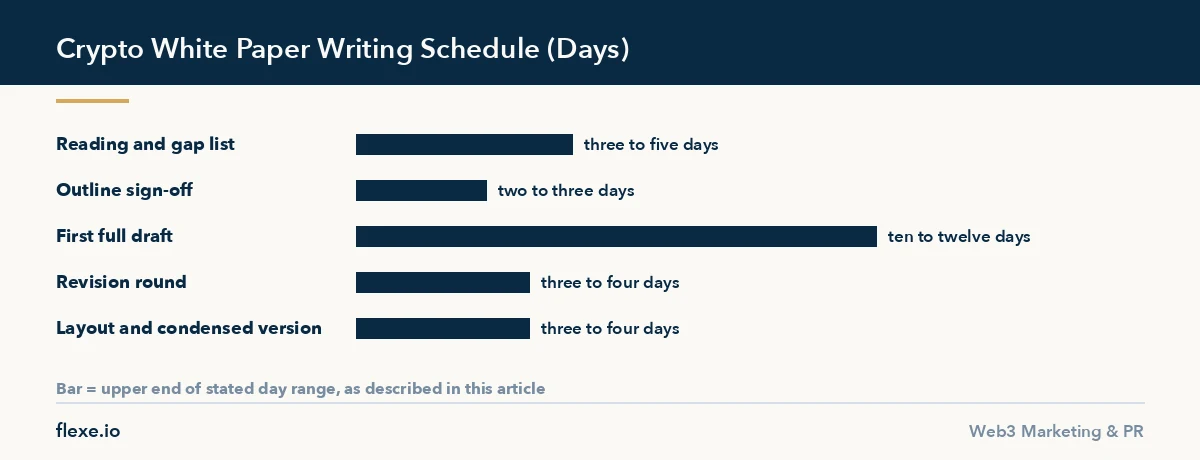
A paper with settled tokenomics and usable technical documentation runs about four to five working weeks from brief to publishable file. The reading and gap list take three to five days, because someone has to go through the repository, the deck, the notes and whatever half draft exists, then sit with the person who can answer what is missing. The outline is another two to three days and is signed off before a paragraph of prose is written. The first full draft is ten to twelve working days. Every revision round takes three to four days once consolidated comments arrive. Layout, charts and the condensed version add three to four days at the end. Time spent waiting on an undecided supply schedule belongs to the project rather than to the writing, and we put that in the quote instead of absorbing it quietly.
- Reading and gap list: three to five working days
- Outline signed off: two to three working days
- First full draft: ten to twelve working days
- Each revision round after consolidated comments: three to four days
- Layout, charts and the condensed version: three to four days
Compressing that calendar is possible and it costs something specific. A two week paper means the outline and the draft overlap, which removes the stage where disagreements are cheap, and it means comments have to come back inside 24 hours from one person. We take rush work when the launch date is real, and refuse it when the tokenomics are not settled, because a fast paper built on numbers that are still moving is a paper written twice.
What you supply before we start
Nothing on this list is unusual, but the work stops without it. The item that changes the schedule most is a named decision maker on your side who can settle a disagreement between two founders in a day rather than a fortnight.
- Whatever technical documentation exists, including unfinished repositories and internal notes
- The supply table: total, allocation by bucket, vesting and cliff dates
- A dated roadmap carrying the dates you are willing to publish
- Team names and history, or the reason you intend to stay anonymous
- Any audit report, legal memo or exchange feedback already received
- One named decision maker and one technical contact who answer within a day
If a piece is missing we still start, and the gap is recorded in the outline as an open question with the date it has to be closed. A paper with two open questions at draft stage is normal. A paper with nine is a project that is not ready, and we say so before invoicing rather than after.
What counts as a revision round
Two rounds are included. A round is one consolidated set of comments from your side, delivered as a single document or a single threaded review, not five people editing the file in sequence over two weeks. We rewrite against that set, return the draft, and the next set of comments is the second round.
Correcting a number, restructuring a section, tightening an argument, changing tone, replacing an example: all revision. Changing the token model after the draft is written, adding a second language, rewriting for a different audience after the outline was approved, or a new reviewer appearing at the end with objections to the agreed structure: those are new scope, quoted before they are done. We tell you which one it is on the day the request arrives, not in the final invoice.
Formats and how the files arrive
Handover is a set of files you can maintain without us, which matters because numbers in a paper age faster than the prose around them.
- Publishable PDF with the layout applied and the fonts embedded
- Editable source file, so your team can update figures later on its own
- Chart and table data as a spreadsheet, so a supply change does not mean redrawing a picture
- Condensed version, usually four to six pages, for readers who will not open the long one
- A version number and a date on the cover, so exchanges and investors know which copy they hold
Copyright in the delivered text is yours on final payment. We keep nothing back, and your tokenomics section is not reused anywhere else.
How the quote is built
Budgets across our services start from $4,000 for focused single-channel work. Crypto white paper writing is quoted against the brief rather than a price list, as a fixed fee tied to a written scope: the sections, the number of included rounds, the languages, and whether design layout and a condensed version are inside it. The fee is usually split between outline sign-off and delivery.
What the fee does not include is worth stating plainly: a legal opinion, a smart contract audit, a brand identity system, and updates after delivery. Those are real costs that projects often assume sit inside a paper quote. Updates are quoted as a small separate job, and most projects need one within six months because a date moves or an allocation changes.
Where the process breaks down
Across more than 800 campaigns since 2018, the failure pattern in packaging work is rarely the writing itself.
- Comments arriving one person at a time, each contradicting the last, until the argument of the paper is gone
- A launch date that keeps moving, which leaves the paper rewritten three times for three different narratives
- Tokenomics changed after the draft, which invalidates the section reviewers read first
- An internal reviewer who appears only at the end and objects to the structure agreed in week one
- A budget spread thin across many parallel deliverables, a pattern that correlates with a 34 percent failure rate in our own data
A fixed launch date is the cheapest fix on that list. In our first-party benchmark across 150 campaigns, projects with a clear launch date show a median net return of 3.1x against 1.4x for those without one, and the mechanism is ordinary: everything downstream, the paper included, gets written once instead of three times.
Who should not order a paper
If you have no token and no fundraise, product documentation and a landing page will serve you better and cost less. If supply, allocation and chain choice are still open, the paper waits for them anyway, so the money is better spent settling them first. If you expect the document itself to create demand, it will not; it is read after something else has already convinced someone, and it succeeds by surviving scrutiny.
We also say plainly what no document can buy. There is no paper that produces a guaranteed exchange listing, guaranteed trading volume, or guaranteed indexation of your announcement in Google. Anyone promising those is selling something else.
There is a timing answer as well. A paper written before anything exists to point at it gets read by nobody, ages while it waits, and then needs a rewrite at the moment it finally matters. If your launch is more than a quarter away and the token model is still moving, the outline is worth doing now and the draft is worth doing later. We will say that instead of selling the same job twice.
Where the paper sits in a launch
Our first-party benchmark across 150 campaigns shows a median net return of 2.8x within 90 days, a range of 1.4x to 7.0x, and a failure rate of 12 percent that we disclose rather than hide. Papers do not appear in those numbers on their own, because a document is not a channel. The paper holds the argument that the channels point at, which is why it is usually ordered alongside crypto PR and a pitch deck rather than instead of them.
Ordering all three at once is also the moment projects spread a budget too thin. If you have to choose, the deck comes first for investor conversations, the paper first for exchange and audit conversations, and coverage first when nobody knows the name yet.
Frequently Asked Questions
How long does crypto white paper writing take?
About four to five working weeks from brief to publishable file, when tokenomics are settled and technical documentation already exists. The reading and gap list take three to five days, the outline two to three, the first full draft ten to twelve working days, and layout with the condensed version another three to four. The writing is rarely the bottleneck: unfixed supply or an unresolved chain choice holds the draft for as long as the decision does.
Do you write the tokenomics?
We present them and pressure-test them, but deciding supply, allocation and vesting stays with you. We turn the model into a table and a chart, flag what a listing team will question first, and say where an allocation looks hard to defend. A paper cannot rescue a model that does not work, and dressing one up is how a document loses a reviewer on page two.
Can the team stay anonymous?
Yes, if the paper defends the choice instead of ignoring it. Silence on the team reads as concealment, while a stated reason and a verifiable track record do not. Exchange and investor reviewers accept anonymity more often than founders expect, provided the document explains the reason and the rest of the disclosure, especially the supply schedule, is complete.
Do we need a white paper at all?
If you are approaching exchanges or investors, yes. If you are launching a consumer product with no token, product documentation and a landing page serve better and cost less. We also do not sell guaranteed listings, guaranteed trading volume or guaranteed indexation, and in our first-party benchmark across 150 campaigns the disclosed failure rate is 12 percent.
What if the roadmap dates have already passed?
They come out. Publishing dates that expired before the document did is the fastest way to lose a reader who was otherwise convinced. We replace them with dates you are willing to defend in public, or with stages that carry no date at all, and the cover gets a version number and a date so readers know which copy they hold.
Tell Us About the Project
Send whatever exists – docs, deck, notes, a half-written draft. You get back an outline and the list of gaps that will have to be filled before it can be written.