Telegram crypto channel advertising is the purchase of a named slot in someone else’s feed: one post, one channel, an agreed hour, a fee agreed up front. Flexe has bought those slots inside more than 800 campaigns since 2018. You get a shortlist of verified channels, the booking, the live post and a report against the view range we quoted. It is media buying, and it rewards the same discipline any other media buying does.
What follows is the buying process itself, in order: how a channel is verified, what the buyer has to supply, how a rate is assembled, what the booking order says, and what lands in the report once the post is live.
Telegram is where crypto audiences already are, and since July 2026 it is also where their wallet is. Channel placement puts your project in front of communities that hold tokens rather than readers who merely follow the news.
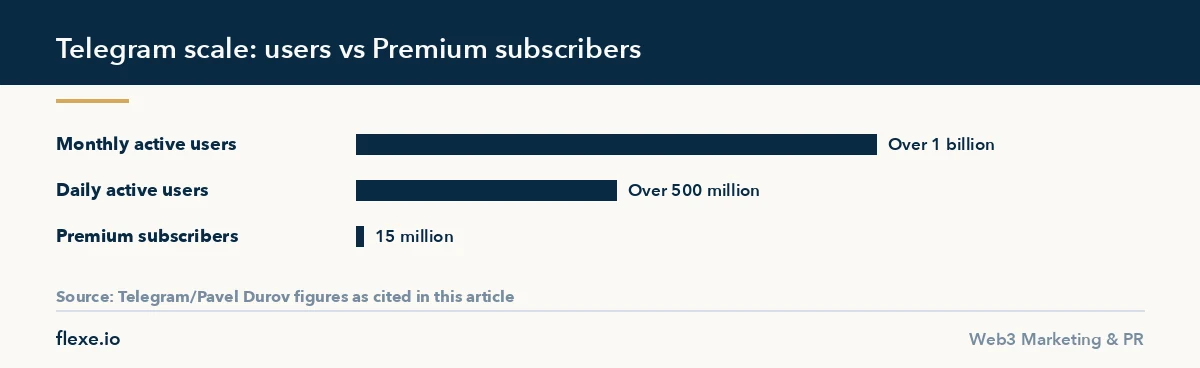
The Scale, and What It Actually Means
| Figure | Value | Source |
|---|---|---|
| Monthly active users | Over 1 billion | Announced by Pavel Durov, March 2025 |
| Daily active users | Over 500 million | Telegram |
| Premium subscribers | 15 million | Telegram, May 2025 |
One caveat worth stating plainly: those are platform-wide numbers. Telegram does not publish how many of its users are crypto holders, and any agency quoting a precise crypto-only figure is guessing. What can be measured is a specific channel – its view counts, its posting history and whether its audience behaves like a real one.
Why Telegram Changed for Crypto in 2026
On 21 July 2026 Telegram announced a native, non-custodial wallet rolling out across all versions of the app, aimed at its full user base. That collapses the distance between seeing a project and holding it: no separate app, no extension, no seed-phrase detour in the middle of the funnel.
For a launch this matters more than reach does. A placement on a channel whose readers already have a funded wallet in the same app converts on a different curve than one that asks people to go install something first.
How Channels Are Chosen
Subscriber counts are the easiest number on Telegram to buy and the least useful to read. Selection runs on views instead:
- View-to-subscriber ratio. A channel with 200,000 subscribers averaging 3,000 views per post is a bought list. The ratio, tracked across recent posts, exposes it immediately.
- Posting history. Channels that ran fifteen promotions in a month have trained their readers to scroll past promotions.
- Comment behaviour. Real communities argue. Purchased ones post emojis.
- Audience overlap. Buying five channels that share most of their readers means paying five times for one audience.
What Is Measured
Views are reported by Telegram natively, so they are hard to dispute. What is worth agreeing on before a campaign is which number decides whether it worked:
| Metric | Why it is used |
|---|---|
| Views per post | The only figure Telegram reports itself |
| Joins to your own channel | Attributable per placement with a unique invite link |
| Retention after 7 days | Separates a spike from an audience |
| Wallet connections | The only metric that reflects intent rather than attention |
Retention is the one to insist on. A placement can deliver a large join count and lose most of it within a week, and only the second measurement tells you which happened.
If you are choosing between platforms rather than committing to this one, crypto influencer marketing compares them on measured reach and engagement rather than follower counts.
How Telegram Crypto Channel Advertising Is Bought
The sequence is fixed: shortlist, verification, rate negotiation, written booking order, creative, publication, proof of publication, report. A channel owner’s published rate card is an opening position rather than a price, and on most channels the gap between the card and the agreed figure is meaningful once verified view history is on the table. Nothing is paid before the booking order names a channel, a slot and a date.
Telegram crypto channel advertising has one structural weakness a buyer has to work around: the seller controls the inventory, the statistics and the proof. Every step below exists to move at least one of those three out of the seller’s hands before money changes them.
Verifying A Channel Beyond The Ratio
Three independent checks run on every channel before it is bought, and they are deliberately built on different evidence so that they can disagree. A seller who has inflated one signal rarely remembers to inflate all of them in the same pattern.
- Growth shape. Audiences built by events grow in steps. Audiences bought in bulk grow as straight lines on unremarkable days, and staggered delivery flattens the line without changing its character.
- First hour view curve. Genuine reading follows time zones and trails for a day or more. Delivered views land in a block and then stop, which is visible on any recent post without asking the owner for anything.
- Forward trail. Telegram shows where a post travelled. Heavy reading with no onward forwarding describes an audience that consumes and passes nothing along.
- Operator overlap. One desk running twenty handles will sell them as twenty placements. Identical posting minutes, shared comment accounts and matching promotion calendars give it away.
- Price against peers. A rate far below comparable channels with similar verified views is usually a channel that knows what its views are worth.
Failing one check is a note on the shortlist, not an automatic exclusion, and the note travels with the channel to the buyer. Failing two ends the conversation, because at that point the cheapest outcome is to spend the money somewhere the numbers agree with each other.
What The Buyer Has To Supply
Placements are booked against slots that are held for hours rather than days, so the material has to be ready before the slot is confirmed rather than after.
- A final destination link with its tracking parameters already decided. Changing a link after publication means paying for an edit or losing the placement outright.
- Post creative: one image or a short vertical video, plus a caption under roughly 90 words. Longer copy gets trimmed by the owner or skipped by the reader, and neither outcome is under your control.
- One named approver who can sign off inside the booking window, with a deputy. Approval that waits for a Monday meeting loses Friday’s slot.
- The date and hour you want, and the dates the post must not fall on, including any embargo you are bound by.
- A destination that is already live and staffed during the hours the post runs, whether that is a channel, a landing page or a sale form.
A launch date is worth stating even when it is provisional. Across 150 measured campaigns, having a clear launch date moves median net ROI from 1.4x to 3.1x, which is a larger swing than any channel selection decision produces on its own.
Booking Orders, Slots And Exclusivity
Every placement is confirmed in writing before payment, and the document is short on purpose. It names the channel handle, the format, the publication time in UTC, how long the post stays pinned or unedited in feed, the agreed price, and what happens if the owner misses the slot or deletes the post early. Reschedule and refund terms are the clauses that matter, because a missed slot on launch week is the expensive failure.
Exclusivity is bought separately. An owner who agrees to publish no competing project for 24 or 48 hours on either side of your post is selling the absence of neighbours, and on a busy launch week that absence is often worth more than a second placement elsewhere. Owners who refuse an exclusivity clause are not necessarily a problem, but the shortlist should say which ones did, so the calendar can be arranged around them.
Formats, Pinning And Flight Length
Format changes the price more than reach does, and the pin is where buyers overspend most often.
- Single post, left in feed. The cleanest unit to compare between channels and the right shape for a first purchase in an unfamiliar channel.
- Pinned for a set number of hours. Worth the premium on a channel that posts many times a day, wasteful on a channel that posts twice, where the pin simply shows the same readers the same message again.
- Post with comments open. Higher engagement and a real moderation cost, since an unanswered hostile thread under a paid post is read as an answer.
- Flight of two or four posts. Spread across a fortnight in one channel, tied to a date, with the last touch closest to it.
- Mini app inventory. Bought on its own terms inside Telegram mini apps and judged on opens and retained users rather than on feed views.
Prices, Reporting And Failure Modes
Media spend is paid by the client directly to the channel or its representative. The agency does not take a percentage of ad spend, which means advice to buy fewer placements costs nothing to give. A focused single-channel campaign starts from $4,000, and a full stack launch combining channels, KOL posts and mini app inventory runs from $50K to $500K over three to six months.
What Sets A Placement Rate
- Verified views, not subscriber count, as the basis for every negotiation.
- Pin duration and flight length, priced on top of the base slot.
- Exclusivity windows, priced by the hour of silence on either side.
- Calendar pressure. Rates rise around large listings and market runs and soften in quiet weeks, so booking three weeks out rather than three days out is the cheapest saving available.
- Edit rights. Copy approval and a revision round costs more with owners accustomed to writing their own wording.
- Payment terms. First purchases from an unfamiliar buyer are often priced above repeat business, and that premium falls after one clean transaction.
Proof Of Publication And Reporting
Proof is collected on the day, because a screenshot reconstructed a week later proves only that a post existed at some point.
- A dated screenshot and a direct message link for every published post.
- Telegram’s own view counter recorded at 1 hour, 24 hours and 7 days per placement.
- A unique invite link per channel, so joins are attributable to the placement that produced them rather than to the week.
- Landing arrivals split by tracking parameter, matched against the invite link figures.
- Cost per thousand verified views per channel, and the raw export behind every table so the arithmetic can be repeated without us.
Deciding Whether The Buy Worked
The decision rule is agreed before publication, not chosen afterwards from whichever figure looks best. Our first-party benchmark across 150 campaigns is a median net ROI of 2.8x within 90 days, spread from 1.4x to 7.0x, with a disclosed failure rate of 12 percent. The spread matters more than the median: a campaign landing at 1.5x is inside normal, and a plan that only works at 7x is a plan built on the tail of a distribution.
This is also why guaranteed view counts are not sold here. On a Reddit trending campaign the observed outcome ranged from roughly 10 views to 150,000, and a number that unstable cannot be promised by anyone being straight with you. A verified view history, a named slot and a published post can be committed to. A result cannot.
How A Buy Goes Wrong
Most of the money lost in telegram crypto channel advertising is lost in the same five ways, and four of them are decided before the post is published rather than by the channel itself.
- The budget is split across too many channels. Thin spreading correlates with a 34 percent failure rate in our own data, because overlapping audiences mean the tenth placement often reaches people the second one already did.
- The buy is made without a date, so the attention it produces has nowhere to go and decays inside a week.
- Creative arrives late and the owner publishes something written in a hurry, in a slot that was paid for at a premium.
- A competing project publishes in the same channel the same day because exclusivity was not bought.
- Only views are reported, which flatters every campaign and distinguishes none of them.
When Not To Buy A Placement
Placement buying is the wrong purchase for a project with nothing at the other end of the link, for one that needs a guaranteed number, and for one whose total budget is below the point where a single credible channel can be afforded. It is also wrong immediately after a failed launch, when the cheaper move is to fix the destination first and buy attention second. Promotion of a project inside Telegram more broadly, including community work and owned channel growth, is covered under Telegram KOL promotion, and keeping arrivals engaged after they land is covered under Telegram and Discord activity.
Comparing providers first? See our ranking of crypto Telegram marketing agencies with published prices and services.
Frequently Asked Questions
How many channels does a campaign need?
Fewer than most projects expect. Overlap between large crypto channels is heavy, so a handful of well-chosen placements usually reaches more distinct people than twenty cheap ones. We would rather book four channels whose audiences barely intersect, and show you the overlap we found, than sell a volume package that counts the same readers five times.
Are posts marked as advertising?
On most reputable channels, yes, and that is the correct outcome. Unmarked promotion is what trains an audience to distrust a channel, which destroys the thing you are paying for. Channels that offer to hide the label are usually the same ones whose view counts do not survive checking, so they come off the shortlist.
Can you guarantee views?
No. You get a range based on the channel’s recent post history, and that is the most anyone can honestly offer. A precise guaranteed number would mean the views are being manufactured, which is why we do not sell guaranteed volume here. If a post underperforms its range, the report says so rather than quietly averaging it away.
How current are these figures?
Platform figures are Telegram’s own published announcements, dated in the table above. Channel-level figures are pulled at the time a shortlist is built, because they move week to week. A number quoted to you in March is not one we would stand behind in June, so we refresh it rather than reuse it.
Tell Us What You Are Launching
Send the token, the chain and the date. You get back a shortlist with view history and an indicative reach range, and nothing is committed until you approve the channels.