Paid telegram and discord activity puts real people into your chat under a written brief, so arriving traffic finds a room with conversation in it, and one room for a month starts at $4,000. Telegram alone reaches roughly a billion users, which is why an empty channel is so visible there. What the service is not is a community, and nobody should buy it as one.
An empty channel is worse than no channel. A visitor who opens your Telegram, sees the last message was four days ago and it was an announcement nobody replied to, has learned something about the project that no amount of marketing undoes.
What telegram and discord activity is
Sustained conversation in your Telegram or Discord: questions asked and answered, discussion of announcements, reactions to news. The chat stays alive, so a newcomer arriving from an ad, a KOL post or an exchange page sees a room with people in it.
Being straight about what this is: it seeds the conversation. It does not manufacture holders, and anyone promising that is describing something else.
When It Is Worth Doing
| Situation | Verdict |
|---|---|
| Traffic is arriving but the chat is silent | Yes – you are paying for visitors who bounce off an empty room |
| Ahead of a listing or launch | Yes – exchanges and newcomers both look |
| No traffic at all yet | No – activity with no audience to see it is spending for nothing |
| Real community already talking | No – moderation is what you need instead |
What It Does Not Replace
Activity fills a room; it does not answer a holder asking why the price dropped. That is community management, and it is the thing that actually keeps people. Building the audience in the first place is community growth.
How the work runs
- Read the room first. We look at what the channel already sounds like, so the conversation matches the project instead of reading like a different product.
- A brief on what is off limits. Price talk, promises about returns and anything that could be read as financial advice stay out.
- Daily conversation. Questions asked and answered, reaction to announcements, discussion of news in the sector.
- Handover to your team. Anything factual about the product goes to you rather than being guessed at in public.
- Weekly report. Messages, participants, and which topics drew replies from real members.
What changes the cost
| Factor | Effect |
|---|---|
| One channel or several | Telegram plus Discord is two rooms with different rhythms, not one job |
| Hours covered | A channel that looks alive across time zones costs more than one alive for eight hours |
| Language | A second language means a second set of people, not a translation |
| Topic depth | General chat is cheaper than conversation that engages with your technology |
| Duration | A launch window of two weeks prices differently from a standing arrangement |
What to measure, and the honest ceiling
Watch the share of messages that come from people who are not on the brief. That is the only number that tells you whether the room started running on its own. Also watch what happens in the week after the campaign stops, because that is the real result.
The ceiling is worth stating. Activity fills a room so that arriving traffic does not bounce off silence. It does not create holders, and it does not answer a member asking why the price fell. If you already have people talking, what you need is crypto community management instead.
Who the people posting are
Every account that enters a campaign is screened for bought engagement through three independent checks before it posts anything. An account with purchased followers or a rented history behaves differently in a group chat, and other members notice it faster than you will. Accounts that fail any of the three are dropped rather than cleaned up and reused.
Behind the accounts are writers who follow the sector, not a shift of people reading a script. One writer carries a small number of rooms so they remember what was said last week and can pick a thread back up without contradicting it. They read your documentation before the first message and work from a written brief that sets out what the project does, what it never claims, what is still unannounced, and which questions go straight to your team instead of being answered in public.
Nothing about this is automated. Bot chatter is recognisable within a few scrolls, and a member who spots it stops trusting everything else in the room, including the announcements that are real.
What you send us first
The brief is only as useful as the material behind it. A campaign that starts without the items below spends its first fortnight sounding like a generic crypto chat instead of like your project, and that fortnight is paid for at the same rate as the rest.
- Product documentation, the public roadmap, and a note on the parts that are deliberately not public yet.
- A written list of forbidden claims: price, returns, listings that are not signed, partnerships that are not announced.
- The real answers to the twenty questions your team is already tired of answering, in writing, once.
- A calendar of announcements, so a release is discussed the hour it lands rather than three days later.
- One named person who answers factual questions, plus the response time you can honestly promise.
- A moderator contact with the ban button, so a spam wave is handled by someone who can actually handle it.
What is posted and what is not
The posted material is ordinary chat with a purpose: questions about how the product works, follow-ups when an answer is thin, reactions to your announcements, comparisons with what else exists in the category, and discussion of sector news that touches your project. Where a question has a documented answer, the answer is quoted from your own material rather than improvised.
The permanent no list is shorter and it does not move. No price talk, no targets, no predictions. No promises about returns. No hinting at listings, partnerships or funding that you have not published. No attacks on competitors, in your room or anyone else’s. No direct messages to members, ever, because every scam in this sector starts with one. No invented personal stories about profits made, and no claim to be an employee, a holder or an auditor.
If a brief asks for any of that, the campaign does not start. It is a short conversation and we would rather have it before an invoice than after a screenshot.
Moderation and escalation in practice
Activity and moderation are separate jobs, but the people posting are in the room when things go wrong, so there are rules for the overlap. A hostile but fair question gets a straight answer or an honest we do not know yet. A factual question with no documented answer goes to your named contact and is answered in the room once you reply, with your words rather than a guess.
Three things get escalated immediately rather than answered: anything touching security, such as a member reporting a drained wallet or a fake contract address being circulated; anything legal or regulatory; and any accusation about the team that the room cannot resolve on its own. Scam links and impersonation accounts are reported to your moderators the moment they appear, with the message link, because removing them needs the button we do not hold.
Coordinated attacks are the one case where the honest advice is to slow down. A room under an organised raid does not need more conversation in it; it needs slow mode, your moderators awake, and a statement from the team. We say so rather than posting into the noise.
How the invoice is built
The billing unit is a room for a month, not a message. Per message pricing pushes both sides in the wrong direction: it rewards volume in a place where volume is exactly what makes a chat look fake. A month of telegram and discord activity covers the brief, the writers, the coverage hours agreed, escalation handling and the weekly report.
A focused single channel campaign starts at $4,000. That figure buys one room, one language and coverage across the hours where your audience actually is, for long enough to see whether the room holds. A launch programme that runs several channels alongside other work sits in the $50K to $500K band across three to six months, and at that size the activity is one line in a larger plan rather than the plan itself.
What we do not sell at any price is a guaranteed number. Not guaranteed members, not guaranteed messages from real people, not guaranteed daily trading volume, because manufactured volume is wash trading and exchanges delist for it. The only honest guarantee is the input: agreed coverage, agreed rules, a log you can read.
What lands in your inbox weekly
The weekly report is built to be argued with rather than admired. It carries message volume by room and by day, the share of messages written by people who are not on the brief, the topics that drew those unprompted replies, the questions escalated to your team with the time each one waited for an answer, and a list of anything that was asked and never got a usable answer from anyone.
The last item is the one worth reading. A recurring unanswered question is a hole in your documentation, and it costs nothing to fix once you can see it. Alongside the report there is a running log of escalations and incidents, sent as they happen rather than collected for the end of the month, because a fake contract address in your chat is not a monthly summary item.
What the wider campaign data shows
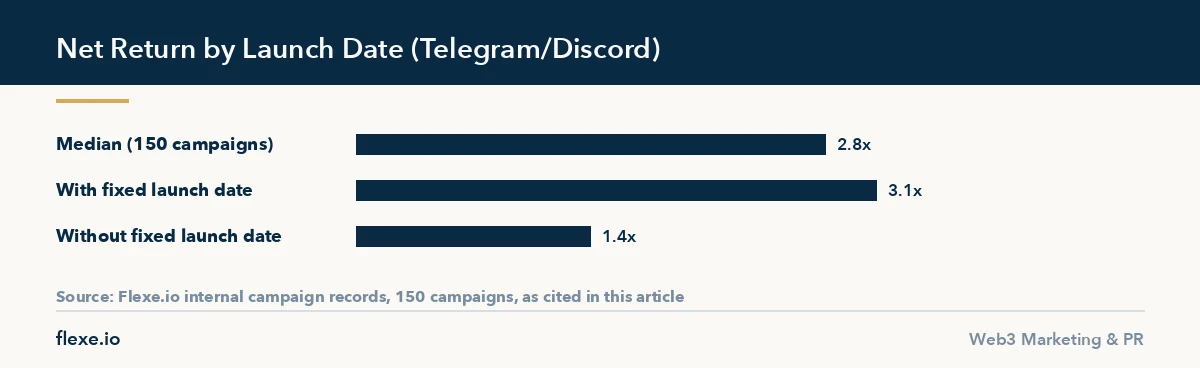
Across more than 800 campaigns since 2018 there is a first party benchmark worth setting against your own expectations. On 150 campaigns the median net return was 2.8x within 90 days, with a range from 1.4x to 7.0x and a disclosed failure rate of 12 percent. Activity in a chat is one contributor inside those numbers, never the whole of them.
Two patterns in that data apply directly here. A campaign with a fixed public launch date moves the median from 1.4x to 3.1x, because a room with something to discuss behaves differently from a room waiting for news. And budgets spread across too many channels at once correlate with a 34 percent failure rate, which is the arithmetic case for funding one chat properly instead of half funding four.
We also publish the awkward side of measurement. On a Reddit trending campaign the observed spread ran from about 10 views to 150,000 on comparable work. Paid attention is not a dial with a number on it, and anyone quoting one is quoting a sales figure rather than an observation.
How these campaigns fail
The most common failure is silence on your side. Questions get escalated, nobody answers for four days, and the room learns that the team is not there. No amount of conversation covers that, and after a fortnight of it the activity starts working against you by drawing more people to a place where nothing gets answered.
The second is buying activity with no traffic arriving. A busy room that nobody visits is a private performance. The third is scale mismatch: a handful of conversations dropped into a group of forty thousand disappears, while the same volume in a group of four hundred reads as a takeover. The fourth is stopping on the day of a listing, which is the one week the room is most likely to be read by strangers.
The last one is quieter. Some teams start treating the activity as the community, stop hiring a community manager, and stop reading the chat themselves. The room then holds together exactly as long as the invoice does, and the week after it stops is the week the truth shows up.
Who should not buy this
If you have no product to discuss and no date for one, a conversation about nothing is not worth paying for. If you want holders, members or price movement guaranteed, telegram and discord activity is the wrong service and probably the wrong agency. If you already have members talking to each other, what you need is crypto community management rather than more conversation poured on top.
If nobody on your side can answer a technical question within a working day, fix that before buying a room that will generate those questions faster. And if your budget only stretches to one thing, the order that usually works is traffic first, then somewhere alive for it to land, which is why paid Telegram promotion and this service are normally bought together rather than one instead of the other.
Frequently Asked Questions
Is this bots?
No. Bot chatter is obvious to anyone reading and it damages the thing you are paying to protect. This is people holding a conversation under a written brief, working from your own documentation, with every account screened through three independent checks for bought engagement before it posts anything.
Will it bring holders?
No. It stops arriving traffic from bouncing off an empty room, which is a different job. Whether those people stay depends on the product and on how fast their questions get answered by your own team. We sell no guaranteed members, no guaranteed messages from real people and no guaranteed trading volume.
How fast does a channel look alive?
Within days. The room reads as active almost as soon as coverage starts across the hours your audience is awake. What takes longer, and does not always happen, is real members joining the conversation unprompted. The weekly report shows the share of messages written by people who are not on the brief.
Do you moderate as well?
No. Moderation and answering real holders is community management, a separate service. Activity seeds conversation; management keeps people. We do report scam links and impersonation accounts to your moderators the moment they appear, with the message link, because removing them needs a button we do not hold.
When is it a waste of money?
When nobody is arriving yet. Activity with no audience to see it is spending for nothing, so get traffic first and then make sure it lands somewhere alive. It is also wasted if nobody on your side can answer a technical question inside a working day.
Tell Us About Your Channel
Send the channel, its size and where the traffic is coming from. If the honest answer is that activity will not help you yet, we will say so.