Crypto SEO services put your project in front of people already searching for it: a technical audit, keyword and content work, and link acquisition, run by a team with 800+ campaigns behind it since 2018. Buyers arrive with one question, what changes and how soon, and the sections below answer it in order.
Search is slower than paid traffic and far cheaper than it over any horizon longer than a quarter. What follows covers the audit, what your team supplies, the monthly deliverables, the fee, and the cases where we tell a project to spend the budget elsewhere.
What We Offer in Our Crypto SEO Services
With thousands of projects chasing the same queries, search decides whether investors and users who are already looking find your brand or a competitor. The work covers six areas:
- Keyword Optimization: Identifying high-impact keywords and mapping them to the pages that can rank for them.
- On-Page SEO: Rewriting content, metadata and structure so search engines index the page correctly.
- Technical SEO: Site speed, mobile rendering and structured data.
- Link Building: Acquiring high-quality backlinks to increase domain authority.
- Content Marketing: Blog posts, press releases and educational material that answer what buyers type.
- Local and Global SEO: Targeting a single region or international markets.
Additional Digital Marketing Services
Alongside search we run the adjacent channels: Short Videos for Instagram Reels, YouTube Shorts and TikTok (daily short video production), Text and Graphic Posts to keep several social channels active (Explore our SMM service, crypto social media marketing services), and Community Management, moderation and engagement from $2,000 a month (Explore our Community Management service).
Why Choose Flexe.io?
We have run 800+ campaigns since 2018, with SEO specialists, content strategists and blockchain analysts on the same team, and the failure rate is published further down this page rather than only the wins.
Get Started with Crypto SEO Services
Our SEO guide covers the method in full. Send us the domain and the markets you sell into, and we will come back with what we would change first.
👉 Visit Flexe.io
📩 Message us on Telegram
If the placement is still an open question, crypto traffic acquisition sets out every option side by side – explorers, media, ad platforms – with monthly visits and what each platform allows.
What crypto SEO consists of in practice
Search work for a crypto project splits into four jobs that are usually confused with each other. Separating them is what makes the timeline predictable.
- Technical. Crawlability, indexation, duplicate URLs, canonical tags, sitemaps, page speed and structured data. This is the part that produces movement fastest, because it removes obstacles rather than building new authority.
- Content. Pages that answer questions people actually type, written to be usable rather than to hit a keyword density. In crypto this increasingly means procedural and comparison content, because that is what assistants quote.
- Entity and reputation. Whether search engines and AI assistants can identify the project, its team and its product with confidence, and whether what they find agrees with itself across your site, the trackers, the explorers and media coverage.
- Links. Coverage that passes authority. Which placements do and do not is covered in how to tell if a placement passes a followed link.
What is different about crypto
Three things. Queries turn over faster than in most industries, so a page built around this quarter’s narrative decays quickly while evergreen procedural pages hold value. Trust signals matter more, because search engines apply stricter scrutiny to financial topics and a page with unsourced numbers is a liability. And much of the visible answer is now written by assistants summarising sources, which changes what a page must look like to be used at all.
That last point is the one most projects have not adjusted to. Being summarised requires a page that states facts plainly, dates them, sources them and structures them so a machine can lift a section without the surrounding argument collapsing.
How the first ninety days run
The first two weeks are diagnosis and nothing gets published. We crawl the whole site, pull whatever history already exists in Google Search Console and Bing Webmaster Tools, compare indexed pages against the pages that should be, and record every query the site appears for. That record is the baseline every later report is measured against, so it is taken first.
Weeks three to six are repair. Wrong canonical tags, duplicate parameter URLs, pages blocked by a stray directive, templates slow enough to lose a crawl budget, structured data that describes the page incorrectly. This is the cheapest block of work on the list and usually the only block that moves numbers inside a single quarter, because it removes obstacles instead of building authority from zero.
From week seven the work turns to content and to how the project is described elsewhere. New pages are written against queries with buying intent, pages stuck on the second result page are rewritten rather than replaced, and the project’s facts are made to agree across the site, the trackers, the explorers and any media coverage. Search engines treat disagreement between those sources as a reason to trust none.
What your team supplies
The single largest cause of a slow first month is access that arrives late. Everything below is needed in the first few days, not in week three.
- Read access to Search Console, Bing Webmaster Tools and your analytics, granted on day one
- A person who can merge changes to the site, or a staging branch we are allowed to commit to
- A factual brief on the product: what it does, what it does not do, and which claims your legal counsel will not allow
- Contract addresses, exchange listings and audit reports you want cited, each with a date we can attribute
- One reviewer who can approve copy, rather than a committee that returns five conflicting opinions
Where a client cannot provide a reviewer, we write to a narrower brief and publish less. That is a real cost and it shows up as fewer pages per month, so it is worth solving before the engagement starts.
What arrives every month
A report is a document you keep, not a slide deck read out on a call. The contents are fixed so that two reports six months apart can be put side by side.
- A change log listing every technical fix, every page published and every page edited, with dates and URLs
- Indexation status of the pages we touched, read from Google and Bing directly rather than from a third party estimate
- Query, position and click movement against the week one baseline, with the queries that are new since the last report marked
- A plain note on what did not work, why we think it did not, and what replaces it in the coming month
Reports land in the first week of the month and cover the month that closed, not a rolling thirty days, so the numbers in two consecutive reports can be added together without double counting. Where a month produced nothing worth reporting, that is what the report says.
Everything written during the engagement belongs to the client, including the audit, the keyword map and the drafts that were never published. Nothing is held back as a retention device.
How the fee is set
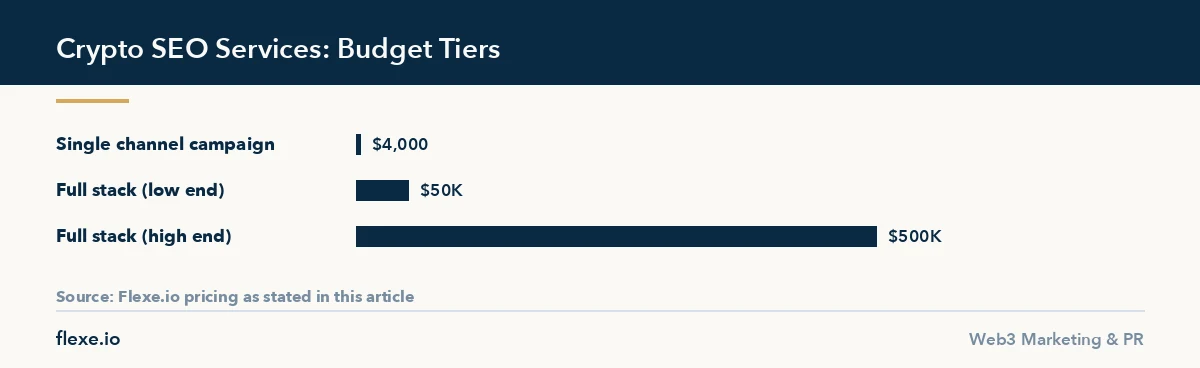
Pricing follows scope rather than a headline rate. A focused campaign on a single channel starts at $4,000. A full stack launch programme, where search runs alongside PR, KOL work and paid traffic, sits between $50K and $500K across three to six months. Search on its own falls between those poles and is quoted after the diagnosis, which tells us whether the job is two months of repair or a year of building pages from almost nothing.
We have run more than 800 campaigns since 2018, which is enough history to price a job from what similar sites needed rather than from a guess. It is not enough to price one before looking at the site.
What moves the quote
- Site size and platform. A forty page marketing site is a different job from a documentation portal that generates four thousand URLs on its own.
- Language count. Every additional language multiplies the writing, then adds hreflang and duplicate content problems that did not exist before.
- Who writes. Engagements where we review your drafts cost less per month and produce fewer published pages.
- Query difficulty. Ranking for a long tail procedural question and ranking for a two word commercial term are different budgets and different timelines.
A quote that ignores those four variables is a quote for an average project, and there is no average project in this industry.
How results are checked
Four numbers, in this order: how many of the pages we touched are indexed, how many distinct queries the site appears for, clicks from those queries, and what those clicks did after landing. The first two move first and the last two move last, which is why a report at week six that shows only indexation gains is a report going according to plan.
Our own first party benchmark across 150 campaigns is a median net return of 2.8x inside 90 days, with a range from 1.4x to 7.0x and a disclosed failure rate of 12 percent. We publish the failure rate because a benchmark without one is marketing. A campaign tied to a clear launch date moves the median from 1.4x to 3.1x, the strongest argument for fixing the date before work starts.
Google and Bing are not one channel
Our own site ranks second in Bing for its fintech marketing guide while sitting between position 73 and 86 in Google for that same page. Same content, same domain, same day. Treating one engine as a proxy for the other produces reports that look like failure or like success depending only on which one was opened.
Bing also feeds a share of assistant answers, so a page that is invisible in Google can still be quoted back to a user who never touched a search box. Both engines are reported separately for that reason, and neither number is presented as the headline on its own.
Where this work goes wrong
- The site changes without warning. A redesign shipped on a Friday can undo a quarter of technical work before Monday.
- Approval stalls. Pages that wait six weeks for sign off push every downstream result back by exactly six weeks.
- There is no demand yet. A product category nobody searches for cannot be found by people searching, and no budget creates the queries.
- Links are bought in parallel elsewhere. The profile fills with domains that later have to go into a disavow file, and the cleanup costs more than the links did.
Three of those four are client side, which is not a complaint. It is the reason the monthly report names the blocker rather than averaging it away.
Who should not buy this
Projects that need traffic for an event six weeks out. Search will not arrive in time and paid channels will. Projects that will not publish anything beyond a product page, because there is nothing to rank. Projects that want a named position for a named keyword written into a contract, since nobody controls that and a firm willing to sign it is telling you what its reporting will look like.
If a launch is close, the honest sequence is paid traffic and PR now, search started in parallel so that it is working by the time the paid budget stops. How those channels sit together is set out on our crypto PR page, and the package options are listed under ready made press release packages.
Timelines: weeks for indexation, months for new content to settle
Technical fixes show up in indexation within weeks. New content on an established domain takes a couple of months to settle. A new domain competing for commercial queries takes considerably longer, and no amount of spend compresses that into a launch window.
If the requirement is traffic during a launch that is six weeks away, search is the wrong instrument and paid channels are the right one. We will say that rather than sell a retainer against a date it cannot meet.
What we do not promise
Positions for a named keyword by a named date, a fixed number of links per month regardless of what is worth having, or removal of a competitor from a result. Anyone promising the first is describing an outcome they do not control, and the second is how link profiles acquire the domains you later have to disavow.
How work is reported
A baseline at the start, then monthly: what changed on the site, which pages moved, which queries the site now appears for that it did not before, and what is planned next. Where a change did not work, it is reported as a change that did not work.
Search is one channel among several and rarely the fastest. Where it fits alongside PR, KOLs and paid traffic is set out on our crypto traffic acquisition page. SEO scope and terms are available on request.
Frequently Asked Questions
How long do crypto SEO services take to work?
Indexation moves in weeks, rankings in months. Technical fixes and metadata show up in Bing and Google within two to four weeks, while new content needs one to two quarters before its position settles. Anything promising a top spot in thirty days is counting a query nobody searches.
How much do crypto SEO services cost?
A focused single-channel campaign starts at about $4,000, and a full-stack launch across PR, KOL, paid media, community and content runs $50K to $500K over three to six months. The quote moves with the number of pages we rewrite and the technical state of the site.
Do you guarantee first page rankings?
No, and nobody honest does. We commit to the work and to a measured baseline, not to a position, because the result depends on the product, the competition for that query and how fast your team ships changes. In our own benchmark of 150 campaigns, 12 percent did not pay back, and we report that when it happens.
Can you rank a project that has just launched?
Yes, on long-tail queries first. A new domain has no history, so early wins come from low-competition questions your product answers precisely, and head terms follow once there is content and a link profile behind them. Expect two quarters before the comparison means anything.
Who writes the content, you or our team?
We write it and your team checks the technical claims. Draft, review, correction, publication is the loop, and review is where most projects lose time. If your engineers cannot answer protocol questions within a week, the content calendar slips by the same amount.