Crypto landing page design from Flexe is one page built backwards from a single conversion goal, delivered with the wallet flow, ad compliance and event tracking wired in. Flexe has built these inside more than 800 campaigns since 2018. The work starts with two answers, where the visitor comes from and what counts as success, and everything after that, the look of the page included, is decided by those two. Below is the build schedule with real timing, what you supply, what a revision round covers, what arrives at handover, how the quote is built and when a page is the wrong thing to buy.
A landing page is not a small website. It has one job, one measurable outcome, and no navigation offering the visitor somewhere else to go.
One Goal Per Page
The most common mistake is a page that asks for four things at once: join Telegram, read the white paper, follow on X, and connect a wallet. Every additional option lowers the completion rate of the one that mattered.
| Campaign | The single goal |
|---|---|
| Presale or launch | Wallet connected |
| Paid traffic | Email or Telegram join, then nothing else |
| Listing announcement | Click through to the exchange |
| Fintech and licensed products | Application started |
Where Crypto Pages Lose People
The wallet step. This is where the funnel breaks, and no amount of design above it compensates. What helps is stating what happens before it happens: which network, what will be signed, and whether anything is spent.
Ad platform compliance. A page built without reading the rules gets the whole ad account rejected, not just the page. If the traffic is coming from Google or Meta, the copy has to be written against their policy from the start – see crypto traffic.
Mobile. Most crypto traffic arrives from a phone, often from a Telegram in-app browser, which behaves differently from Safari or Chrome. A page that is only tested on a laptop will look fine and convert badly.
What You Get
- Design and build, mobile first
- Copy written for the campaign, not a translated brochure
- Analytics and event tracking wired in before launch, so the result is measurable on day one
- A second variant when the traffic volume justifies a test
The crypto landing page design process
- Goal and traffic source fixed first. The page is built backwards from what counts as success and where the visitor arrives from.
- Copy before design. A layout drawn around finished words is faster than words squeezed into a layout.
- Compliance pass. If the traffic is paid, the copy is written against the platform policy before the build, not corrected after a rejection.
- Build, mobile first. Most crypto traffic arrives from a phone, often inside a Telegram in-app browser.
- Tracking wired before launch. Events, not just pageviews, so day one is measurable rather than reconstructed later.
What changes the cost
| Factor | Effect |
|---|---|
| Wallet connection | A connect flow with network switching and signature prompts is the largest single addition |
| Number of sections | A one-screen capture page and a full launch page are different builds |
| Ad platform compliance | Writing against Google or Meta policy adds a review pass and usually a rewrite |
| Second variant for testing | Worth it only once traffic volume can resolve a difference |
| Languages | Each language is separate copy, not a translation layer |
Budgets across our services start from $4,000. A landing page is quoted on the brief, and a wallet flow is what moves the number most.
What to measure
One completion rate, for the one goal. Then the step where people leave, which in crypto is almost always the wallet connection. Everything above that step can be beautiful and it will not compensate.
Sessions from a phone should be looked at separately from desktop, and in-app browser sessions separately again, because a page that behaves correctly in Chrome can break inside Telegram and the average hides it.
The page is only as good as what arrives at it. Choosing and buying that traffic is crypto traffic acquisition, and the two decisions are made together or not at all.
The build schedule week by week
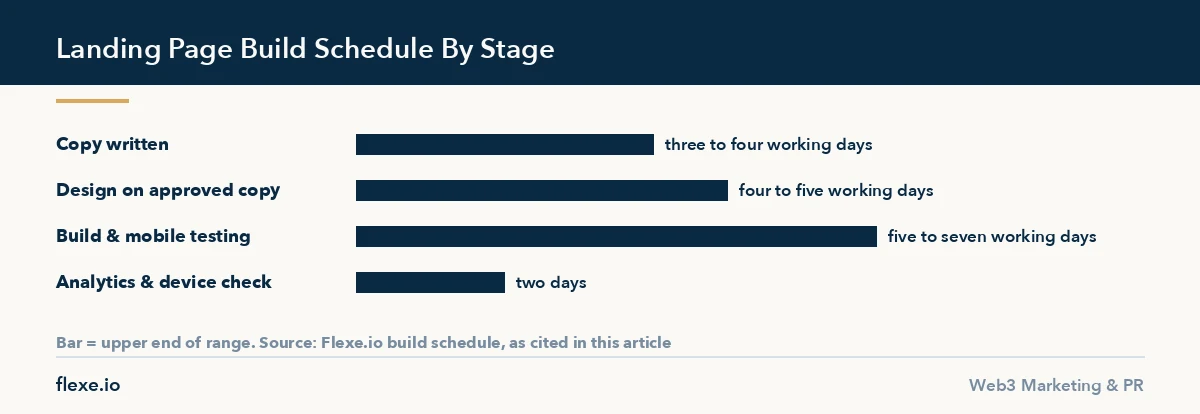
A single language page with a form, no wallet connection and copy written from scratch runs about two to three weeks. Goal and traffic source are fixed on the first call. Copy takes three to four working days. Design drawn on approved copy is four to five days. Build and mobile testing are five to seven days. Tracking, event setup and a live check on real devices add two days. A wallet connect flow with network switching adds roughly a week of build and testing on its own, and that week is the one projects forget to plan for.
- Goal, traffic source and success metric agreed: one call in the first week
- Copy written against the campaign: three to four working days
- Design on approved copy: four to five working days
- Build and mobile testing, including an in-app browser: five to seven working days
- Analytics, events and a device check before launch: two days
- Wallet connect flow, where there is one: about a week more
Two weeks is possible when the copy already exists and is approved, the brand files are ready, and there is no paid compliance pass. It is not possible with a wallet flow, because the testing is the work: every network, every wallet, every rejection path, and the in-app browser that behaves unlike anything on a desktop. Naming that week openly beats discovering it on launch day.
What you supply before the build
Six items, and five of them are usually available on day one.
- Where the traffic comes from, and whether it is paid, which decides the compliance pass
- What counts as success, written as one measurable action
- Hosting and domain access, or a decision to host the page with us
- Brand files in vector, fonts with licences that cover web use, and any style guide
- Contract addresses, network details and the exact wallet flow, when the page connects one
- Analytics accounts, ad pixels and the person who can grant access to them
Access is the quiet delay. A page finished on Friday can sit unlaunched until Wednesday because nobody with domain or analytics rights is reachable, and that wait still occupies the calendar even though no work is happening.
The sixth item, analytics access, is the one worth chasing first. Tracking added after launch cannot recover the opening days of traffic, and those are usually the most expensive days you will ever buy for that page.
What counts as a revision round
Two rounds are included: one on copy and layout before the build, one on the built page. A round is a single consolidated set of comments carrying the change and the reason behind it, not a running conversation across a week.
Inside a round: wording, section order, colour and spacing, image swaps, form field changes, and anything behaving incorrectly on a device we listed. New scope, quoted first: a new goal for the page, added sections, a second language, a wallet flow that was not in the brief, a design restart after the layout was approved, and rebuilding on a platform different from the one agreed. Anything that behaves differently from the agreed brief is a fix, not a revision, and it is never counted against your rounds.
Rounds get cheaper the earlier they happen, and the copy round is the one projects underuse. Changing a headline in a text document takes a minute. Changing it after design means the section is redrawn, and after build it means the section is rebuilt and retested on every device in the list. Same sentence, three different prices.
Access, files and handover
The page is yours, and the handover is built so you can run it without calling us for a headline change.
- The live page on your hosting, or on ours with a monthly line if you prefer
- Full source files and, where relevant, admin access with an owner account in your name
- Design source with editable components, so copy changes do not need a designer
- Analytics and event tracking documented: what each event fires on and where it lands
- A one page note on editing copy without breaking the tracking
Nothing is held in an account we control, and no licence stops working if you stop working with us. If we host the page, handover is a file transfer and a DNS change rather than a rebuild.
The tracking plan is handed over in the same document as the page, because the two rot apart otherwise. A section added by your team six months later with no event attached becomes a blind spot, and blind spots in a funnel are how a page quietly stops earning without anyone being able to name the week it changed.
How the quote is built
Budgets across our services start from $4,000 for focused single-channel work. Crypto landing page design is quoted on the brief as a fixed fee against a written scope: number of sections, languages, whether there is a wallet flow, whether a second variant is built, and the included rounds. Half at design approval, half at launch.
Outside the fee: paid media, hosting after the first period, content updates after launch, and the compliance rewrite if you change ad platform once the page is already built. Most projects need one update inside the first month, because the first week of real traffic shows something no mockup could.
Where builds go wrong
The failures repeat across projects, and none of them are visual.
- The traffic source decided after the page exists, so the copy argues with the ad that brought people in
- A wallet flow added late, which is a week of build and the exact step where the funnel breaks
- Approval by committee, where each reviewer adds a section until the single goal has quietly become four
- No tracking at launch, so the first week of expensive traffic teaches nothing
- Budget split across several pages at once, a pattern that correlates with a 34 percent failure rate in our own data
A fixed launch date is the cheapest correction available. In our benchmark across 150 campaigns, a clear launch date moves the median net return from 1.4x to 3.1x, largely because the page, the ads and the announcement stop being rewritten for each other.
One failure looks like success: a high completion rate on tiny traffic. Fifty visits and nine sign-ups is not an 18 percent conversion rate, it is nine people. Judging a page before it has seen a few hundred sessions from the real source leads to rewriting the thing that was working and keeping the thing that was not.
Who should not order a page
If there is no traffic budget, a page converts nothing, because a page is a floor rather than a door. If the offer is still changing weekly, the copy gets rewritten weekly at your cost. If what you actually need is a documentation site, a blog or a full product marketing site, a one goal page is the wrong shape and an ordinary site serves better.
We also state what a page cannot do. Crypto landing page design cannot rescue traffic arriving with the wrong intent, it cannot make an ad account compliant after a rejection, and it cannot manufacture trading volume or guaranteed indexation of an announcement in Google. Those are not design problems.
There is a size answer as well. If you need eight pages for eight campaigns, one build is the wrong purchase; what you need is a template with a component set, which is a different job at a different quote. We say so rather than selling the same page eight times.
How the page fits the budget
More than 800 campaigns since 2018 sit behind the way we quote this. Our first-party benchmark across 150 campaigns shows a median net return of 2.8x within 90 days, a range of 1.4x to 7.0x, and a failure rate of 12 percent that we disclose. Pages live inside those campaigns rather than beside them, which is why the question about traffic comes before any question about design.
The rest of what we run sits next to that number: a PR inventory of more than 790 outlets, 249 of them above Majestic Trust Flow 30, and an active roster of 85 verified X accounts, drawn from 11,859 X KOLs, with 8.7 million combined reach and 1.74 percent average engagement. A page is where all of that lands. Building the page carefully and pointing nothing at it is the most reliable way to waste both halves of a budget.
A full launch with paid distribution behind it runs $50K to $500K over three to six months, while a single page with one channel pointed at it starts near the lower end of the range. The page and the traffic are one decision, and crypto traffic acquisition is where the other half of that decision gets made.
Frequently Asked Questions
Why one goal per page?
Because every extra option lowers completion of the one that mattered. Join Telegram, read the paper, follow on X and connect a wallet on the same screen is four ways to not do any of them.
Can you use our existing site?
Usually not, and that is the point. A landing page has no navigation offering the visitor somewhere else to go, which is exactly what a site is built to do. We can match your existing branding exactly, so the page still looks like yours, but it lives on its own URL with its own tracking.
What breaks conversion in crypto specifically?
The wallet step. What helps is stating what happens before it happens: which network, what will be signed, and whether anything is spent. Visitors who have been drained once read every connect button as a risk, and a page that explains the transaction in plain words converts better than one that only looks more polished.
Do we need an A/B test?
Only when the traffic can resolve a difference. Below a few thousand visits per variant a test tells you nothing, delays the launch and invites a decision based on noise. We would rather fix the wallet step and the first screen, then test once the paid traffic is actually running at volume.
What do you need to start?
Where the traffic comes from and what counts as success. Everything else follows from those two answers, including the copy, the layout and how many screens the page needs. Brand assets, the contract address and any legal wording your jurisdiction requires all help, but none of them blocks the start.
Tell Us About the Campaign
Send where the traffic comes from and what counts as success. The page gets built backwards from that.