Crypto YouTube influencer marketing services from Flexe.io place your product in long-form video on channels verified before any money moves, starting at $4,000 for one focused channel. You get a shortlist with median views and quoted fees attached, a written brief and disclosure wording per creator, a dated publication calendar with tracked links, and reports at day 7 and day 30. The page below sets out how that work runs, how the fee is arrived at and when the honest answer is that the campaign should not run yet.
Influencer work in crypto fails in two predictable ways: paying for followers that are not there, and paying real accounts to reach an audience that was never going to care. Both are avoidable, and avoiding them is most of what this service is.
Where to Start
| You need | Start here |
|---|---|
| A campaign on X, run for you | X KOL campaigns – active roster of 85 verified accounts, 8.7M combined reach |
| Accounts in a specific market – India, Asia, Turkey | Influencer lists built to brief – found, vetted and priced in a week |
| Long-form review or explanation | YouTube placements |
| Reach outside the existing crypto audience | TikTok creators |
| Your own account to travel further | X-Engagement Growth – no KOLs involved |
How Accounts Get Verified
Every account we would put your budget behind is cross-checked against three independent services before we recommend it. Each looks at something the others cannot.
| Check | Question it answers |
|---|---|
| Wallchain | Does this account sit inside the real crypto circle, near VCs, funds and active traders? |
| Sorsa | Is the following a genuine community or purchased volume? |
| TwitterScore | How many followers are people who make decisions – VCs, exchanges, other KOLs? |
Accounts that fail any one of the three do not get recommended, regardless of how the follower count looks. You see the scores before you approve anything, so you can disagree with our judgement rather than take it on trust.
What We No Longer Sell
We removed several services because they stopped producing results we could put in a report. Shilling – pushing a project name into other people’s replies – damages the brand it promotes and gets suppressed by the platform. AMA sessions fill with bots and produce an attendance number that means nothing. Neither is coming back.
What replaced the first is X-Engagement Growth, which builds engagement on your own content rather than intruding on someone else’s.
Crypto YouTube Influencer Marketing Services Step by Step
Every campaign runs through the same four stages, and the order matters more than the roster does. The usual way to waste a budget is to skip verification because a channel looked convincing and the launch date was close.
Brief Before Any Names
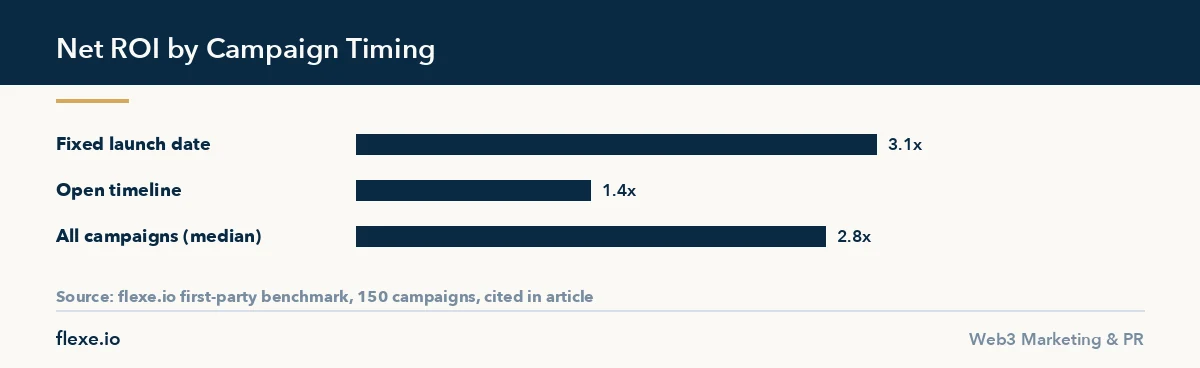
We start with the asset, the market and the date. What is shipping, which countries carry the users you want, whether a listing or a mainnet release is fixed in the calendar, and what an acceptable outcome looks like in numbers you already track. That last question decides more than the channel list. Our own campaign data is blunt about it: campaigns built around a fixed launch date reach 3.1x median net ROI, while campaigns that run on an open timeline sit at 1.4x. If there is no date yet, we will say that waiting is the cheaper option.
Shortlist and Verification
The shortlist is built by hand from channels that already cover the category you are entering, then checked on watched behaviour rather than on subscriber counts. Median views across the last ten uploads, the share of viewers who stay past the first two minutes, whether comments carry questions or only emoji, and whether previous paid placements on that channel were disclosed. The same discipline runs on the X side of a campaign, where our roster of 85 verified accounts holds 8.7M combined reach, 102,199 average followers per account, 12,615 median views per post and a 1.74% average engagement rate, all measured rather than quoted by the accounts themselves. You see the shortlist with the numbers attached and you cut names from it before any money moves.
Brief, Script and Disclosure
Each creator gets a written brief covering what the product does, the two or three claims worth making, the claims that must not be made, and the disclosure wording. Price targets, return figures and urgency framing stay out of every brief we write, both because platforms act on them and because they are the part that later reads badly. Creators keep editorial control over how they say it. We review the script or the rough cut for factual errors, not for tone, and a channel that refuses any review is a channel we drop rather than argue with.
Publication Window and Tracking
Placements are spread across an agreed window rather than dropped on one day, because a single video landing alone produces a spike your product team cannot staff and nothing afterwards. Every placement carries its own tracked link, so traffic, signups and deposits are attributed per channel rather than pooled. YouTube keeps delivering views for weeks, so a placement is read twice: at day 7 for the initial response, and at day 30 for the tail that decides whether the fee was worth paying.
What You Get and What It Costs
Deliverables, price and measurement get settled in the same conversation, because each one decides the others. A budget that cannot cover repeat placements changes the roster, and a roster of small channels changes what the report is able to prove afterwards. Agreeing all three before the first outreach email is what keeps a campaign from being renegotiated halfway through it.
What We Need From You
Four things are needed from your side, and they are needed before outreach rather than after a creator has said yes. A working product or a demo environment someone can film, since nothing damages a review faster than a broken interface on screen. Brand assets, plus the single claim you most want repeated in the creator’s own words. A named person who can approve a script inside one working day, because approval delay is the usual reason a publication date moves. And agreement, in writing, that every placement is disclosed. The rest is ours: sourcing, contracting, payment, tracked links and reporting.
What You Receive and When
The deliverables for crypto YouTube influencer marketing services are fixed before the campaign starts, and they are the same whether the budget is four thousand dollars or four hundred thousand.
- A shortlist with channel, market, subscriber count, median views over the last ten uploads and the quoted fee per placement
- A brief per creator carrying the approved claims, the banned claims and the disclosure wording
- A publication calendar with a confirmed date for every placement and the tracked link attached to each
- A report at day 7 and again at day 30, per placement, showing delivered views, watch-through, comments, tracked clicks and conversions against what was projected
Reports name the placements that missed their projection as plainly as the ones that beat it. A report that shows only the winners tells you nothing you can plan a second campaign with, which is why the per-placement projection is written down before publication rather than after.
How the Fee Is Arrived At
A focused single-channel campaign starts at about $4,000. A full-stack launch across influencers, PR, paid media and community runs $50K to $500K across three to six months. Inside those ranges the figure comes from the roster the campaign needs, which is why crypto YouTube influencer marketing services are quoted per project instead of from a published rate card.
- Market, since a channel serving United States finance viewers costs several times one serving the same audience size in India, Turkey or Southeast Asia
- Format, since a dedicated review costs more than a sixty second segment inside a video about something else
- Usage rights, which are priced separately and cost far more once a creator learns you want to run the cut as an ad
- Timing, since a placement inside a fixed launch week is priced above one the creator can schedule freely
Roughly the whole of a small budget goes to creators, and our fee sits on top rather than being taken out of it, so you can see what each placement actually cost. Lists of vetted channels can also be bought on their own if you plan to run the outreach yourself, through our crypto influencer list service.
How Results Get Measured
Across 150 campaigns our first-party benchmark is a median net ROI of 2.8x within 90 days, ranging from 1.4x to 7.0x depending on project type, with a disclosed failure rate of 12 percent. We publish the failure number because any agency quoting only its median is quoting a survivor. A campaign counts as a failure when the tracked revenue inside 90 days does not cover what was spent on it, and those campaigns are in the same benchmark as the rest.
Per campaign the measurement is simpler. Delivered views against projected views per placement, tracked clicks, and whatever the conversion event is on your side, which is usually a signup, a deposit or a wallet connection. Secondary signals get reported but never sold as results: comment sentiment, search volume for the project name, and whether other channels picked the story up without being paid. Anything we cannot attribute to a placement is labelled as such.
Where Campaigns Go Wrong
We have run more than 800 campaigns since 2018, and the ones that went wrong went wrong in a short list of repeatable ways. Almost none were surprises in hindsight, which is the argument for putting them on a service page instead of saving them for a post-campaign call.
What Makes a Campaign Fail
The 12 percent that fail tend to fail for reasons visible before launch, which is why we raise them during the brief rather than in the report.
- No date to point at, so good videos land on an ordinary week and nothing compounds
- A product with nothing to show on screen, which leaves the creator describing a roadmap for eight minutes
- A roster chosen on subscriber counts, where a channel with 400,000 subscribers delivers fewer watched minutes than one with 40,000
- A brief written as advertising copy, which strong channels turn down and weak channels accept without hesitation
- A budget spread so thin that every channel gets one placement and nothing repeats anywhere
The last one is the most common. Reach bought once in eight places is worth less than reach bought twice in three places, because a viewer who sees a project a second time from a voice they trust is the one who looks it up.
Who This Is Not For
We turn down work that will not produce a report worth sending, and it is cheaper for both sides to establish that in the first call.
- Pre-product teams with a deck and no interface, where there is nothing for a creator to demonstrate
- Anyone who needs deposits this week, since video placements build over weeks rather than hours
- Teams that cannot agree internally to disclosed partnerships, because undisclosed placements are the fastest route to a restricted channel and the association follows the brand
- Budgets below $4,000 that are also split across three platforms, where each channel receives too little to be measured
Questions Worth Asking Any Agency
Whoever you hire in the end, four questions separate the agencies that measure from the agencies that invoice. Ask what share of their campaigns did not return the budget, and read a refusal as an answer; ours is 12 percent. Ask to see a report from a campaign that went badly rather than a case study. Ask where the median view figures came from, the channel itself or third-party tooling, because those two numbers disagree more often than they match. Ask what the agency fee covers and what actually reaches creators, since a firm taking its margin out of the placement budget has a standing reason to prefer cheap channels.
If your question is which channel should carry the launch at all rather than which video to buy, start with KOL campaigns on X for announcement moments, and use YouTube placements when the product needs explaining before anyone will try it. Most launches we run use both, in that order.
Frequently Asked Questions
How do you know an account’s followers are real?
We do not rely on follower counts at all. Three independent services examine the composition of the audience and the quality of engagement, and view figures come from third-party tooling rather than from the account itself. Buying followers is trivial; passing all three checks at once is not.
Which platform should we use?
X for moments and announcements, YouTube for anything requiring explanation, TikTok for audiences outside crypto. Most launches use X and YouTube together. If someone recommends all three at once without asking what you are launching, they are selling inventory rather than advising you.
Can we see the accounts before committing?
Always, and with the verification scores from all three services attached to every name. You cut the list before any contract is signed and before any money moves, and rejecting names at that stage costs nothing. Discovering after launch that you paid for the wrong audience costs the whole campaign.
What does it cost?
A focused single-channel influencer campaign starts at about $4,000, and a full-stack launch across KOL, PR, paid media and community runs $50K to $500K over three to six months. Inside that range the figure is set by which accounts the campaign needs, so we quote per project rather than publishing a rate card.
Do you work with regions outside English-speaking crypto?
That is a large part of what we do. India, Southeast Asia, Korea, Japan and Turkey come up most, and those accounts rarely appear in the tooling most agencies rely on, so the lists get built by hand.
What do we get at the end?
A per-account breakdown of what each placement delivered against what it was projected to deliver, including the ones that underperformed. We do not sell guaranteed views or a guaranteed outcome. Across 150 campaigns our disclosed failure rate is 12 percent, and those campaigns sit in the same benchmark as the rest.
Tell Us What You Are Launching
Send us the project, the market and what success would look like, and we will tell you which platform to start with – including when the answer is none of them yet. Message us on Telegram.