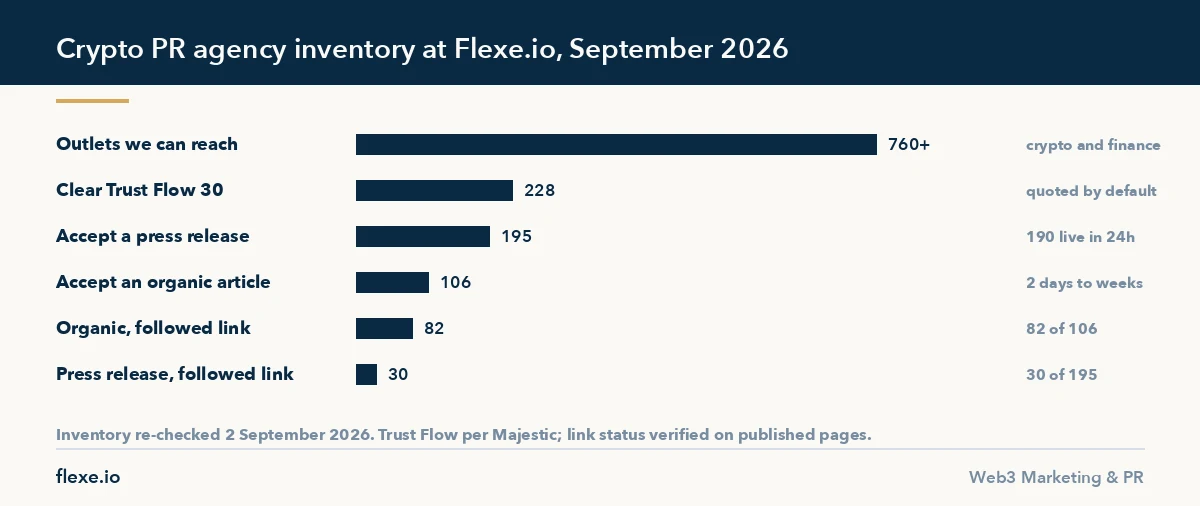
Flexe.io is a crypto PR agency that places client news across 760+ crypto and finance outlets, 228 of which clear Majestic Trust Flow 30 and are quoted by default. 190 of our 195 press release outlets publish within 24 hours, organic articles carry a followed link at 82 of 106 outlets against 30 of 195 for releases, and focused campaigns start from $4,000. We have run 800+ campaigns since 2018.
The outlet inventory was re-checked on 2 September 2026 and the figures on this page on 24 September 2026. The short version for a buyer comparing agencies:
- Best for: token launches, exchange listings, funding rounds and founder reputation work that needs a verifiable media record.
- Inventory: 760+ outlets; 228 above Trust Flow 30; 195 take a press release and 106 take an organic article.
- Speed: 190 of 195 release outlets publish within 24 hours of approved copy; organic placements take two days to several weeks.
- Links: followed at 30 of 195 release outlets and 82 of 106 organic outlets, listed per outlet before you pay.
- Pricing: from $4,000 for a focused campaign; full launch programmes run $50,000 to $500,000 over three to six months.
- Track record: 800+ campaigns since 2018, including a reputation programme of 700+ publications for a hedge fund manager.
- Reporting: a live URL log with authority, Trust Flow and link status for every placement.
What our crypto PR services include
Each service can be bought on its own or combined into one programme. The order below is the order most projects buy them in: a dated announcement first, then editorial depth, then volume.
1. Press releases on demand
- What you get: the release written or edited to each outlet’s submission rules, then placed only on outlets that can publish inside your window.
- Best for: listings, funding announcements, TGEs and partnerships with a fixed date.
- Turnaround: 190 of 195 outlets publish within 24 hours; tail outlets can take up to two weeks and are quoted with their real queue.
- More: press releases on demand across 195 outlets
2. Organic articles and editorial placements
- What you get: an article written for one outlet, not duplicated across dozens of domains, placed at one of 106 publications that accept organic work.
- Best for: search presence and answers that AI assistants can cite months after the campaign.
- Turnaround: two days to several weeks; Wired runs eight to twelve weeks.
- More: organic crypto articles on demand
3. Crypto PR packages
- What you get: syndicated coverage across a named list at three tiers of 8, 16 and 75 outlets, plus a premium tier built around a Cointelegraph placement.
- Best for: a listing committee or launch that needs coverage volume answered in one line.
- Vertical mixes: tech, fintech and Web3 gaming, drawn from outlets that cover that sector.
- More: crypto PR packages with outlet lists and prices
4. Publication shortlist with authority data
- What you get: a shortlist for your announcement with domain authority, Trust Flow, monthly visits, turnaround and link status on every line.
- Best for: teams that buy placements themselves and want to check a quote before paying anyone.
- Cost: free as a 24 hour proposal.
- More: crypto PR outlets with DA, traffic and link status
5. Reputation programmes in waves
- What you get: coverage built in stages, from general business sites through crypto and fintech outlets to financial media, with an indexing check before each new wave.
- Best for: founders and funds whose name is searched before a deal and asked about in AI assistants.
- Proof: a hedge fund manager programme ran four waves from May to December 2025 and produced 700+ publications, 691 outlets in the December wave alone.
- More: the hedge fund manager PR case study
6. Amplification through KOLs
- What you get: placements pushed through our base of 11,859 crypto KOLs on X, led by an active roster of 85 screened accounts with 8.7M combined reach and a 1.74% average engagement rate.
- Best for: funding news aimed at investors, where the coverage needs readers in the first 48 hours.
- Cost: quoted separately and never added by default; for a routine product update it rarely pays for itself.
- More: X crypto influencer campaigns
Press release or organic article
The two formats are different products bought for different reasons, and most wasted PR budgets come from buying one while expecting the results of the other. The table compares them on our own inventory as measured on 2 September 2026.
| Press release | Organic article | |
|---|---|---|
| Outlets available | 195 | 106 |
| Typical turnaround | 24 hours | 2 days to several weeks |
| Carries a followed link | 30 of 195 | 82 of 106 |
| Labelled as sponsored | Usually | Often not |
| Duplicated across sites | Yes, by design | No, written for one outlet |
| Bought for | Speed and a record of coverage | Authority, links and citations |
A release is the right tool when the news has a date: the listing, the raise, the mainnet. If the announcement has no date, an organic article usually does more for the same money, and the followed-link ratio is roughly three times higher. Google’s guidance on qualifying outbound links asks publishers to mark paid placements as sponsored or nofollow, which is why a paid slot on a strong domain rarely passes link equity, whatever the invoice says.
How outlets are screened
Every outlet in the default quote set clears Trust Flow 30, a score for how trustworthy the sites linking to a domain are, as defined in the Majestic glossary. We read it next to domain authority, the 1 to 100 ranking score described by Moz, because the two disagree more often than sellers admit. Of the 760+ outlets we can reach, 228 clear the line; the rest are quoted only when a client names a title.
When we checked our own list against DomDetailer in August 2026, 53 of 89 domains showed a published authority score that was wrong. Nineteen were off by five points or more, and 16 of those 19 were overstated. Seven outlets carried domain authority above 50 with Trust Flow below 25: they collected links rather than earned them, and we flag that in the quote instead of hiding it behind an average.
Screening is repeated on a schedule, not bought once from a reseller. An outlet that changes its link policy or loses traffic drops out of the default set at the next check, and the report says so.
How a campaign runs, step by step
Every engagement follows the same sequence, and the first two stages happen before any outlet is contacted. Skipping them is the most common reason coverage goes live that nobody reads and nobody cites.
- Week one: positioning call, a one page message document and the list of announcements already dated for the next quarter.
- Weeks one to two: outlet mapping against your sector and region, with authority, Trust Flow, turnaround and link policy on every line.
- Week two: copy drafted to each outlet’s rules, then one revision round on your side with a named approver who signs off within 24 hours.
- Weeks two to six: submission, editorial back and forth, publication and a live URL log updated as placements go up.
- After publication: an indexing check, amplification where a dated event justifies it, and a close-out report that keeps bought placements and earned coverage in separate columns.
What we need from you is short, and none of it is optional: material we can verify (audit reports, funding confirmations, exchange agreements, product dates), a spokesperson quote or a founder free for a 30 minute interview, and any legal wording your counsel requires, supplied before drafting rather than after publication. If a claim cannot be evidenced, it does not go into the text, because editors at the 228 outlets above Trust Flow 30 check what they publish and a bounced draft costs the window you paid for.
A launch programme that mixes releases and organic articles needs about six weeks of runway to have something live on the day the product ships. Teams that arrive with two weeks get the fast half of the inventory and a smaller result. When a placement misses its window, we substitute an outlet of equal or better standing inside the same window or remove the line from the invoice.
What it costs and how results are measured
Price follows the outlets, not the hours. A focused single-channel campaign starts from $4,000, and a full-stack launch programme runs $50,000 to $500,000 over three to six months. We quote per placement so you can delete lines and see what each name costs. Four variables decide most of the spread:
- Outlet tier: a tier-one financial title costs a multiple of a crypto news site with similar traffic.
- Followed links: scarce at release outlets, so a tier weighted toward them costs more.
- Languages and regions: each market is a separate editorial process, priced per language.
- Speed: a 24 hour window and a two week editorial queue are different products.
Coverage volume is the easiest number to report and the least useful to act on. We track placements still indexed after 90 days, followed links that survive a later policy change, branded search before and after a wave, and whether the coverage comes up when a partner runs a legitimacy check. Across our benchmark of 150 campaigns, median net return was 2.8x within 90 days, ranging from 1.4x to 7.0x. A clear launch date moved the median from 1.4x to 3.1x. The failure rate we disclose is 12 percent.
The report is a working spreadsheet rather than a slide deck, updated while the campaign runs. It holds a live URL for every placement with the outlet’s authority, Trust Flow and link status, the final approved copy in each language, and an indexing check reported as it came back, including pages search engines chose not to index. A single on-demand release produces the same report on a smaller scale, which is the cheapest way to see the format before a programme.
Repeat orders are the honest metric for PR. The hedge fund manager in our case study came back four times in eight months; a client who does not come back did not get value, whatever the closing report claimed.
When a crypto PR agency is the wrong spend
A project with no product, no team page and no verifiable traction gets nothing from coverage, and placements cannot stand in for an audit. The same goes for anyone who needs a guaranteed slot in a named tier-one title on a fixed day: no vendor can sell Reuters editorial, only a paid Reuters release placement.
If the goal is search visibility rather than a record of coverage, an organic article is the cheaper instrument and we say so before you pay for a release. Projects marketing to UK consumers also need the promotion itself to be lawful: the FCA guidance on cryptoasset financial promotions has applied since 8 October 2023 and covers paid articles and social posts alike. Price predictions and investment language are edited out before submission, because most finance outlets refuse them anyway.
For an outside view of the market, our guide to crypto PR agencies and outlets compares ten other agencies and lists 228 verified outlets.
Frequently Asked Questions
What does a crypto PR agency do?
It turns a project’s news into published coverage and keeps a record of it. At Flexe.io that means writing or editing the text, choosing outlets from an inventory of 760+ crypto and finance publications, placing press releases and organic articles, checking every live URL for indexing and link status, and handing over a report that a listing committee or investor can verify.
How much does crypto PR cost?
A focused single-channel campaign with us starts from $4,000. A full launch programme that combines releases, organic articles and social runs $50,000 to $500,000 over three to six months. Price follows the outlets you pick: a tier-one financial title costs a multiple of a crypto news site with similar traffic, and followed links cost more because few outlets pass them.
How fast can a crypto press release go live?
Usually the next day. 190 of the 195 outlets that take a press release from us publish within 24 hours of approved copy, so a release approved on Monday is normally live on Tuesday. Drafting takes about two working days. Organic articles are slower: two days to several weeks, and the strongest titles take the longest.
Do crypto PR placements give followed links?
Press releases mostly do not: 30 of the 195 release outlets pass a followed link. Organic articles mostly do: 82 of the 106 outlets that accept them. Link status is listed for every outlet before you pay and verified on the published page afterwards, because outlets change their link policy without notice and no agency can guarantee it.
Is a PR package better than ordering releases one at a time?
It depends on how often you announce. A package prices a batch of outlets at once and suits a TGE or listing that needs volume on one day. Teams with one dated announcement a quarter usually save by ordering on demand, then compare the totals after the second or third order. The outlet list and link status come before payment either way.
Can a crypto PR agency guarantee Forbes or Reuters coverage?
No honest one can. Reuters and AP News are available as paid press release placements and Forbes as a contributor placement, each with a stated turnaround. Editorial coverage is different: a journalist deciding your project is news is not a product. Any quote that says Forbes without saying which of the two it means deserves a follow-up question.