Twitter ads for crypto buy paid placement on X with wallet level and behavioural targeting, run on your own verified advertiser account, from about $4,000 for a focused single channel flight. You get account clearance, conversion tracking installed before launch, policy safe creative variants, daily management, and reporting on the conversion event rather than on impressions.
Before you read further: this channel only works at scale. Retargeting an audience you already have is where it earns its keep, and cold acquisition from a standing start rarely does.
Crypto advertising on X (formerly Twitter) is restricted rather than closed, and the policy set is stricter than most teams expect. We run X crypto ads with wallet level targeting, which puts an offer in front of accounts that hold specific tokens, follow named crypto handles or sit inside Web3 communities. That is what makes the channel worth its approval overhead for on-chain products.
Twitter Ads Crypto: Why This Channel Performs Like No Other
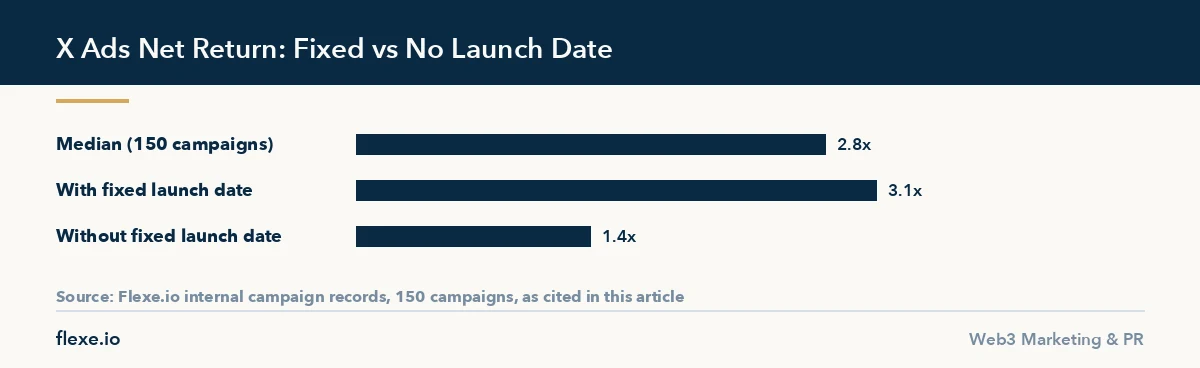
Crypto offers are rare in the X feed, so the audience is not banner blind to them and click-through rates run above what the same creative earns on Web2 platforms. Return follows when targeting, message and creative agree with each other: across 150 campaigns our median net return is 2.8x within 90 days.
What We Offer
Access to the channel is the easy half. These four pieces of work are what make it pay:
- Audience Matching: We help you find the perfect wallet-based or behavioral segments.
- Moderation Support: We take your creative through the X review process and get it approved.
- Creative Testing: We run A/B tests to find your top-performing banners and messages.
- Performance Optimization: We refine targeting and creatives based on real data.
Learn more about the types of audiences available for X crypto ads the Web3 ad inventory. Contact us on Telegram to launch X ads now.
If the placement is still an open question, crypto traffic acquisition sets out every option side by side – explorers, media, ad platforms – with monthly visits and what each platform allows.
When X Ads Fits and What Wallet Based Targeting Buys
X Ads is a large-budget channel. The platform sells reach at auction, and auctions reward volume, so a campaign that runs for a week on a small budget produces a learning phase and little else. We say this before taking the work rather than after.
It fits when a project has an audience already active on X, a launch or listing date to concentrate spend against, and a landing destination that converts traffic it did not warm up. It fits badly when the goal is discovery from a standing start, when the token is not yet tradeable, or when the budget has to cover several channels at once.
Where the budget is the constraint, quote-retweet campaigns through vetted accounts usually deliver more per unit of spend than paid placement does. That work is described on our crypto influencer marketing page, and the selection method in how to vet a crypto KOL.
Wallet based targeting covers two different things and they perform differently. The first is behavioural targeting inside the platform: accounts that follow, engage with or resemble the audiences of specific crypto handles. The second is a custom audience you supply, built from your own users and matched against platform identifiers.
The second is stronger and depends entirely on the quality of the list you own. Projects with a mailing list, a testnet cohort or a set of known wallets have something to build a lookalike from. Projects without one are buying interest targeting, which is broader and needs more budget to find the same people.
Moderation, and what gets a campaign rejected
Financial promotion rules apply and are enforced unevenly. Creatives implying returns, using words like guaranteed or risk-free, showing price charts as a promise, or pointing at a token sale without the required disclosures are the common rejections.
Rejections are not always explained, and an account can be restricted rather than a single creative refused, which is the expensive version. We prepare several creative variants in advance and start with the most conservative, because recovering a restricted account costs more time than any campaign saves.
How the campaign runs
- Setup. Objective, audiences, creative variants, tracking parameters and conversion events agreed before anything is submitted.
- Learning. The first days buy data rather than results. Judging performance inside this window leads to the wrong decisions.
- Consolidation. Losing audiences and creatives are cut, spend moves to what converts, and the remaining variants are tested against each other.
- Reporting. Spend, impressions, clicks, cost per click and the conversion event you chose, per audience and per creative, so the next campaign starts from evidence.
We report the conversion event, not the impression count. A campaign that delivered cheap reach and no wallet connections did not work, and saying so is more useful than a screenshot of the delivery figures.
How Twitter ads for crypto get bought
Twitter ads for crypto are bought on a prepared account, against a date, with tracking that already works. What follows is the buying side of the channel rather than the pitch for it: the preparation that decides whether a flight can run at all, what we take on, what stays with you, and the numbers we report against once the campaign is live. Most of the reasons a campaign here disappoints are visible in this section, before a single impression has been served.
Advertiser verification and account setup
The account has to exist in a form the platform will keep. Financial and crypto promotion requires advertiser verification, and for some products and countries certification on top of it, with rules that are not the same in every market. An application refused on the first pass can take weeks to work through and appeals are slow, so this starts before the creative brief. Verification attaches to a legal entity and a domain you control, which is why the account should never be opened under a freelancer login or a personal handle somebody may lose access to.
Billing belongs in the same week, and it is the item most often left to the day before launch. Card limits, prepayment thresholds and currency settings decide how fast spend can scale once something is working, and a cap discovered on day four of a listing week is an expensive way to find out about it.
Country rules and who they exclude
Approval is granted market by market. The same product can be cleared in one country and refused in the next, and some jurisdictions are closed to financial promotion outright whatever the account holds. Settle the country list before the creative is written, because a campaign built for a global audience and then cut back to four markets carries the wrong message, the wrong language and a budget planned for reach it will never buy. Where a launch is aimed at one market, a short country list with the whole budget behind it competes better in the auction than a wide list spread thin across it.
Tracking that has to exist first
Conversion tracking is installed and firing before the first impression, not retrofitted once the numbers look odd. That means the platform tag on the destination, one named conversion event that matters to you, and tagged URLs per audience and per creative so the report can separate them later. On a Web3 destination that event is usually a wallet connection or a completed action inside the app, which needs a few lines from your developer and about a day of their time.
If you are supplying a customer list for matching, its hygiene decides the match rate. Deduplicate it, keep raw field values rather than display formatting, drop anything you collected under terms that do not allow this use, and expect a share of the rows to fail to match at all. A few thousand rows that match cleanly are worth more than a large export nobody checked, and the resulting audience has to clear the platform minimum before it will serve.
Creative formats we ask for
- Static images in the current placement sizes, with text kept away from the busy edges of the frame
- Short video under fifteen seconds that reads with the sound off, since most of the feed is muted
- Several headline variants per audience, each written so the claim survives a policy review rather than one strong line and no fallback
- A conservative cut of every creative with the sharpest claims removed, to submit first
- Editable source files, so a resize does not turn into another design round or a delay in the review queue
The destination has to say what the ad said. Reviewers open the landing page, and a mismatch between an ad describing a product and a page selling a token is a common cause of a refusal that arrives without an explanation attached.
What the budget buys and what we charge
Media spend goes from you to the platform directly. We take no percentage of it, so there is no version of this arrangement where a larger budget quietly pays us more. Our fee covers audience construction, creative direction, moderation handling, daily management and reporting.
The entry point is about $4,000 for a focused single channel campaign, which here means one objective, a short list of audiences and a defined window rather than an always on program. A full stack launch, with paid placement sitting alongside PR, KOL work, community and content, runs $50K to $500K over three to six months. The number worth worrying about is not the minimum but the split: budgets spread across too many channels at once correlate with a 34 percent failure rate in our records, and this channel punishes thin spend harder than most, because the auction needs volume before it optimizes anything.
Measured against our own records
Across 150 campaigns the median net return was 2.8x within 90 days, ranging from 1.4x to 7.0x, with a 12 percent failure rate that we publish rather than hide. More than 800 campaigns have run since 2018. The factor that moves the median most is a fixed date to spend against: campaigns with a clear launch date sit at 3.1x where undated ones sit at 1.4x, which on this channel is the difference between concentrating a flight and letting it drift.
Read a flight on the conversion event and the cost per event, per audience and per creative. Impressions and cheap clicks are the easiest numbers to produce here and the least informative, and a campaign that bought reach without events is written up as a failure rather than averaged into a total.
When posts outperform paid placement
Paid reach and earned reach are different purchases. Our X base holds 11,859 KOLs, and the active roster of 85 verified accounts has 8.7M combined reach and 1.74% average engagement, each screened through three independent checks before it is offered to anyone. For Margex, a derivatives exchange with more than 500,000 traders across 153 countries, engagement work on X lifted engagement by 270 percent. Below a certain budget that route buys more attention per dollar than the auction does, and we will point a project at it rather than sell a placement that cannot clear its learning phase. The full inventory picture, including explorers and crypto media, sits on our crypto traffic acquisition page.
Failure modes on this channel
Four of them account for most of the campaigns that go wrong here.
- An account restricted rather than a single creative refused, almost always after the sharpest claim was the first one submitted.
- A flight judged and switched off inside the learning window, so the spend bought data that nobody then used.
- A matched audience too small to serve, which falls back to broad targeting at a worse price without anyone noticing.
- A landing page that converts warm traffic and collapses on traffic it did not warm up, which looks like a targeting problem and is not.
Who we turn away
Projects with nothing tradeable yet, no date to concentrate against, or a budget that has to cover several channels at the same time. Anyone who wants the account opened in our name to skip verification, which we do not do, because the account has to survive after the campaign ends and a borrowed one does not.
What we need from you
A landing destination that loads quickly on a phone, an analytics setup that records the event you care about, brand assets in the right dimensions, and a named person who can approve creative inside a day. The last one decides more schedules than anything technical.
Where X Ads is one part of a launch rather than the whole plan, the channel mix and the budget split across it are covered on our crypto traffic acquisition page. Scope and terms are available on request.
Frequently Asked Questions
Can you run crypto ads on X?
Yes, on a verified advertiser account. Financial and crypto promotion needs advertiser verification, and some products and countries need certification on top of it. We prepare the account, the country list and the creative variants before anything is submitted, because an application refused on the first pass can take weeks to work through.
How much do Twitter ads for crypto cost?
Media spend goes straight from you to the platform and we take no percentage of it. Our entry point is about $4,000 for a focused single channel flight, meaning one objective, a short audience list and a defined window. A full stack launch across several channels runs $50K to $500K over three to six months.
What is wallet based targeting on X?
Two different things. Behavioural targeting reaches accounts that follow or engage with named crypto handles. A custom audience is a list you already own, matched against platform identifiers, and it performs better. Expect a share of the rows to fail to match, and the audience has to clear the platform minimum before it will serve.
Why do crypto ads get rejected on X?
Implied returns, words like guaranteed or risk free, price charts used as a promise, and token sale pages without the required disclosures. Refusals are not always explained, and the platform can restrict a whole account rather than refuse one creative. We submit the most conservative variant first for exactly that reason.
Does this channel work on a small budget?
Often it does not, and we say so before taking the work. The auction needs volume, the opening days buy data rather than results, and budgets split across too many channels at once correlate with a 34 percent failure rate in our records. We disclose a 12 percent failure rate and sell no guaranteed reach.