Follower counts in crypto are a purchasable commodity, and the people selling promotion know exactly which numbers buyers look at. Knowing how to vet a crypto KOL means looking at the numbers they cannot buy cheaply, and it takes about twenty minutes per account once you know where to look.
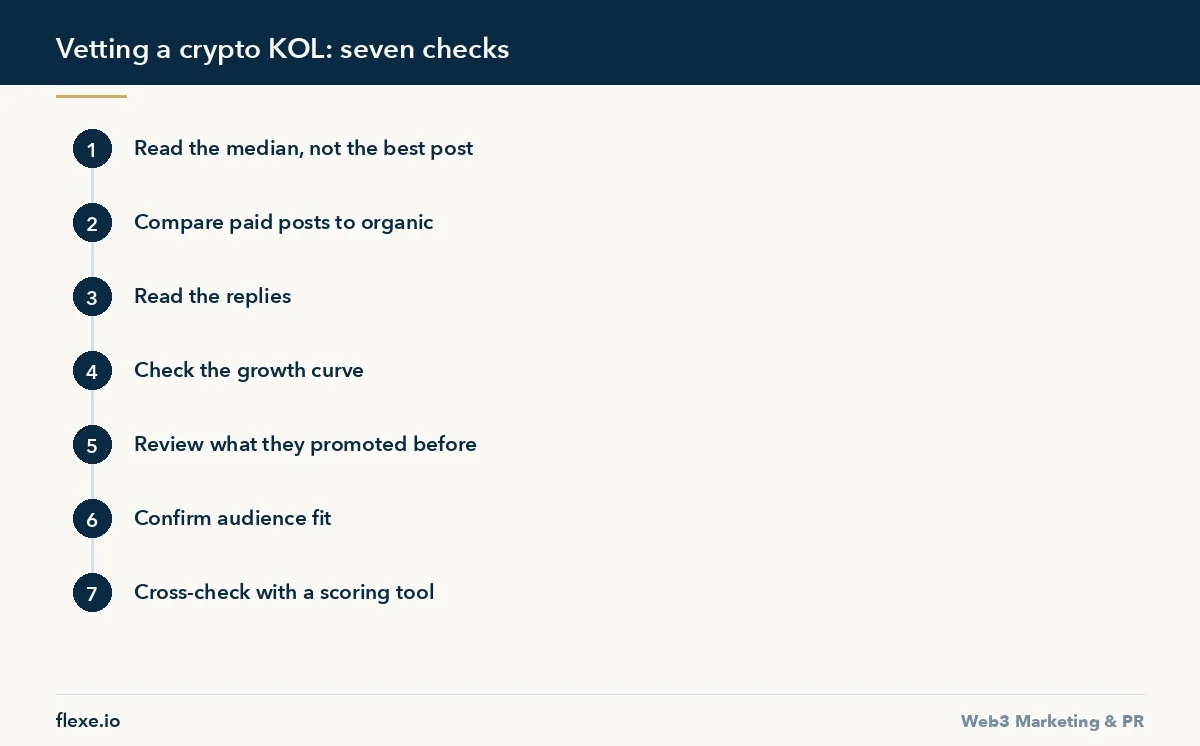
This is how to vet a crypto KOL with the seven checks we run before an account enters a campaign, in the order that eliminates the most candidates fastest.
1. Read the median, not the best post
Take the last twenty posts and find the middle value for views and replies. One viral post distorts an average badly, and the pitch deck you were sent was built around exactly that post.
The median tells you what a typical post from this account does, which is what you are buying. A large gap between the best post and the median means the account has occasional reach it does not control.
2. Compare paid posts against organic ones
Find their previous promotional posts and compare the engagement to their normal content. A steep drop on sponsored content means their audience recognises and ignores paid placement, and your post will perform like their other paid posts, not like their best organic one.
This single comparison is the most predictive check available and almost nobody runs it, because it requires reading their feed rather than a media kit.
3. Read the replies
Open the replies on three or four recent posts. Real audiences argue, ask specific questions and reference earlier posts. Purchased engagement is short, generic, positive and often from accounts created in the same period.
Click through to a handful of the repliers. Accounts with no history, a default avatar and a following list full of other promoters are the signature, and once you have seen one such reply section you recognise the next one in seconds.
4. Check the growth curve
Follower growth from real content is uneven, with steps around notable posts. Purchased growth appears as a smooth ramp or a vertical jump with no corresponding rise in engagement.
An account that gained a large block of followers in a week and whose median engagement did not move bought them. The follower count is now permanently misleading and the engagement rate is the honest number.
5. Look at what they promoted before
Scroll back six months and list the projects they posted about. If most of them failed quickly, their audience has learned what a promotion from this account means, and that learning applies to your campaign too.
Frequency matters as much as outcome. An account promoting something new every few days has an audience that has stopped reading promotions, whatever the engagement numbers say.
6. Confirm the audience is the one you need
A large account whose audience trades memecoins is close to useless for an infrastructure product, and the reverse is equally true. Read what their audience actually discusses in the replies rather than what the account’s own bio claims.
Language and region matter here more than most buyers expect. An account with strong engagement in one regional market may deliver almost nothing in another, and both facts are visible in the replies.
7. Cross-check against an independent tool
Several services score crypto accounts on audience authenticity and historical performance. None of them is authoritative alone, and each has known failure modes, but a serious disagreement between two of them and the media kit is worth investigating.
Use them as a filter that flags accounts for closer reading, never as the decision itself. The manual checks above are what actually decide, and the tools only tell you where to spend that time.
To see what verified numbers look like in practice, compare a shortlist against our top crypto influencers list, where every account was checked for followers, median views and engagement.
Run the checks in a fixed order
Work through a shortlist in one sitting with the same sequence every time, and stop at the first hard failure instead of completing every check on a candidate already eliminated. Reply quality and the comparison between paid and organic posts remove the most candidates fastest, so they come first. Growth shape, promotion history, audience fit and price come next, and the tool cross-check goes last, on the short list that survived everything else.
Keep one sheet with a row per account and a column per check, filled in as you go. The same checks run from memory across a fortnight produce inconsistent judgements, and a written sheet makes the disagreements visible when two people screen the same list. It also means an account rejected in March can be reconsidered in September against a recorded reason rather than a vague recollection. Write that reason as a sentence, since one word will not mean anything later.
How to vet a crypto KOL: new accounts
New accounts and accounts that changed topic recently break most of the checks above, because there is no median worth taking and no promotional history to read. That is not automatically a rejection. Read what does exist: whether the replies come from people with real histories, whether the account answers questions rather than broadcasting, whether it posts about anything other than promotion, and whether anyone with an established audience engages with it in a way that looks unpaid.
Where an account looks promising and unproven, treat the first booking as the test rather than the campaign. One post, a modest fee, tracking applied by you, and a decision made on the measured result instead of on the pitch. Several of the accounts that become long term bookings are found this way, and the cost of being wrong is one small invoice rather than a campaign budget. Book the test when nothing else is running, so the result stays readable.
Ask the creator these questions directly
Request analytics screenshots for the last five posts rather than the best five, taken from inside their own account. Ask what a recent sponsored post delivered in clicks rather than views. Ask which projects they turned down and why. Ask whether they will disclose the post as paid and in what form. The answers matter, and so do the speed and the specificity with which they arrive. A creator who needs a week to find their own numbers has never been asked before.
Vague answers about reach, refusal to show recent analytics, a fee that moves once you mention a budget, and insistence that clicks are not something they track are all common and all informative. Accounts that deliver regularly tend to know their own figures, because clients have asked before. An account that cannot describe its last campaign in concrete terms is not necessarily dishonest, but it is not evidence of anything either.
Price, payment and contract terms
Price against delivered views rather than follower count, and against the median rather than the best post. Where an account quotes a flat fee, divide it by the median views to get a figure that compares across the shortlist. That single calculation reorders most shortlists, because the accounts with the largest followings frequently sit at the worst end of it once the number is expressed per view instead of per post.
Put the deliverable and the timing in writing before any money moves: what is posted, where, when, how long it stays live, whether the tracked link appears unaltered, and what happens if the post is removed. Where the budget allows, split payment so a portion arrives after the post has been live for the agreed period. Payment in full up front removes every remedy you might later have needed, and nobody who skipped these terms enjoyed the consequences.
Be careful with intermediaries offering bundles of accounts at a package rate. The bundle is usually priced on combined follower count, the strong accounts subsidise the weak ones, and you have no way to decline the accounts that failed your own screening. Book individually where you can, and where you cannot, insist on the full account list in advance and screen every name on it. A package that cannot be itemised before payment is a package to walk away from.
Where to find candidates yourself
Build a list of your own instead of screening only the names somebody proposed. Read the replies under posts your target audience already follows, note which accounts other people quote when they want something explained, and watch who answers technical questions accurately in public. Accounts found this way have already demonstrated the thing you are trying to buy, and the overlap with the list you were sent is usually smaller than anyone expects.
Keep a running file of candidates rather than starting from nothing each campaign. Add accounts whenever you notice one, with the date and a line about why it caught your attention, then screen them in batches as a campaign approaches. Searching for creators under deadline is how projects end up booking whoever replied fastest, which selects for availability rather than for the audience you needed. Availability correlates with nothing you actually care about.
Run the whole process on one account you have already worked with before trusting it on strangers. A known result gives the checks something to calibrate against, and it usually exposes a step that sounded sensible and measures nothing. Adjusting the process against an account whose performance you can already verify is far cheaper than discovering the weakness halfway through a shortlist of thirty unknowns.
Mistakes that repeat across shortlists
Rejecting small accounts on size alone is the most expensive habit. An account with a modest following whose replies are full of specific product questions converts at rates the large accounts rarely match, and it costs a fraction as much. The check that matters is whether the audience acts, not whether it is numerous, and most scoring tools cannot see that difference at all. Booking two or three small accounts together also spreads the risk that any single post lands badly.
Accepting a clean tool score as a pass is the second. Scores read the follower graph and the posting history, both of which can be cultivated deliberately by anyone who knows what is being measured. An account built to pass automated screening will look better on a dashboard than a real person with an untidy history, which is why the manual reading decides and the tool only points at where to read.
Screening the account and ignoring the deal is the third. An account that passes every check and charges four times what its median views justify is still a poor booking, and a shortlist ordered by quality alone will never show that. Carry the price through the whole process so the final decision compares what each account delivers against what each account costs. The strongest account on the list is not always the one worth buying.
When an approved account goes wrong
Accounts change. A creator who passed screening in spring may be posting a new promotion every other day by autumn, and their audience will have adjusted accordingly. Re-run the comparison between paid and organic posts before every repeat booking rather than trusting the earlier verdict. It takes a few minutes on an account you already know, and it catches the decay that quietly turns a reliable booking into a disappointment.
Where a booked post underperforms badly, read the post before blaming the account. A deliverable published at the wrong hour, with the link in a reply, or stripped of the context the brief supplied, is a different failure from an audience that did not care. Note which one it was, because the two call for opposite decisions about whether to book again. One of them is a brief to fix and the other is a name to remove.
Where the account did everything asked and the result was still poor, the honest conclusion is often that the audience was wrong rather than fake. That is a screening failure on your side, and it is worth writing down as one. Projects that record every disappointing campaign as a dishonest creator never improve their own selection, and they work through the same shortlists repeatedly with the same outcome. The accounts are not the only variable being tested.
Decide in advance what you will do about a creator who takes payment and does not post. Keep the exchange in one written channel, state a deadline, and be prepared to write it off rather than spending a fortnight on it. Public disputes cost more attention than the booking was worth, and the accounts worth working with are watching how projects behave when something goes wrong. A quiet removal from the roster is usually the whole remedy available.
Keep rejected and failed accounts in the same file as the successful ones. A roster that records only what worked cannot tell you how selective the process actually was, and that ratio is worth knowing. A screening process approving most of what it sees is not screening anything, and the ratio is the quickest way to notice that standards have slipped between campaigns. Review it before each new shortlist rather than at the end of the year.
If you would rather hand the vetting to an agency, we compared ten of them on what each lets a buyer verify before paying: the best crypto KOL agencies in 2026.
The same checks apply to NFT names; our list of NFT brand ambassadors shows who brands actually work with.
Start from a shortlist: our ranked top crypto accounts on X shows follower counts and what each account is known for.
How to vet a crypto KOL: what passing looks like in practice
The accounts that survive this process are usually smaller than the ones initially proposed. Our active X roster for quote-retweet work runs to 85 verified accounts with a combined reach of 8.7 million and an average engagement rate of 1.74 percent, and assembling it meant rejecting the large majority of accounts that applied.
That ratio is normal. A vetting process that approves most candidates is not a vetting process, and the accounts with the most impressive follower counts fail these checks more often than they pass them.
Once an account passes, the next problem is the brief, covered in how to brief a crypto KOL. Screening, negotiation and reporting as a service are on our crypto influencer marketing page.