A vetted account with the right audience can still produce a post that does nothing, and the usual cause is the brief. Either it was a paragraph of adjectives with no facts, or it was a script the creator was told to publish word for word, which their audience recognises immediately.
A good brief constrains the facts and frees the voice. Here is what goes in one.
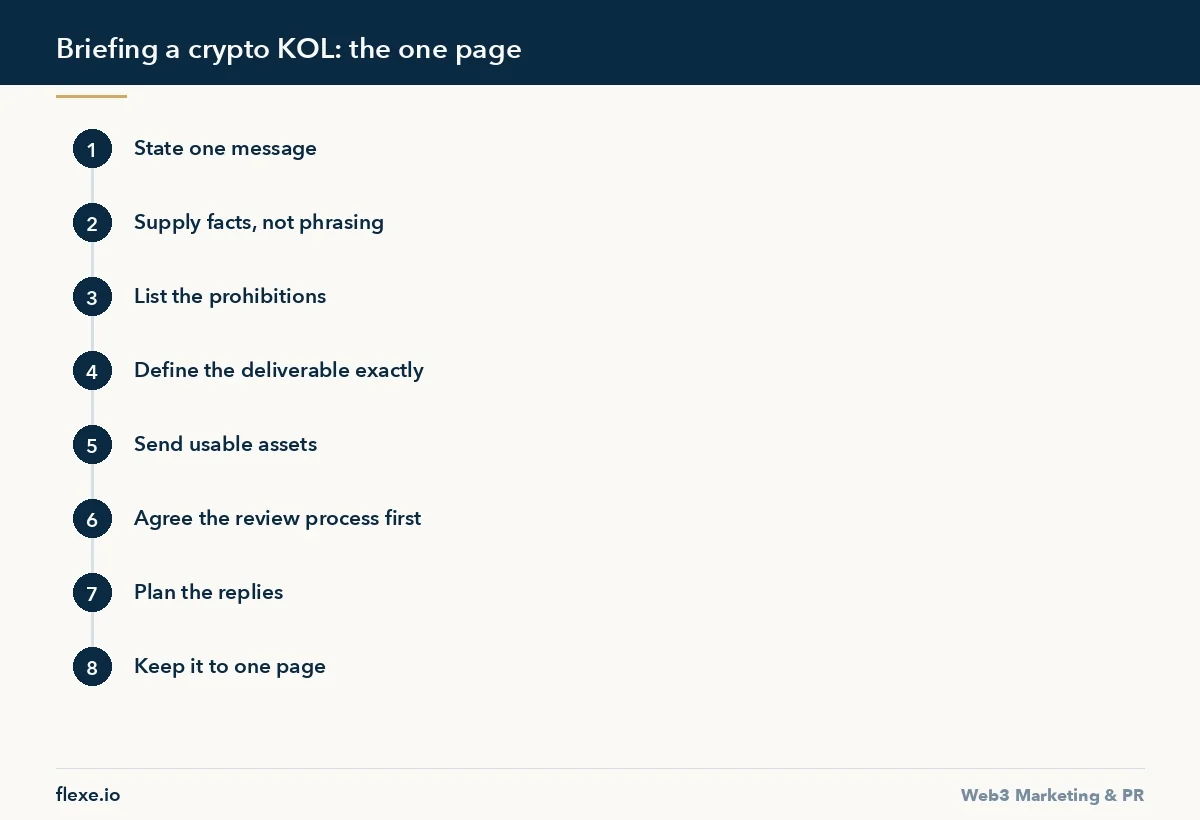
1. State the one thing the post must communicate
One sentence, written before anything else, describing what a reader should know after seeing the post. Not three things. A post carrying three messages carries none, and the creator will pick which one survives if you do not.
If the team cannot agree on that sentence, the campaign is not ready and no amount of reach will compensate.
2. Give the facts, not the phrasing
Supply what is checkable: what the product does, the launch date, the chains supported, the audit status, the contract address, the numbers you are willing to have quoted. These are the raw material.
Then let them write it. You are paying for a voice their audience has come to trust, and a paragraph in your marketing register inside their feed reads as an advertisement even when it is labelled as one anyway.
3. Be explicit about what cannot be said
List the prohibitions plainly: no price predictions, no guaranteed returns, no claims about listings that are not confirmed, no describing the token as an investment. Say which jurisdictions require a disclosure and what wording it needs.
Creators generally comply when told. They invent when left to guess, and the invention is usually a return claim, which is the one that creates a problem for the project rather than for them.
4. Define the deliverable exactly
Format, length, whether a link is included and where it points, whether it is a standalone post or a reply in a thread, how long it stays up, and whether it may be deleted afterwards. Put the publication date and time window in writing.
Deletion after payment is a real and recurring problem. Agreeing a minimum period in advance costs nothing and removes the argument.
5. Send the assets in usable form
Logo in the right formats, a short product clip, screenshots at the right dimensions, the exact handle to tag, the exact link with tracking already applied. Every asset the creator has to request delays the post and increases the chance of a wrong link.
Apply the tracking parameters yourself. A campaign where each creator builds their own link is a campaign that cannot be measured afterwards.
6. Agree the review process before the draft exists
State whether you want to see it first, how long you will take, and what kind of change you can request. Factual corrections are reasonable. Rewriting their sentences is what makes creators refuse to work with a project twice.
Keep the turnaround short. A draft sitting in an approval queue for four days misses the window the campaign was built around.
7. Say what happens after publication
Whether the team will amplify the post, whether the creator should reply to questions underneath it, who answers technical questions they cannot, and where to send someone who wants support.
The replies under a KOL post are where interested people actually convert or leave. A post that goes up with nobody from the project watching the thread wastes most of the attention it bought.
8. Keep the brief to one page
Everything above fits on one page. A ten-page brand document will not be read, and the parts that matter will be the parts that were skipped.
Send the one page, attach the detail separately for anyone who wants it, and be available for questions. Creators who ask questions produce better posts, and a brief that invites them is doing part of the work.
The two failure modes
Over-scripting produces a post that reads as an advertisement and performs like one. Under-briefing produces a post that is enthusiastic, vague and occasionally wrong about the product, which is worse because the correction happens in public.
The brief that works sits between them: strict about facts and prohibitions, silent about phrasing. Selecting the account in the first place is covered in how to vet a crypto KOL, and what to measure afterwards in how to measure whether a KOL campaign worked.
Briefing, negotiation and creator management as a service are on our crypto influencer marketing page.