Most KOL campaign reports are screenshots of view counts. They arrive quickly, they look substantial, and they answer a question nobody needed answering. Whether the campaign worked is a different question, and it can only be answered if the measurement was set up before the first post went live.
Here is what to instrument, what to record, and which numbers actually decide whether to run the campaign again.
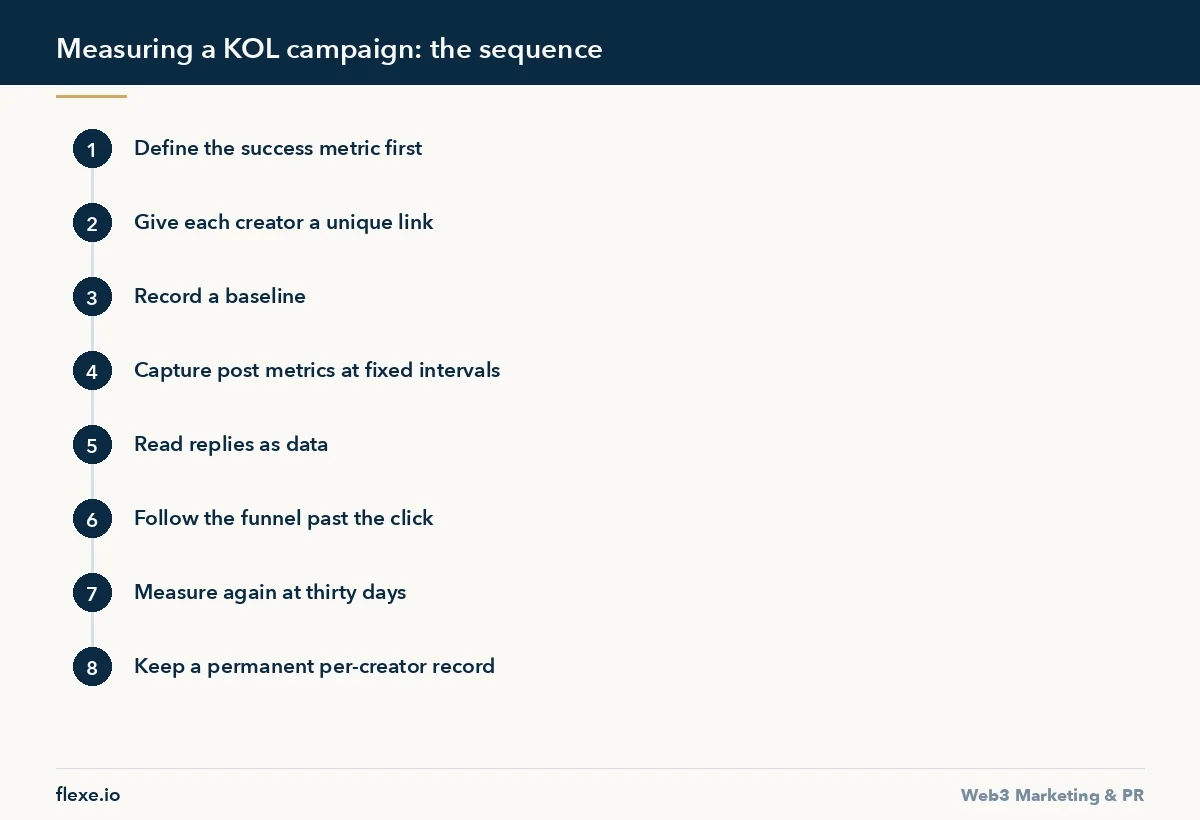
1. Decide the success metric before booking anyone
Pick one primary outcome: wallets connected, deposits made, community members who stay a month, applications submitted. Write down the number that would make the campaign worth repeating.
Campaigns without a target defined in advance are always judged afterwards by whichever number looked best, and that number is always impressions.
2. Give every creator a distinct link
One unique tracked link per creator, built by you, applied before the brief is sent. This is the entire foundation of attribution, and it is the step most commonly skipped because it feels administrative.
Without it you will know that traffic arrived during a week when eight people posted, and nothing more. With it you know which two of the eight are worth booking again.
3. Record the baseline
For the two weeks before the campaign, record daily site visitors, wallet connections, community joins and whatever your primary metric is. Everything afterwards is measured against this, not against zero.
Note anything else happening in the same window: a listing, a product release, a market move. A campaign that coincided with a broad rally will look excellent, and the baseline is what stops you concluding the wrong thing.
4. Capture the post metrics at fixed intervals
Screenshot and record views, replies, reposts and quote posts at twenty four hours and again at seven days. Numbers rise steeply and then stop, and comparing creators requires reading them at the same age.
Record the post URL too. Deleted posts are common, and a campaign report referencing content that no longer exists cannot be checked by anyone, including you.
5. Read the replies as data
Count how many replies ask a real question about the product versus how many are generic praise. That ratio predicts conversion better than the view count does, and it tells you whether the audience was the right one.
A post with modest views and fifteen specific questions delivered more than a post with ten times the views and a reply section of emoji.
6. Follow the funnel past the click
For each creator, track clicks, then the next step, then the primary metric. The drop-off between them is where the answer lives: heavy clicks with no conversion means the audience was wrong or the landing page failed, and few clicks with strong conversion means the account is small and worth keeping.
Those two cases look identical in a report that stops at impressions, and they call for opposite decisions.
7. Measure again at thirty days
Come back a month later and check how many of the users acquired are still active. This is the number that separates a campaign that moved people from a campaign that moved a chart for two days.
Retention differs enormously by creator, and the ranking at thirty days frequently reverses the ranking at twenty four hours. That reversal is the most valuable output the whole exercise produces.
8. Keep a permanent record per creator
One row per creator per campaign: date, deliverable, cost, views at both intervals, clicks, conversions, thirty-day retention. After three campaigns this file is worth more than any external scoring tool, because it is measured on your product and your audience.
It also changes negotiations. A creator whose last two campaigns produced nothing is a different conversation when you have the numbers in front of you.
What the numbers cannot tell you
Attribution in crypto is genuinely partial. People see a post, do nothing, and arrive through search a week later. Some wallets never touch a tracked link at all. Treat the tracked figures as a floor rather than a total.
That is an argument for consistent measurement across creators, not for abandoning it. The comparison between accounts stays valid even when the absolute number understates the effect.
Selection is covered in how to vet a crypto KOL and the brief in how to brief a crypto KOL. Campaign management and reporting are on our crypto influencer marketing page.