A DAO marketing strategy recruits governors rather than customers, and it works through five levers: a concrete mandate, a proposal process people can read, accountable delegates, a paid contributor pipeline and treasury reporting on a fixed schedule. A DAO is an organisation whose decisions are made by token holders through on-chain voting rather than by an executive team.
Marketing one is unlike marketing a company, because the thing being promoted is participation rather than a product, and the people you attract become the people who govern. Recruit the wrong holders and you have not just a quiet community but a governance problem.
What is DAO marketing?
DAO marketing is the work of attracting holders, voters and contributors to an organisation run by token governance. The difference from a normal company is decision rights: in a company an executive team decides and shareholders have limited direct input; in a DAO token holders vote directly on the matters within its scope. That makes DAOs slower and more transparent, and it means the composition of the holder base determines what the organisation actually does.
- A DAO recruits governors, not customers. Who joins determines what it becomes.
- Voter turnout is the health metric that matters, and most DAOs have very little of it.
- Governance theatre, where votes are held on decisions already made, destroys participation faster than inactivity.
- Concentrated token ownership makes voting decorative regardless of how it is presented.
- DAOs have real legal exposure in several jurisdictions, including potential personal liability for members.
- Contributor pipelines matter more than member counts.
DAO marketing strategy: the key tactics
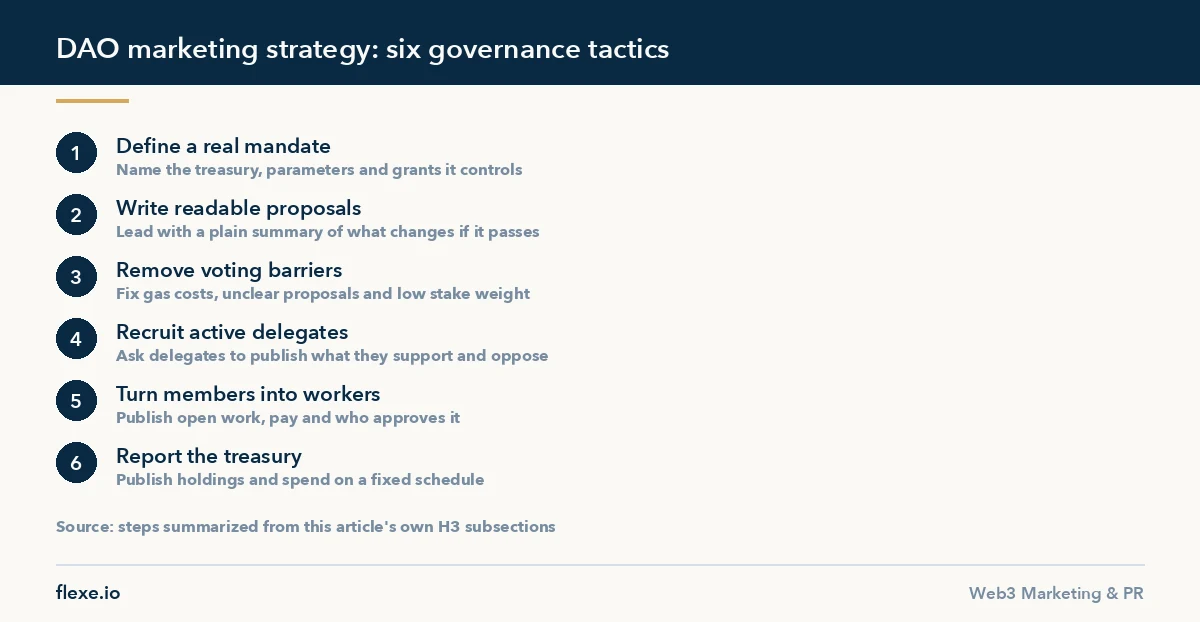
1. Start with the decision the DAO controls
A DAO formed without a specific mandate produces proposals about its own process and little else. Be concrete: which treasury, which parameters, which grants, which appointments. People join a DAO because they care about a decision, and if there is no decision worth caring about, the community that forms is speculative rather than participatory.
Then design for the participation you want. Publish the proposal process, the quorum, the voting period and what happens if quorum fails, before anyone joins. Make the first few proposals genuinely consequential so early members see that voting changes outcomes. The first month sets the expectation, and a DAO that opens with symbolic votes rarely recovers real participation later.
- Best for: a DAO before launch or before a token distribution.
- Metric to watch: whether the first proposals changed an outcome anyone could see.
2. Write proposals people can read
Low turnout is the normal state of DAO governance, and it is usually a design problem rather than an apathy problem. Every proposal needs a plain summary at the top saying what changes if it passes, what it costs, who executes it and when. Below that sits the technical version with the exact parameters or addresses being changed. Reviewers should not have to reconstruct intent from a code diff, and a proposal that cannot be summarised in a paragraph is usually several proposals bundled together so they pass as one.
Name the author and any interest they hold. A grant proposal from a wallet that receives the grant is fine when disclosed and fatal to trust when discovered afterwards. Keep a standard template so proposals arrive comparable, and set a minimum notice between publication and the vote opening, so nothing consequential can be introduced and voted through over a weekend.
- Best for: DAOs where turnout is falling.
- Metric to watch: turnout per proposal against the length of its summary.
3. Remove the barriers to voting
The main causes of low turnout are proposals that are hard to understand, voting that costs gas, decisions that were visibly made elsewhere, and holders with too little stake to bother. Each has a fix. Use off-chain signalling for low-stakes decisions so gas is not the barrier. Above all, do not run votes on decisions already taken, because participants notice quickly and stop showing up.
4. Recruit delegates who actually vote
Delegation is the practical fix for low turnout, and it works only when delegates are visible and accountable. Ask each delegate to publish a short statement of what they will support and oppose, and record their voting history where holders can see it. Make redelegation easy and never discourage it, because the credibility of the arrangement comes from holders being able to withdraw power as cheaply as they gave it.
Recruit delegates from people already writing in the forum rather than from name recognition. A holder who has argued a position in public has told you how they will vote. A well-known account that accepts a delegation and then abstains does more damage than an empty seat, because turnout looks healthy while decisions are made by whoever remains.
- Best for: DAOs with many small holders.
- Metric to watch: share of delegated power that votes in each period.
5. Turn members into contributors
Most DAOs have a gap between joining and doing anything, and closing it is a matter of paperwork rather than enthusiasm. Publish what work is open, what it pays, who approves it and how long payment takes. A contributor who has to ask several people whether a task is already taken will not ask twice. Keep a small set of starter tasks with a named reviewer so a first contribution can complete quickly.
Pay on a schedule and say what the schedule is. Treasury payments that depend on somebody being available break contributor pipelines faster than low rates do, and the people who leave first are the ones with alternatives.
- Budget: contributor payments approved through the treasury.
- Metric to watch: time from first contact to first paid contribution.
6. Report the treasury without a launch
Treasury reporting is the most persuasive marketing a DAO produces, and it works only on a fixed schedule. Publish holdings, what was spent, against which approved proposal, and what remains, in the same format each period so the numbers can be compared. Include payments that went to contributors and to anyone connected to the core team, because that is the line readers look for first and the omission they notice.
Report outcomes next to spending. A grants programme that lists recipients without saying what shipped teaches holders that approval is the end of the process. Where something failed, write it up with the reasoning that led to the decision rather than quietly dropping it from the next report, because those retrospectives are what convince serious contributors that the organisation learns.
How to plan it step by step
- Build the calendar backwards from proposals. DAO marketing runs on a governance rhythm rather than a content schedule. Each consequential vote needs a period where the proposal is drafted in the open, a period where it is debated, and the vote itself.
- Publish the dates before the quarter starts. The announcements then write themselves: a call for input, a summary when debate closes, a reminder before voting ends, and a record of the outcome.
- Keep one channel authoritative. When a forum post, a chat message and a post on X carry slightly different versions of the same proposal, holders vote on whichever they happened to read, and the loser of a close vote will say so. Any change made after debate opens belongs in a dated edit note.
- Write the participation path before tokens move. Where proposals live, how delegation works, which decisions are currently open, and what a voting period looks like, in one document rather than a chat where the same question gets answered differently each time.
- Set spam rules early. A token distribution brings a wave of governance spam. Set the proposal threshold and any deposit before it becomes a live argument, publish what gets removed and by whom, and keep removed proposals visible in an archive.
- Plan for a vote that goes badly. If quorum fails, publish the turnout, say what happens next under the published rules, and resist rerunning the vote with a quieter announcement. If a proposal passes that the core contributors oppose, implement it or say plainly why it cannot be implemented, with the constraint named.
Which channels work for a DAO
Governance forums and the DAO’s own discussion space do the substantive work, because that is where proposals are debated. A governance-heavy DAO often needs a forum rather than a chat platform. In a DAO marketing strategy, content is unusually important: transparent reporting, retrospectives on decisions that went wrong, and clear documentation of how to participate do more to recruit serious contributors than promotional material.
| Channel | What it does for a DAO | Watch out |
|---|---|---|
| Governance forum | Where proposals are debated and a prospective member judges whether the organisation is serious | Must stay the one authoritative text of each proposal |
| X | Carries announcements and reaches beyond existing holders | Link to the forum text rather than restate it |
| Discord | Suits working groups and contributor coordination | Chat does not preserve arguments |
| Off-chain signalling | Low-stakes decisions without gas as the barrier | Keep consequential votes on the published process |
| Treasury reports and retrospectives | Recruit serious contributors better than promotional material | Only persuasive on a fixed schedule and format |
Mistakes to avoid
- Governance theatre. Votes held on decisions already made destroy participation faster than inactivity.
- Symbolic opening votes. A DAO that opens with them rarely recovers real participation later.
- Treating a quorum failure as a communications problem. Quorum failures and hostile proposals are governance events, and handling them as messaging is what destroys trust.
- Pretending concentration away. Where a handful of wallets decide every outcome, no amount of communication fixes it. Say what the distribution is, say what would change it, and let people decide whether to stay.
- Ignoring the legal side. This is the part most DAO marketing ignores, and it is cheaper to handle early.
What are the legal risks of a DAO?
In several jurisdictions an unincorporated DAO may be treated as a general partnership, which can expose members to personal liability for the organisation’s obligations. Token-based governance can also attract securities analysis depending on how the token was distributed and what holders were led to expect.
Many DAOs address this by wrapping the organisation in a legal entity in a jurisdiction that recognises the structure, which limits member liability and allows the DAO to contract, hold assets and pay contributors. Whether that is right depends on where members and assets sit. This is not legal advice, and it is one of the areas where taking it early is materially cheaper than taking it late.
Where an entity sits behind the DAO, decide early which decisions belong to the vote and which the entity must take on its own, then publish the division. Contributors and counterparties need to know who can sign, and directors of the entity carry obligations that a vote cannot override. The mismatch surfaces at the worst moment, when a counterparty asks for a signature nobody is authorised to give. Contributor agreements and payment records sit with the wrapper, which is also what makes the arrangement defensible if anyone later asks in what capacity the work was done.
Keep governance records in a form the entity can rely on: the proposal text, the tally, the date and who executed it. Those records connect a vote to an action, and they are the first thing anyone reviewing the organisation will ask to see. Review the division of authority on a schedule rather than after an incident, because mandates drift as the DAO takes on suppliers, hires contributors and acquires obligations that nobody voted on individually. Say publicly which parts are settled and which are still open; contributors weighing whether to commit read that answer more carefully than any recruitment post.
How to measure results
Member count is a weak signal. A DAO marketing strategy is judged by how many people vote regularly, how many contribute work, and whether ownership is distributed enough that votes are not decided by a handful of wallets. A DAO of 300 active participants governs better than one with 30,000 holders and 2% turnout, so report turnout, active delegates, paid contributors and the ownership distribution each period, next to the treasury numbers.
The DAOs that keep contributors through bad quarters are the ones that published the bad numbers without being asked. Track whether the treasury report went out on its date, whether funded grants reported what shipped, and how many new holders from a distribution cast a vote or delegated within the first voting period.
Where the direction is still open, it is worth reading how to pick a crypto marketing agency before committing budget to a channel.
Frequently Asked Questions
What is a DAO?
A DAO is a decentralised autonomous organisation, where decisions are made by token holders voting rather than by an executive team. In practice most DAOs govern a specific scope such as a treasury, a set of protocol parameters, or a grants programme, rather than every aspect of an organisation.
How do you market a DAO?
By recruiting participants rather than customers. Publish what the DAO actually decides, make the governance process legible, report transparently on treasury and outcomes, and make early proposals consequential enough that voting visibly matters. Governance forums and documentation recruit better than promotional campaigns, because the audience you want reads before joining.
Why is DAO voter turnout so low?
Usually because proposals are hard to understand, voting costs gas, decisions appear to have been made elsewhere, or individual holdings are too small to feel meaningful. Plain-language proposal summaries, off-chain signalling for minor votes, and easy delegation address most of it. Running votes on settled decisions is the fastest way to lose participation permanently.
Are DAOs legal?
They exist, but the legal position varies significantly. In some jurisdictions an unincorporated DAO may be treated as a general partnership, potentially exposing members to personal liability. Several jurisdictions now offer legal wrappers designed for DAOs. Take local advice before the treasury holds anything substantial.
How many members should a DAO have?
Member count is a weak signal. What matters is how many people vote regularly, how many contribute work, and whether ownership is distributed enough that votes are not decided by a handful of wallets. A DAO of 300 active participants governs better than one with 30,000 holders and 2% turnout.
Building a DAO or Community-Governed Project?
Flexe.io has worked with 800+ crypto and Web3 clients since 2018, across token launches, NFT collections and protocol growth. For help with positioning, launch strategy or campaign execution, message us on Telegram at t.me/flexe_io_agency.
Communities are the line item that decides whether a launch holds. We run community management with round-the-clock moderation, AMA sessions when a project needs explaining rather than announcing, and audience building for channels starting from zero.