Token retention after listing is the work of keeping holders and community members active until day 30, and it rests on five levers: growth that is verified rather than rented, announcements held back past launch, rewards staged beyond the listing, a staffed channel that answers hard questions, and cohort tracking week by week. Listing day is the peak, and treating it as the starting line is the most expensive misreading in token marketing.
The figures below come from our own campaign work: Reddit trending pushes, task-based community campaigns run in 2026, and more than 60 managed communities. The decay is faster than most plans assume. In our Reddit trending campaigns almost all organic views arrive in the first two to three hours and then fall close to zero. A launch built on that kind of spike has roughly a day of attention and no mechanism for what follows.
What is post-listing retention?
Post-listing retention is the share of the people who arrived for the listing who are still active once the reward has stopped, the trending push has decayed and the room has to hold together on its own. The figure that describes whether a launch worked is the one at day 30, not the peak.
The uncomfortable version is worth stating plainly: most launches look successful for about seventy-two hours regardless of quality. The measurement that distinguishes a good launch from a bad one does not exist until the fourth week. The timeline usually runs like this:
| Period | What happens | What to do |
|---|---|---|
| Hours 0 to 3 | Trending and announcement traffic peaks and begins decaying immediately | Nothing new; this window is won or lost before launch |
| Day 1 to 3 | Reward-motivated participants claim and leave | Do not treat the drop as failure; it is the design working |
| Day 4 to 14 | The real cohort becomes visible as the noise clears | Start measuring; this is the first honest read |
| Day 30 | The number that predicts everything after | Report this figure, not the peak |
| Month 2 onward | Growth or decline is now organic and slow | Content and community, not campaigns |
Communities empty after listing for three reasons, in order of frequency. The audience was rented rather than built, so it leaves when the payment stops. The channel has nothing to say after launch, because everything interesting was announced at once. And the first difficult question after listing went unanswered, which in our experience across 60-plus managed communities is the single fastest way to lose a room.
Token retention after listing: the key tactics
1. Build the audience instead of renting it
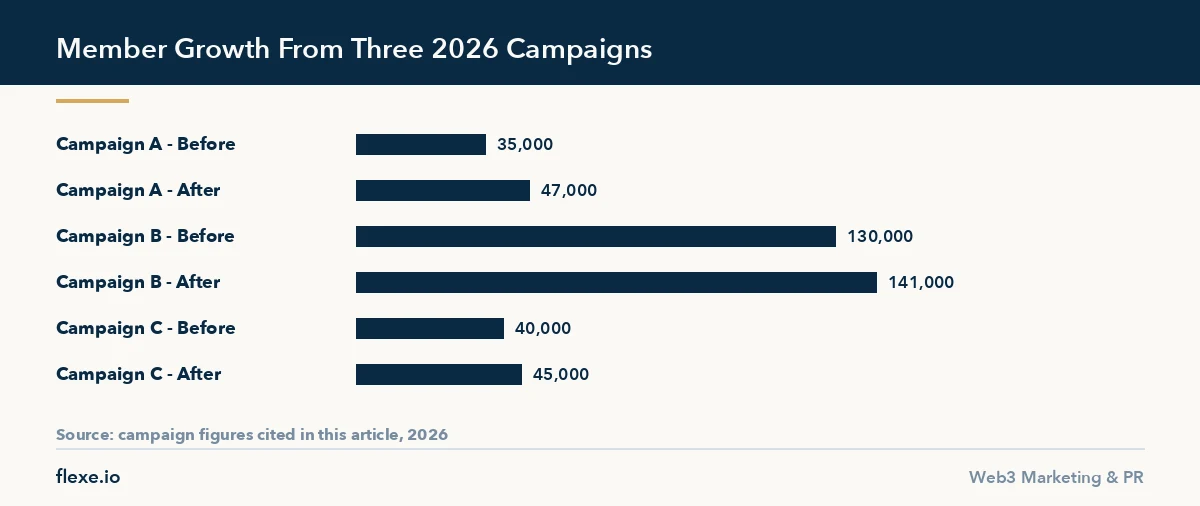
The first cause of an empty room is decided before launch. Task-based community campaigns run against a floor of 5,000 verified participants and a ceiling of 10,000 a month precisely because a slower campaign that can be verified retains better than a fast one that cannot. Three campaigns run that way in 2026 moved member counts from 35,000 to 47,000, from 130,000 to 141,000 and from 40,000 to 45,000.
- Best for: projects that still have time before listing day
- Budget: paced at 5,000 to 10,000 verified participants a month
- Metric to watch: retention of the paid cohort at day 30
- Watch out: fast growth nobody can verify
2. Hold back announcements
A roadmap item saved for week three gives the channel a reason to exist in week three.
- Best for: teams with a roadmap that can be staged
- Metric to watch: weekly activity in weeks three and four
3. Stage rewards past the listing
Paying part of any incentive after a holding period removes the claim-and-sell cohort before it arrives.
- Best for: airdrop and task campaigns
- Metric to watch: the drop between day 3 and day 14
4. Answer the hard questions publicly
A community that watches uncomfortable questions get answered stays through the next uncomfortable period. A channel where questions visibly wait trains people to stop asking them.
- Best for: every launch
- Metric to watch: the share of questions answered inside the agreed window
5. Give the channel a job
Governance, testing, translation and support give members a reason to open the app that is not the price.
- Best for: protocols with governance or a product to test
- Metric to watch: members posting on quiet days
6. Publish something weekly that is not an announcement
Data, a build update or an honest problem beats silence between milestones.
- Best for: the gap between roadmap items
- Metric to watch: replies and reactions per weekly post
7. Cover the languages you recruited in
A campaign that brought people in through regional groups and then answers only in English converts them into silent members within days, and they were the most expensive members to acquire. One person per major language for the first month costs less than the alternative, and the cost drops quickly once the repeated questions have been documented and translated once.
- Budget: one person per major language for the first month
- Metric to watch: activity of regional cohorts after week one
Because day 30 is when the campaign is actually judged: how we plan post-listing work.
How to plan it step by step
1. Staff the channel with a rota
The retention plan is mostly a rota. Decide before listing who is answering at three in the morning in the busiest time zone, who escalates a technical claim to someone able to confirm it, who approves anything touching supply, and how long an unanswered question is allowed to sit before it counts as a failure. An hour is a usable ceiling for the first week.
2. Write a handover document
Do not rely on the people who built the community. The document needs the current answers to the questions that repeat, the ones a moderator must never answer alone, the agreed wording for anything touching price or supply, and the contact who can reach the exchange out of hours. Most bad answers in the first week come from a moderator improvising under load at an hour when nobody senior is awake.
3. Separate moderation from support
The person removing spam should not be the person confirming how a reward claim works, because the first job rewards speed and the second punishes it. Two rotas with an explicit handoff keep a guessed answer from appearing in the same minute as a ban, and they give you a way to tell whether the channel is noisy or genuinely confused.
4. Prepare for impersonation
Impersonation peaks alongside the listing. Expect accounts copying moderator names to arrive in direct messages within minutes of the announcement: restrict who can message members where the platform allows it, pin the list of official accounts and addresses, and state plainly that staff never message first. A single successful impersonation costs more community trust than a week of good answers earns.
5. Rotate people out deliberately
A launch month moderated by two people who are permanently online ends with both of them exhausted in week three, which is precisely when the channel needs the most patience. Plan the relief before it is needed, keep a third person briefed even if they are not scheduled, and treat an exhausted moderator as an operational incident rather than as a personal failing.
6. Log what was asked, not only what was answered
Any question that appears more than a few times belongs in the pinned material, in the documentation, in the onboarding message, and in the following week’s post, which solves the problem of having nothing to publish between milestones. The log also shows what the audience misunderstood, usually a marketing problem rather than a support one.
7. Schedule who speaks for the project
A founder who shows up only when the price moves teaches the room that an appearance is a signal about price. Scheduled appearances on a fixed day, answering questions collected in advance, keep the presence predictable and keep the answers reviewed, which matters more in the weeks when there is nothing comfortable to report.
8. Tag the cohorts before listing day
Cohorts cannot be reconstructed afterwards. Every paid campaign, every regional group and every reward task needs its own entry point and its own identifier, carried through to the community platform wherever the tooling allows it. Once everyone sits in one channel with no record of how they arrived, the only available measurement is the total, and the total moves for reasons nobody can attribute.
Mistakes to avoid
Arguing about price after a fall. A price fall in the first fortnight is the most common shock, and the room will ask whether the team sold. Answer with the allocation and vesting facts that are already published, and point at where they can be checked, rather than offering reassurance about direction. The price is not answerable at all, and attempting it makes every later statement look promotional.
Letting holders discover a late payout. If a reward payout slips, publish the new date before anyone has to ask, state the reason without decoration, and pay the people who completed the task even where the campaign itself is cancelled.
Arguing with a hostile wave. A coordinated wave of hostile posts is handled by structure. Slow the channel, pin one answer that addresses the substance, and link every later question to it instead of retyping a defence. Delete only what breaks the stated rules, never criticism itself; a deletion screenshot travels further than the complaint.
Hiding a roadmap slip. Say so in the week it slips, in the channel, with the revised date and what changed. A missed date announced in advance costs a day of grumbling. Discovered later, it becomes evidence of a pattern, and patterns are what people leave over.
Refilling an empty room. If the channel is genuinely empty by week three, stop paying to move more people into it; the same outcome repeats at a higher price. Fix the reason first: something worth publishing every week, questions answered inside the window, a reason to open the app on a quiet day, and a job for members.
Renewing a contractor before reconciling. Growth bought from a contractor that stops working needs reconciliation before renewal. Ask for the participant list, compare it against join timestamps and verification records, and pause the next tranche while the comparison runs.
Deleting the old room after a platform move. Moving mid-month is survivable if nothing is deleted. Keep the old channel open in read-only form with a pinned pointer, announce the move twice with a gap between the announcements, and accept that a share of members will never make the jump.
How to measure results
Not peak members and not total impressions. The honest set is the share of day-one members still active at day 30, the number of holders rather than wallets, the proportion of community questions answered, and the retention of the specific cohorts you paid for, separated from organic arrivals. A report that mixes paid and organic cohorts cannot tell you which campaign to repeat.
- Define active once. Counting anyone who opened the app, posted, reacted or is simply still a member produces four different curves from the same month. Pick one, usually posted or reacted inside the last seven days, write it down and use it every week.
- Count holders, not wallets. Wallet counts rise when one person spreads a balance across addresses, fastest when an incentive rewards addresses. A rising address count against a flat balance-weighted holder base is churn being redistributed, not growth.
- Sample the answer rate. Take threads from a few fixed hours across the week and count questions answered by staff inside the window. A rate that falls in week three is the earliest warning that the rota has collapsed.
- Strip the bots first. Accounts that never post, react or open a link and arrived in one block inflate the denominator and flatter whichever campaign brought them. Verification at entry is the cheaper fix.
- Keep the raw exports. Platforms change what they expose and contractors change what they claim; the archived weekly file settles the dispute when the participant list and the member count disagree.
Report weekly on one page: cohort retention against the definition, the answer rate, holders, and what actually shipped that week. Circulating it while the month runs makes the day-30 figure a compilation rather than an excavation.
Watch departures as events rather than as a line on a chart. People leave in clusters, usually within a few hours of a specific post, a payout that did not arrive, or an answer that landed badly. Export membership with timestamps while the platform still has the data and look at what preceded each drop.
When the day-30 figure for token retention after listing is poor, report it anyway, internally and to any exchange contact who asks, with the change you are making and the date of the next read. Projects taken seriously on the next application are the ones whose numbers were the same before and after somebody asked.
Listings can also go the other way, and our token delisting guide explains what to tell holders when a venue drops your pair.
Frequently Asked Questions
Why does community activity collapse after a token listing?
Usually because the audience was rented rather than built, so it leaves when the payment stops. The other two common causes are a project that announced everything at once and has nothing left to say, and a first hard question after listing that went unanswered, which across 60-plus managed communities is the fastest way to lose a room.
When should a token launch be judged?
At day 30. Most launches look successful for about seventy-two hours regardless of quality, and trending pushes deliver almost all their organic views in the first two to three hours. The first honest read comes between day 4 and day 14, and the day-30 figure is the one that predicts everything after.
Is a drop in members after listing a failure?
Not in itself. Reward-motivated participants claiming and leaving in the first days is the design working. The failure signal is the day-30 figure, and specifically how much of the paid cohort remains once it is separated from organic arrivals and the obvious bot accounts have been stripped from the base.
What should a post-listing report measure?
The share of day-one members still active at day 30, holders rather than wallets, the proportion of community questions answered, and the retention of paid cohorts kept separate from organic arrivals. Use one fixed definition of active, report weekly on one page, and include what actually shipped that week.
How do you improve token retention after listing?
Verify growth instead of renting it, hold roadmap items back past launch, stage rewards after a holding period, and staff the channel so hard questions are answered within about an hour in the first week. Give members a job such as governance, testing or translation, and publish something useful every week.