This is usually argued as a philosophy question and it is not one. Media coverage and a community do different jobs at different points, and the order that works is decided by which asset a specific project is missing.
The failure both directions produce is symmetrical. Coverage that lands with nowhere to send the reader converts nothing. A community with nothing to discuss goes quiet in a month. Neither is a criticism of the channel.
What each one actually produces
| PR first | Community first | |
|---|---|---|
| Speed | Weeks, and a release can go out sooner | Months to build anything real |
| What it creates | Findability and third-party credibility | Retention and a feedback loop |
| Cost shape | Discrete campaigns | Continuous staffing |
| Who it reaches | People who have not heard of you | People who already arrived |
| Durability | Coverage stays indexed and quotable | Decays the moment attention stops |
| Failure mode | Traffic that lands and leaves | An empty room that reads as no traction |
| Effect on the other | Fills a community with strangers | Gives journalists something real to write about |
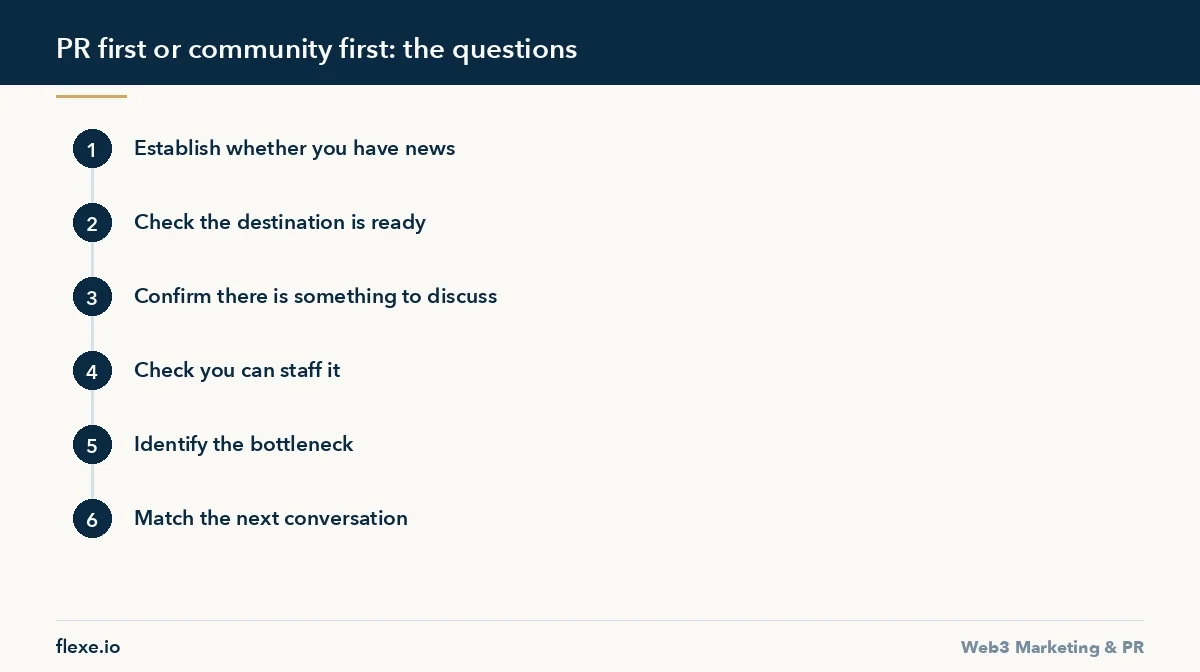
1. Do you have news, or only a project?
Journalists cover events, not existence. Funding with named investors, an incident and its handling, original data, a regulatory development affecting you, or a genuinely new capability are stories. A rebrand, a roadmap update or a partnership with no product consequence are not.
With no event, PR reduces to paid distribution: it puts a release in front of an audience but does not produce a reporter deciding you matter. Whether that is worth buying now is a different question from whether PR works. The distinction is set out in how to pitch a crypto journalist.
2. Is there somewhere for the reader to go?
Coverage sends people to your site, your channel and your product within a few hours and then stops. If the channel is empty, the documentation is thin or the product is not usable, that traffic converts at close to nothing and does not come back.
This is the most expensive mistake in the sequence, because the coverage is spent. You cannot re-run the same announcement once the destination is ready.
3. Is there anything to talk about yet?
Communities form around a shared activity. Users of a live product, testers, holders with a stake, people waiting for a specific thing on a known date all have a reason to be in a room together. A project with none of those is asking people to gather around an intention.
Twenty people talking is a community. Two thousand silent members is worse than no room at all, because the ratio is visible to everyone who looks. Getting the first fifty right is covered in how to build a Telegram group from zero.
4. Can you staff it?
Community is a continuous cost, not a campaign. It needs someone answering across time zones, moderation during the hours your team is asleep, and a publishing rhythm that does not break when the team is busy shipping.
PR is discrete. You can run a campaign, stop, and run another in three months without the first one decaying. A team that cannot commit continuous attention should not open the room yet, and should say so rather than open it and let it die.
5. Which asset is your bottleneck?
If people cannot find you, PR is the instrument. If people find you and do not stay, community is. Most teams can answer this from what they already see: traffic with no returning users points one way, a small engaged group with no new arrivals points the other.
Answering it honestly matters more than the choice itself, because both channels are usually funded on the assumption that the other is working.
6. What does the next conversation require?
Exchanges, launchpads and investors read both, and they read them differently. Coverage is a credibility signal that can be verified in a minute. Community is a demand signal, and the number they check is not membership but the ratio of visible activity to it.
If a listing application is imminent, coverage is the faster asset to produce. If the application will be judged on whether anyone actually wants the token, the room has to be real first.
The order that usually works
Open a small room early and keep it small, before there is anything to announce. Build coverage when there is an actual event and a destination worth arriving at. Then let each feed the other: coverage brings strangers the community converts, and community activity gives journalists something concrete to write about next time.
The version that fails is a large announcement into an empty room. The version that quietly works is a small room that was already alive when the coverage landed.
Media relations, outlet selection and distribution are on our crypto PR page, and moderation, staffing and retention on our crypto community management page.