Crypto shilling is paid or coordinated promotion of a token that hides the payment or the promoter’s own position, and since 2022 it has drawn SEC and FTC enforcement in the US.
Checked on 11 November 2026 against SEC, FTC, FCA and platform policy sources.
What does crypto shilling mean?
Shilling crypto means talking up a coin or token to create demand while hiding why you are doing it: a payment, free tokens, or a bag you plan to sell into the buying you create. The shill meaning in crypto is narrower than in auctions or poker, where a shill is a planted bidder or player, because here the hidden interest sits on a public timeline in front of thousands of readers.
Crypto shilling is the aggressive, often paid promotion of a token or project to inflate attention and price, frequently without disclosing the promoter stake. In 2026 it sits in a legal and ethical grey zone with real disclosure and securities risk. This guide explains what shilling is, its tactics, risks, legality, and how it differs from legitimate marketing. A crypto shiller is the person doing it, paid or unpaid, and an undisclosed payment is what turns promotion into a legal problem.
Key takeaways
- Crypto shilling is promotion designed to inflate hype, often paid and undisclosed, which separates it from honest marketing.
- Undisclosed paid promotion carries real legal risk under securities and advertising rules in many regions.
- For investors, treat heavy shilling as a red flag rather than a buy signal.
- For projects, disclosed and evidence-based promotion builds durable trust, while shilling risks penalties and reputation damage.
- The line between shilling and marketing is disclosure and honesty, not the channel used.
| Aspect | Legitimate promotion | Shilling |
|---|---|---|
| Disclosure | Paid partnerships disclosed | Stake hidden |
| Claims | Evidence-based | Hype and price predictions |
| Goal | Inform and build trust | Inflate attention and price |
| Risk | Low | Legal and reputational |
This guide is educational and is not financial or legal advice. Consult a qualified professional before running any promotional campaign.
The shilling definition crypto glossaries use covers both paid and unpaid promotion, and the difference matters. A holder who posts rocket emojis about a coin they own is shilling in the loose sense. An account paid in tokens to post the same message without saying so is shilling in the sense regulators care about. Enthusiasm is legal everywhere; concealment is what creates the liability.
What does shill mean in crypto?
As a noun, a shill is the account doing the promoting; as a verb, to shill a coin is to push it. So what does shilling mean in crypto day to day? Replies under every large post naming the same ticker, paid chats where members repeat a script, and videos that predict a price without mentioning the sponsor.
Early shilling was word of mouth on forums such as Bitcointalk. The ICO boom of 2017 turned it into a paid trade, with bounty campaigns paying tokens per post, and the 2021 cycle moved it to celebrities and large influencers. That history explains the shilling meaning crypto users carry today: any promotion is suspected of being paid until the promoter shows otherwise.
What tactics does a crypto shiller use?
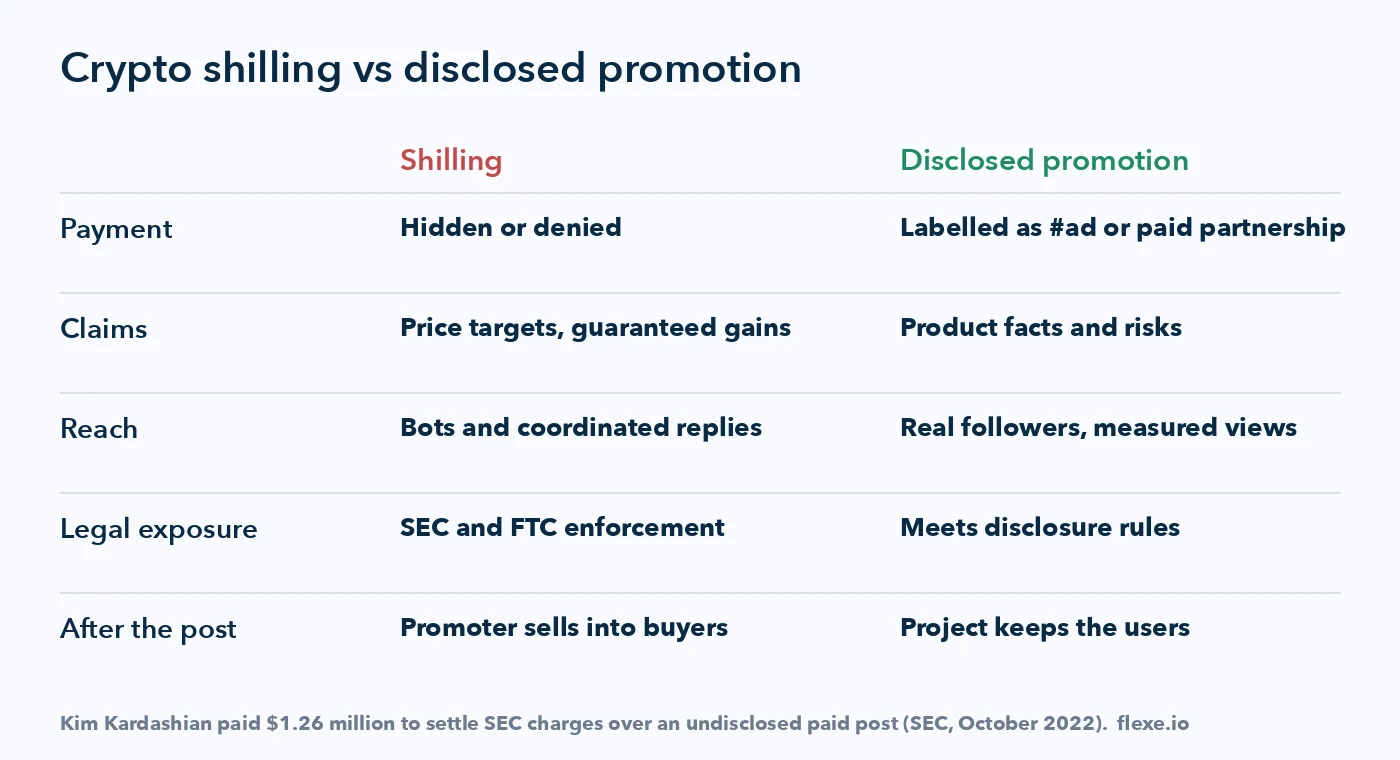
Tactics range from open to deceptive, and most campaigns mix several. The ones we see most often when screening accounts before a campaign are these:
- Social media campaigns: Coordinated messaging across X, Reddit, and Telegram
- Influencer partnerships: Enlisting crypto personalities to promote projects
- Airdrops and giveaways: Creating incentives for promotion
- Technical analysis: Presenting charts suggesting imminent price increases
How Telegram shilling groups work
Telegram shilling usually runs through paid groups. A project or promoter buys access to a chat whose members are told to post a script, raid the replies under a target post on X, or drop a contract address into other groups. Members are paid in tokens or stablecoins per action, and the output looks like spontaneous excitement from many unrelated people.
Two things make these groups a poor buy. Telegram’s terms of service ask every user to agree not to “send spam or scam users”, so the posting accounts get reported and banned. Channel size is also easy to fake: when we checked 299 crypto Telegram channels on 10 November 2026, 3 were deleted or private and 78 were idle, which is why our crypto Telegram directory ranks them by views rather than subscribers.
What does a project gain, and what does it risk?
A project gains attention quickly, and that is all it gains. Shilling can put a ticker in front of thousands of people in an afternoon, but the people it reaches arrive for the price rather than the product, and they leave when the price stops moving.
The risk side is longer. Regulators, platforms and the community itself now look for undisclosed promotion, and each of them can make it public. Excessive or misleading promotion invites regulatory scrutiny, community backlash and damage to the brand that outlasts the campaign. The projects that come out well treat promotion as explanation: what the product does, who it is for and what can go wrong.
Where is the ethical line?
The line is disclosure. A promoter who says plainly that the post is paid, or that they hold the token, has crossed nothing, however enthusiastic the post is. A promoter who hides either has crossed it, even if every claim in the post is true.
Accuracy is the second test. Exaggerating likely returns, playing down risk or promising future performance breaks advertising rules in most markets and securities rules in many. On X it now breaks the ad standard as well: on 16 October 2026 Elon Musk posted that advertisers whose ads overstate claims about their product will be barred from advertising.
How should an investor read a shill?
Treat heavy promotion as a reason to look harder, not a reason to buy. The red flags are consistent: many accounts posting near-identical wording within hours, claims about price rather than product, countdowns that push you to act now, and no mention of who paid. The shilling meaning crypto investors have learned is simple: if a post never mentions risk, assume someone is selling into your purchase.
Then check what the promotion avoids. Look for the team, the audit, the token vesting schedule and real usage, and compare the noise around the token with the activity on the product itself. A coin with loud promotion and a quiet product is the classic setup for a pump that ends with late buyers holding the bag.
What are the legal implications?
The clearest precedent is public. In October 2022 the SEC charged Kim Kardashian for promoting a crypto asset without disclosing the $250,000 she was paid, and she agreed to pay $1.26 million. In the US, the FTC Endorsement Guides require any paid post to say it is paid.
The UK is tightening further. Crypto promotions there already fall under the financial promotions regime, and on 30 September 2026 the FCA opened the authorisation gateway for its new cryptoasset regime, with applications closing on 28 February 2027. Promoting a token to UK residents on behalf of a firm that cannot lawfully market it can be a criminal offence, not only a reputational problem.
Platforms now enforce disclosure themselves. X has offered a native Paid Partnership label since 1 March 2026, and YouTube’s Branded Content Policies, published on 3 September 2026, list financial services as a restricted category and say YouTube may apply a branded content label automatically. Influencers and project teams should assume an undisclosed placement will be labelled, reported or both.
Can paid promotion build a real community?
It can, if the payment is visible and the product gives people something to talk about. Sustainable promotion builds a group that understands the product and keeps posting after the campaign ends, which is why ambassadors who hold the token and say so outperform anonymous accounts paid per post.
Measure the outcome on what stays: active wallets, product usage, questions in the community channel and repeat contributors.
What good practice actually looks like
Ethical promotion is not a weaker version of shilling crypto. It is a different product, built on these habits:
- Full disclosure: Always revealing financial interests or compensation
- Evidence-based claims: Backing promotional statements with verifiable facts
- Balanced perspectives: Acknowledging both strengths and limitations
- Educational focus: Helping audiences understand the technology and value proposition
Which approaches still work?
Disclosed promotion that explains a real product still works, and it works better than volume. Campaigns that move the needle show what the product solves and back each claim with something a reader can check, from a live demo to an audit report.
A plan that replaces shilling usually combines the following:
- Educational content: Articles, videos, and infographics explaining the project
- Community engagement: AMAs, developer calls, and transparent updates
- Partnership announcements: Collaborations that add something real to the ecosystem
- Development milestones: Concrete progress demonstrating team capability
Creator placements follow the same rule: vet each account on views and real replies, and require the platform’s paid label. Our guide to crypto marketing on X covers how we screen accounts before booking, and why follower counts are the number to distrust.
Case studies: what actually happened
Elon Musk and Dogecoin
The most cited case of influencer-driven hype involves Elon Musk and Dogecoin. His posts from 2020 onward repeatedly coincided with sharp Dogecoin rallies, and when he called the coin “a hustle” while hosting Saturday Night Live in May 2021, the price fell during the broadcast. Musk never hid that he liked the coin, which makes this a case about influence and volatility rather than concealment.
Crypto.com and Matt Damon
In October 2021 Crypto.com launched its “Fortune Favors the Brave” campaign starring Matt Damon, and a company spokesperson told CoinDesk the exchange had invested $100 million in it. The ad was disclosed advertising, not shilling, yet it aired weeks before the market peak and became shorthand for celebrity hype. Disclosure protects a project legally; it does not protect it from bad timing.
Cardano’s Community-Led Approach
Cardano offers an example of more sustainable promotion, building a dedicated community through educational content, academic research papers, and transparent development updates. Rather than relying on price promises, Cardano’s promotion focused on its technology and peer-reviewed research, creating a knowledgeable community that supported the project through multiple market cycles.
Why Shilling Stopped Working and What Replaced It
Coordinated promotion is now detected by the audience it targets, and increasingly by the tools that measure it. The economics that made shilling attractive have inverted, and audiences are tuning the topic out: on 30 April 2026 Nikita Bier, then head of product at X, listed crypto as the most snoozed topic on the platform, ahead of politics.
- Sentiment tools cannot separate paid from genuine, but people can. Identical phrasing across accounts is spotted within hours and becomes the story instead of your product.
- Platforms remove it faster. Coordinated inauthentic behaviour policies now cover crypto promotion explicitly on most major platforms.
- The cost of being caught rose. A project publicly identified as shilling loses the credibility it was buying, and the accusation outlives the campaign.
- What replaced it: fewer, disclosed partnerships with people who hold the asset, and community members given reasons to post rather than payment to post.
The uncomfortable arithmetic: disclosed promotion from a credible account converts better per dollar than undisclosed volume, and it does not create a liability that surfaces later.
Where paid promotion is the right call, it should at least be disclosed and placed properly. We run X campaigns and Bitcointalk promotion with the placements named up front.
Picking the accounts is the part that decides the outcome, and follower counts will not tell you which ones deliver. If you would rather hand that over, our crypto influencer marketing team screens every account for bought engagement before it enters a campaign.
The accounts that still move attention without shilling are ranked in our list of the top crypto influencers in 2026.
Promoting a token without shilling? Flexe.io has run 800+ campaigns since 2018 with disclosed creator posts, PR and community work. Send the project and the goal to Flexe.io on Telegram, and within 24 hours we return a free plan built on disclosed promotion and measurable results.
Frequently Asked Questions
What does shilling mean in crypto?
Promoting an asset you hold, usually without disclosing that you hold it, to drive demand you benefit from. The word covers everything from an undisclosed paid post to coordinated campaigns designed to look organic. What separates it from legitimate promotion is concealment of the interest, not enthusiasm.
Is shilling crypto illegal?
It can be. Undisclosed paid promotion breaches advertising rules in most major markets, and promoting a financial product without required authorisation or disclosure carries additional liability in many of them. In the UK the FCA opened its new cryptoasset authorisation gateway on 30 September 2026. Coordinated promotion intended to move a price can attract market manipulation analysis. This is not legal advice.
How do you tell shilling from legitimate promotion?
Disclosure and substance. A legitimate promoter states the relationship plainly and can explain what the product does and what its weaknesses are. Shilling avoids the disclosure, focuses on price rather than product, and creates urgency. If the only argument is that the price will rise, treat it accordingly.
Why is shilling bad for a project long term?
Because it selects for holders who came for the price and leave when it moves. Projects that grew through undisclosed promotion end up with a community that has no interest in the product, which shows the moment incentives stop. It also creates real legal exposure that lands on the project, not on the promoter.
What should a project do instead?
Pay for promotion openly and require disclosure from every promoter, brief creators on the product rather than the price, and accept that credible partners will refuse claims they cannot support. On X and YouTube that now means the platform’s own paid label. It produces slower growth and a base that stays, and it does not create liability.
What are the risks of hiring a crypto shiller?
Beyond the legal exposure, the practical risks are a community that evaporates, permanent reputational damage when it is exposed, and platform bans that remove the accounts you paid for. Communities in this sector actively investigate promotion patterns, and the discovery is usually public, often with screenshots of the payment terms attached.
What are Telegram shilling groups?
They are chats where members are paid, usually in tokens or stablecoins, to post a supplied script, raid the replies under posts on X or spam other groups with a contract address. The activity looks organic but is bought, and it breaches Telegram’s own anti-spam terms, so accounts get banned. Projects that buy it get short spikes and a reputation as a shilled coin.