When choosing a crypto ad network, keep in mind that networks are sold on reach, and reach is the least reliable thing about them. Inventory is resold between networks, traffic estimates are quoted from figures collected once and never rechecked, and the same placement often appears in three different media kits at three different prices.
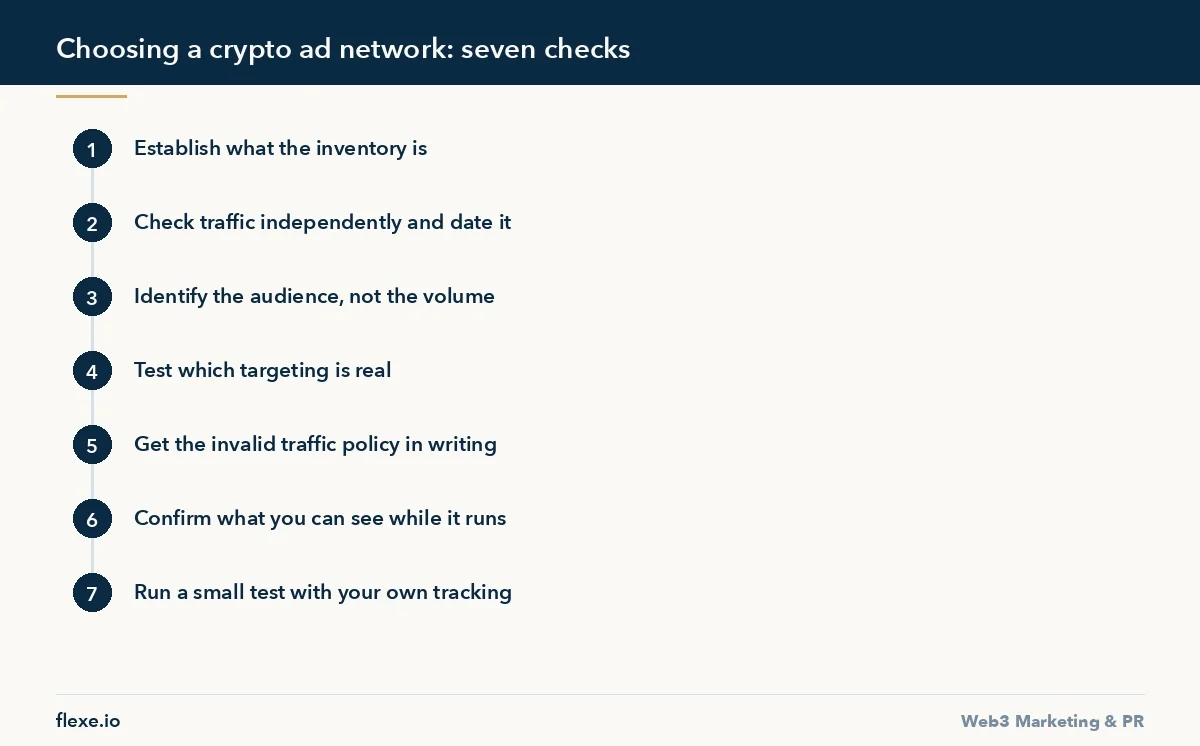
When choosing a crypto ad network, these seven checks separate a network worth testing from one that will spend your budget on traffic nobody can account for.
1. Ask what the inventory actually is
Three kinds of inventory get sold as one. Direct placements on named sites are the most accountable: you know where the banner runs and can look at it. Programmatic inventory is a pool you cannot enumerate. Resold inventory is another network’s supply with a margin added.
Ask which of the three you are buying, and ask for the named sites. A network that will not name its top placements is selling the pool, whatever the deck says.
2. Check the traffic yourself, with a date
Take the sites the network names and check them in an independent traffic tool. Figures in media kits decay badly, and explorer and media traffic in crypto moves with the market, so a number from eighteen months ago can be several times the current reality.
Our own explorer inventory, checked against Similarweb in August 2026, sits at roughly 3.9 million monthly visits for Solscan, 3.4 million for Etherscan, 2.3 million for BscScan, 918,000 for Basescan and 759,000 for Polygonscan. Those same properties were being quoted three to four times higher from a December 2024 collection, which is exactly the decay pattern to expect from any deck that carries no date.
3. Establish who the audience is, not how many
An explorer visitor is a person with a wallet, mid-task, checking a transaction. A crypto news reader may hold nothing. A gaming portal audience overlaps with crypto only partly. These are different products sold at similar prices.
Match the surface to the action you want. Asking for a wallet connection makes sense next to a block explorer and very little sense beside an article someone is reading on a phone during a commute.
4. Find out what targeting is real
Networks advertise segments generously. Ask how each one is determined: contextual placement by site category is honest and limited, on-chain segmentation depends on what the network can actually observe, and declared interest data is frequently inherited from a third party and unverifiable.
The follow-up question is whether you can see performance split by segment. A network that reports only totals is one where the targeting cannot be checked. What genuine on-chain targeting involves is in how to set up wallet-based targeting.
5. Ask how they handle invalid traffic
Every network has some. The ones worth using can describe their filtering, will show you traffic rejected before billing, and have a stated position on what happens when you find fraud after the fact.
Get the refund or credit policy in writing before the first campaign. It is a straightforward conversation before spend and an unwinnable one afterwards.
6. Check what you can see while it runs
You need placement-level reporting, the ability to exclude a site mid-campaign, and enough frequency data to know whether you are reaching new people or the same ones repeatedly.
A dashboard showing impressions and clicks in aggregate is not enough to optimise anything. If you cannot see which placement produced which result, the campaign has one lever, which is stopping it.
7. Test small before committing
Run the smallest campaign the network will accept, against a conversion event you defined, with your own tracking rather than theirs. Compare their reported clicks against your recorded sessions.
A large gap between the two is the single most informative number in this entire process, and it is available for the cost of a test. Networks quoting attractive rates and reporting far more clicks than your analytics ever sees are common enough that the check should be routine.
Setting the test up so it answers
A test only settles anything if the conversion event is one you defined and can observe yourself. Pick the action that matters, instrument it before the first impression runs, and give each network its own tagged destination so results cannot be attributed to the wrong buy. Running two networks into the same untagged page produces a number that neither of them can be held to afterwards.
Give the test a full week rather than a weekend, and enough budget to produce a countable number of conversions rather than a handful. Crypto traffic patterns differ sharply between weekdays and weekends, and a buy judged on two days will mislead in whichever direction the market moved. Decide the spend and the duration in advance, and resist extending a test that is going well.
Exclude your own traffic and your agency’s before the first impression, and confirm the conversion event does not fire on page load, on an internal redirect or twice for the same visitor. Most disputes about a test’s result turn out to be disputes about the event definition, and that is a cheap thing to check in advance and an expensive one to argue about once both parties have a number they like.
Creative that survives the review
Ask for the creative specifications and the review rules before producing anything. Explorer and wallet placements have their own limits on wording and animation, and a set of assets rejected after production delays the test by a week for no useful reason. Where the network reviews manually, ask how long the review takes, because that time sits between your decision and your first data point.
Keep the destination consistent with the creative. A banner promising one thing that lands on a general home page wastes the click you just paid for, and the resulting conversion rate will be read as a verdict on the network rather than on the mismatch. Build the page before the buy, and make sure whoever approves the creative has also seen where it points.
Produce two distinct messages rather than several variations of one. A test that compares small wording changes needs far more traffic than a first buy will deliver, while a test comparing two genuinely different propositions can be read at a much smaller volume. Keep the destination identical across both so the difference you measure belongs to the message and not to the page behind it.
Contracts, payment and cancellation
Get the insertion order to name the placements, the dates, the total, the delivery commitment and the notice period for stopping. A buy described only as a package across the network gives you nothing to point at when the placements turn out to be different from the ones discussed on the call. Written placement names are also what make a mid-campaign exclusion an enforceable request rather than a favour.
Establish how payment works before committing. Prepaid balances that cannot be refunded change the risk of the test considerably, and a network that requires a large minimum deposit is asking you to commit before the check that the test exists to perform. Agree what happens to an unspent balance, and agree the window in which a delivery dispute has to be raised.
Questions the sales call should answer
Ask who manages the account after the contract is signed, and whether that person can see placement level logs or only the same dashboard you get. Ask what the minimum commitment is, how quickly a campaign can be paused outside working hours, and who produces creative if a format needs rebuilding. The answers describe what running the campaign will feel like more accurately than any case study does.
Ask which of their advertisers are running right now in your category, and look at those placements yourself. Live creative on the sites they named is verifiable in a browser, unlike a logo wall, and the absence of anything comparable to your product usually means the audience fit is being asserted rather than demonstrated. A network selling to your category continuously will have something visible.
Reporting gaps when choosing a crypto ad network
Reported clicks and recorded sessions never match exactly, and the reasons are worth knowing before you use the gap as evidence. Blockers stop analytics from loading, some visitors leave before the page executes anything, redirect chains lose parameters, and reporting timezones differ from the ones in your analytics. A modest difference is ordinary. A difference of several times is a finding, and it appears quickly.
Ask for the report split by placement, by day, by creative and by destination URL, and check that the totals reconcile with the dashboard you were shown during the sales conversation. Where a network can only produce a single aggregate figure, you are being asked to accept their arithmetic without the working, and every later optimisation argument will be conducted on their numbers rather than on yours.
Reading the first week honestly
Look at where conversions came from rather than where clicks came from. Placements frequently rank in opposite orders on those two measures, and the one that produces cheap clicks and no actions is the one that will consume the budget if nobody intervenes. Exclude the worst placements while the campaign runs, then check the following days to confirm the exclusion was actually applied.
Watch frequency alongside volume. If the same audience is being shown the creative repeatedly, performance falls even when the placement is sound, and the correct response is a wider buy or a second creative rather than a higher bid. Without frequency data there is no way to tell that case apart from a placement that never worked, which is why the reporting question is asked before the buy.
Fraud signals worth watching for
Compare the behaviour of the traffic against anything else you buy. Sessions that end almost immediately across every placement, visitors arriving from locations the campaign excluded, and clicks distributed with unnatural evenness across the hours of the day are the patterns that appear first. None of them is proof on its own, and all of them together on one placement is enough to exclude it and ask questions.
Keep the evidence in a form the network can check. Screenshots of your analytics mean little; an export with timestamps, the placement identifier, the referring URL and the parameters you set means a great deal. Send it while the campaign is still running, because a network can investigate live supply far more usefully than it can investigate a flight that ended last month.
When the numbers do not reconcile
Raise the discrepancy with the specifics attached: the placement, the dates, their figure, your figure and how yours is measured. A network that has seen the problem before will usually offer a credit or a makegood on a further flight. One that responds by questioning your analytics without looking at the data has told you what the next conversation will be like, which is useful information for a small amount of money.
Keep the exchange in writing and set a deadline for a reply. If the dispute window in the agreement is short, raising it late removes the remedy entirely, which is the practical reason for reading the terms before spending rather than afterwards. Whatever the outcome, record it against the network, because the same sales contact will be in touch for the next launch.
Increasing the buy after a good test
Raise spend in steps rather than all at once, and re-check the placement figures each time new inventory is added, since the sites named for a larger buy are rarely the same as the ones that carried the test. Performance that holds at a small spend often changes as the buy widens, because the additional impressions come from further down the same pool.
Keep the original test conditions available to repeat. Market conditions move, inventory is resold, and a network that performed well one quarter may be passing through different supply the next. Re-running the same small buy with the same tracking, a few months later, costs little and tells you whether you are still buying what you originally checked, which is the question the whole process exists to answer.
Watch the market as well as the campaign. Attention across crypto surfaces moves with price, so a buy that performed during an active period and disappoints in a quiet one may be reporting the market rather than the inventory. Note the conditions each test ran under, and compare buys against each other within the same period rather than against a result from a different one.
Keep at least one alternative network warm even when the current one performs. Inventory is resold, sales contacts change and a placement that carried a launch can be gone by the next one. A second supplier that has already passed a small test is the difference between a quick switch and a month spent repeating this whole process under deadline pressure.
Understand which pricing model you are on and what it shifts onto you. Paying per impression puts the quality of the placement entirely at your risk, paying per click moves part of it to the network, and paying per action moves most of it but usually costs more per result. Whichever applies, keep your own count of the thing you are being charged for.
For the full picture of paid crypto media, including when to hand it to a crypto advertising agency, see our guide.
Choosing a crypto ad network: crypto-native or mainstream
Crypto-native networks and explorers accept creative that mainstream platforms reject, and they reach people who already hold assets. Mainstream platforms reach far more people, apply financial promotion rules unevenly, and can restrict an account rather than refuse a single advertisement.
Most launches use both: crypto-native for the audience that can act immediately, mainstream retargeting to recover visitors who left. What passes moderation is covered in how to get crypto ads approved on mainstream networks, and the budget split in how to split a launch budget across channels.
Our own screened placements, the current traffic figures behind them and how campaigns are reported are on our crypto traffic acquisition page.