Cointraffic is a crypto native and display advertising network with premium publisher inventory and unusually strong European coverage, sold from a 500 dollar minimum on CPM and CPC. Among crypto-native networks it is the one to reach for when the campaign is a launch aimed at European markets. This review covers the inventory, the targeting, and the cases where a different network is the better answer.
Key Takeaways
- European publisher strength is the reason to pick Cointraffic over the alternatives.
- Native placements suit launches that need explaining; display suits announcements.
- Targeting is by publisher and geography, with no wallet-level signal.
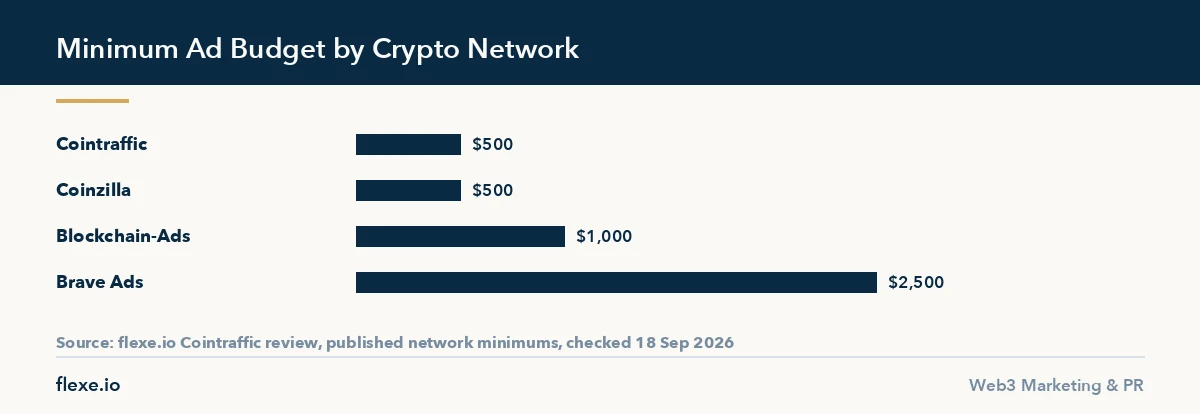
- At a 500 dollar minimum the entry is the same as Coinzilla, so the choice between them is inventory, not price.
- It is a launch instrument rather than a steady acquisition channel.
What is Cointraffic and where is it strong?
Cointraffic places native and display advertising across crypto publisher inventory, with a publisher base weighted toward European media. It is sold on CPM and CPC from a 500 dollar minimum.
The European weighting is the practical differentiator. A project whose target market is Germany, France or the Nordics will find publisher inventory here that a network built around global retail traffic does not carry, and geography is one of the few targeting levers these networks give you.
The second area where it is consistently used is NFT and DeFi launches. Native formats work for these because both categories require the reader to understand something before acting, and a native unit inside an article does that work better than a banner.
Native or display: which should you buy?
Native when the proposition needs a sentence to land, display when it needs a name and a date. A DeFi protocol explaining where its yield comes from is a native placement; a token generation event on a fixed date is a display placement.
Projects default to display because it is easier to produce, then conclude the network underperformed. The format mismatch is doing that, not the inventory.
Where does Cointraffic not fit?
Precision acquisition. Like Coinzilla, targeting runs on publisher category and geography rather than wallet behaviour, so campaigns optimising for deposits or wallet connections are operating without the signal that makes those campaigns efficient. Blockchain-Ads addresses that specific gap with on-chain targeting across 37 or more chains.
It also does not fit a genuinely exploratory budget. At a 500 dollar minimum the money buys one meaningful test, and if the creative is unproven that test answers the wrong question. Bitmedia at around 20 dollars a day is the instrument for that stage, and our Bitmedia review covers why the entry point matters more than it sounds.
Finally, it is not a steady-state acquisition channel. Campaigns here work as launches with a start and an end; running one continuously as a background spend produces diminishing returns as the publisher inventory saturates.
Cointraffic against the alternatives
| Network | Minimum | Inventory strength | Pick it when |
|---|---|---|---|
| Cointraffic | $500 | Premium, European-weighted | Launch aimed at European markets |
| Coinzilla | $500 | Largest crypto-native inventory | Awareness at maximum volume |
| Bitmedia | ~$20/day | Broad, global retail | Creative still unproven |
| Brave Ads | $2,500 | In-browser, consent-based | Privacy-conscious audience matters |
| Blockchain-Ads | $1,000 | Wallet-level targeting | Conversion event is defined on chain |
Cointraffic and Coinzilla sit at the same price with different inventory, which makes the choice between them a question of market rather than budget. If the campaign is European, start with Cointraffic; if it needs the widest possible crypto-media footprint, start with Coinzilla.
Running a Cointraffic campaign end to end
Before you commit the minimum budget
The 500 dollar minimum buys one meaningful test, so decide what that test is answering before the money moves. A launch aimed at European markets has a question worth asking here: does this proposition land with readers of premium crypto publishers in those countries. A question about the offer itself, or about whether the creative works at all, is cheaper to answer somewhere else.
Write the success condition down first, and in a form that can be settled: a cost per qualified action you can live with, and a named market showing measurable response. Campaigns judged after the fact against a moving definition of success always look ambiguous, and ambiguity is what keeps a budget running long past the point where it has stopped teaching anything.
Check the dates as well. This is a launch instrument rather than a background spend, so the flight should sit around an event that gives a reader a reason to act now. The creative, the landing page and the announcement all need to exist before the flight starts, not to be assembled while impressions are already being served.
Decide who is accountable for the flight before it starts, and give that person authority to change creative and to stop the spend. Short flights fail most often because the decision to change something waited for a meeting, and a launch instrument with a fixed end date has no room for a week of internal review. One named owner, one agreed check-in point, and a written note of what would make you stop.
Briefing the network on the market
Geography is one of the few targeting controls available, so the brief has to be specific about which countries matter and which are noise. Saying Europe when the product only works for German-speaking users spreads impressions across a continent for no reason. Name the markets, name the languages you can support, and say plainly which ones you will not be answering questions in.
Publisher category is the other one. Say what kind of reader the campaign wants and, if it matters for the brand, which contexts are unacceptable. Ask for the placement list you are buying into and read it properly, because a premium publisher base is the stated reason to be here and an unread list is an assumption rather than an advantage you can point to.
Settle how reporting will be broken out before anything is booked. Delivery split by placement and by country is what lets you tell whether the European weighting is doing real work or whether one publisher is quietly absorbing the budget. A campaign that comes back as a single line is a campaign you cannot learn anything from.
Producing native and display creative
Native and display are different briefs, not one asset resized. A native unit has to read as something a person would open inside an article, which means a headline stating the proposition and a landing page continuing the same sentence. Display carries a name, a date and one reason to look now, and it fails whenever somebody tries to explain a protocol inside it.
Produce more than one variant of each and decide in advance what separates them: the claim or the market. Variants that differ in several ways at once produce a winner nobody can explain, which leaves you with a result you cannot carry into the next flight and an argument about why it happened.
Localise properly where the market demands it. A machine translation of an English headline is obvious to a native reader and reads as a project that does not really serve them, which is the opposite of the reason to buy European inventory in the first place. Have someone who speaks the language read the landing page too, not only the advertisement.
What to agree before money moves
Get the commercial terms in writing: the buying model, what the minimum covers, how unspent budget is handled, how long a flight runs, and what happens if delivery stalls. Verify the published terms yourself at the moment you buy rather than taking any summary on trust, including this one, because network terms change and the version you agreed to is the only one that matters later.
Agree the approval path for creative and the turnaround for changes. A flight that cannot swap a headline within a working day loses days of a short campaign to a queue, and on a short flight each of those days is a meaningful share of the budget. Name the person on your side who can approve without convening anyone.
Decide who owns the account. An agency-held account is convenient until the relationship ends and the campaign history leaves with it. If somebody buys on your behalf, agree up front what you receive at the end: the placement list, the creative files, the reporting and the invoices, in a form you can hand to whoever runs the next campaign.
Tracking that survives a publisher buy
Targeting here runs on publisher and geography with no wallet-level signal, so the measurement has to come from your side. Tag every placement with parameters identifying the network, the format, the market and the flight, then confirm those parameters survive the landing page redirect before the first impression is served rather than discovering the loss at the end.
Define the event you actually care about and instrument it: a wallet connection, a form submission, some action further down than a page view. Optimising on visits teaches you which headline attracts clicks, which is a different question from which market responds to the proposition, and the two answers frequently point in opposite directions.
Test the whole path on a phone, on a cold browser, with nothing already connected. Plenty of disappointing campaigns turn out to have had a landing page that failed on mobile or a tracker that dropped half the sessions, and the network gets blamed for arithmetic that was never collected properly in the first place.
Reading the first week of delivery
Give the flight enough time to deliver before judging it, then read the split rather than the total. If one country produces almost everything, the question is whether that country is your market or simply the cheapest inventory available. If one format carries the campaign, the brief for the other format was wrong rather than the channel underperforming.
Compare cost per action against whatever you were doing before, not against a number you hoped for. A launch channel that delivers attention in a market you could not otherwise reach is doing its job even when it is not the cheapest line in the account, and judging it against a retargeting line is not a comparison at all.
Watch for saturation. Campaigns here work with a start and an end, and running the same creative into the same publisher base indefinitely produces diminishing returns. Falling response against steady spend is the signal to change the creative or to stop, and on a concentrated publisher base it usually arrives sooner than teams expect it to.
When to stop, extend or switch
Stop when the test has answered its question, including when the answer is no. A flight extended because nobody wants to report a negative result converts a cheap lesson into an expensive one, and the information is just as useful either way: knowing a market does not respond saves the next budget from being spent there.
Extend when the split shows a market responding and the creative still has room, and extend deliberately rather than by default: new creative, a tightened placement list, a defined end date, a stated question for the second flight. Extension without a change is the same test run twice at twice the price.
Switch when the question has moved. If the flight showed that the creative itself is unproven, the next spend belongs where testing is cheap. If it showed that conversion depends on behaviour you cannot address through publisher and geography, the next spend belongs with the category built on chain data, as set out above.
What this Cointraffic review leaves to you
A review can tell you what a network is structurally good at. It cannot tell you whether your proposition, your landing page and your chosen market are ready, and those decide the result more often than the inventory does. Run the small checks first: does the page load quickly in the country you are buying, does the copy answer the objection a cautious reader actually has.
Keep a record of every flight: dates, markets, formats, creative, cost per action, and what you changed between them. Two of your own campaigns compared honestly are worth more than any external benchmark, because they are measured on your funnel with your definition of a conversion rather than on somebody else’s reporting conventions.
And treat every published figure as something to confirm at the moment you buy, the minimum included. Terms move, inventory changes hands, and the version of a network described in any review is not necessarily the one selling to you this quarter. Nothing here is financial advice, and the verification is part of the work rather than an afterthought.
To compare Cointraffic with other networks and formats, see our crypto advertising guide.
Frequently asked questions
What is the minimum budget for Cointraffic?
Around 500 dollars, on CPM or CPC, which is the same entry point as Coinzilla. The choice between the two is publisher inventory rather than price.
Is Cointraffic good for NFT launches?
It is one of the networks most used for them, largely because native formats suit a proposition that needs explaining. A banner rarely carries an NFT project effectively.
Does Cointraffic offer wallet targeting?
No. Targeting is by publisher and geography. For wallet-behaviour targeting the relevant category is networks built on on-chain data.
Cointraffic or Coinzilla for a European launch?
Cointraffic, on inventory. European publisher coverage is its structural advantage, and geography is one of the few levers either network gives you.
Where to go next
For the full comparison across networks, see our guide to crypto ad networks, and for the largest-inventory alternative see the Coinzilla review. For campaign records, see our paid advertising case studies.
Planning a European launch? Send the brief on Telegram at https://t.me/flexe_io_agency and we will come back with a network recommendation and a placement plan within 24 hours.
Nothing here is financial advice. Network terms are as published by the networks and change; verify before committing budget.
If you would rather have this run for you, see our paid acquisition service.