Crypto marketing on X splits into two products that get sold as one: creator placements, which buy distribution beyond your followers, and X Ads, which buy targeted reach in specific markets. The first is where most crypto budgets go and where most of the fraud sits. This guide to crypto marketing on X covers both, with the screening figures from our own network.
Key Takeaways
- A screened crypto network averages around 1.74 percent engagement. Rosters advertising several times that are usually measuring reciprocal activity.
- Follower count is the number in the proposal. Views per post is the number that predicts the result.
- X buys reach beyond your existing audience, which makes it a top-of-funnel channel rather than a retention one.
- X Ads clear moderation for crypto and allow geographic targeting that creator placements cannot.
- Screen before booking, not after. Engagement fraud on X is cheap, industrialised and invisible in a screenshot.
What does the engagement rate actually tell you?
It tells you whether an audience exists. Our active X roster runs 85 verified accounts with 8.7 million combined reach, an average of 102,199 followers per account and 12,615 median views per post, at an average engagement rate of 1.74 percent.
Hold that figure as a reference. A network quoting four percent or higher across hundreds of accounts is either measuring something different or not screening, because reciprocal engagement pods produce exactly that signature: high engagement, low view counts, and comments from the same rotating set of accounts.
Screening runs through three independent tools, Wallchain, Sorsa and TwitterScore, before an account enters a campaign. Using one tool catches the obvious cases; the accounts worth catching are the ones that pass a single check.
What do campaigns produce?
| Campaign | Result |
|---|---|
| Screened KOL campaign | 507,000 impressions over 18 days at 2.0% engagement, with a 4.2% increase in holders |
| MARGEX, engagement-focused | Engagement up more than 270%, organic reach up more than 430% |
| X Ads, African markets | 650,000 people reached, 2,500+ visitors, targeting Nigeria, Kenya, South Africa, Ghana and Zambia |
The holder figure in the first row is the one worth noticing. Impressions are easy to buy and prove nothing; a measurable change in holders over the same window is the only evidence that the impressions reached people who act.
Crypto marketing on X: creator placements or X Ads?
| Creator placements | X Ads | |
|---|---|---|
| Buys | Credibility by association, algorithmic reach | Targeted impressions |
| Geography | Whatever the creator audience is | Targetable by country |
| Main risk | Fake engagement | Moderation rejection |
| Half-life | Days | Runs while funded |
| Buy it for | Launches, narrative, trust transfer | Specific markets, steady acquisition |
Our African campaign is the clearest case for ads: the client needed investors from five specific countries, which no creator selection can deliver reliably. Lookalike audiences cleared moderation and reached 650,000 people in the opening phase.
How do you spot a fake account before paying?
Start with views rather than followers. An account with 200,000 followers averaging 900 views per post is selling a number that no longer corresponds to an audience, and this is the single most common case.
Then look at who replies. Reciprocal pods leave a visible fingerprint: the same handles appearing under every post, replies that respond to nothing specific in the content, and engagement that is high relative to views rather than to followers. Check whether the follower graph has steps in it, since organic growth is gradual and purchased growth arrives in blocks.
The full vetting method across formats is in our guide to crypto influencer channels.
What crypto marketing on X will not do
Retain anyone. X reaches people who follow nobody in your niche, which is exactly what a launch needs and exactly the wrong tool for keeping them. The arrivals need somewhere to land, and a project that runs X placements into an inactive Telegram group converts the reach into nothing.
Sequence it: X to create awareness, then a community channel to convert it. Our guide to where crypto communities live covers the second half.
How to brief a creator
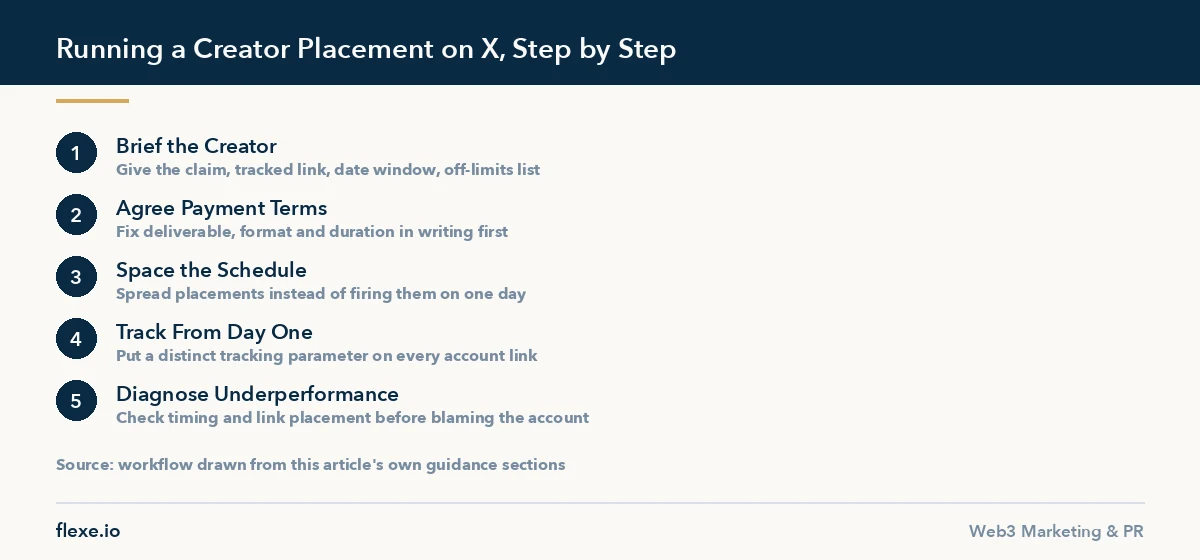
A brief that produces a usable post is short and specific about constraints rather than about wording. Give the account the one claim you want carried, the link with tracking already attached, the date window the post has to fall inside, and the things it must not say. Leave the phrasing to the creator, because an audience recognises a post written by the project and discounts it, and a rewrite in the creator’s own voice is the whole reason you paid for the placement.
Ask for the draft before it goes live and read it for two things only: whether the claim survives, and whether anything in it reads as a promise about returns. Creators accept edits on facts and resist edits on tone, which is the correct instinct. A draft returned with rewritten jokes takes longer and performs worse than the same draft with one corrected figure.
Disclosure belongs in the brief rather than in an argument afterwards. Say plainly that the post has to be marked as paid, then check the marking survived into the published version. An audience that later discovers an undisclosed placement blames the project rather than the account, because the project is the party with something to sell, and the cleanup costs more than the placement did.
Paying for crypto marketing on X
Agree the deliverable in writing before any money moves: which account posts, in what format, how long the post stays up, and whether reposts from the same handle are included or billed separately. The most common dispute is deletion. A post removed after two days has not delivered what the screenshot in the report suggests, so write a minimum live period into the agreement and verify it yourself.
Split the payment so part of it depends on delivery. Pay on booking to hold the slot, and pay the balance once the post has been live for the agreed period and you have pulled your own numbers. Accounts that refuse any staged payment are usually the ones that would not survive the checks you ran before booking, and the refusal itself is a screening signal worth acting on.
Agreeing the posting schedule
Spread placements instead of firing them on one day. A cluster produces a single visible spike and then silence, and anyone checking afterwards sees a campaign rather than a conversation. Placements spaced across the window give the later accounts something to reference, and give you time to stop the programme if the first post shows the audience is not real.
Schedule against the audience you want rather than your own working hours, and avoid the hours when a major listing or market event takes over every timeline. If the campaign supports a dated event, keep at least one placement after the date, since the people who act often arrive from a post they saw earlier and came back to.
What to track from day one
Put a distinct tracking parameter on every account’s link before the first post goes out. Retrofitting this mid-campaign leaves you comparing a creator who sent buyers against one who sent nobody, with no way to tell which was which. Where the link cannot carry a parameter, give each account its own landing path or its own code so arrivals can still be attributed to the placement that produced them.
Record views per post for each placement on the day and again a week later, next to the figure the account quoted at booking. That comparison is the asset the campaign leaves behind, and it is what makes the next round cheaper. Our roster gets a median of 12,615 views per post, so an account landing far under its own recent average is a renegotiation rather than a loss.
Impressions are the number a report leads with and the one that proves least. Agree in advance on a second measure that is harder to buy: arrivals in the community channel during the placement window, or holder movement over the same days. The screened campaign in our records is worth citing for exactly this reason, since the 4.2 percent change in holders is what made 507,000 impressions mean anything. The brand work that should be in place before any placement, from official links to a posting rhythm, is in our guide to build a crypto brand on social media.
When a placement underperforms
Check the post before blaming the account. Look at whether it went out at the agreed time, whether the link sat where you agreed it would, whether the format matched the brief, and whether the account posted anything else in the same hour. A placement that broke the brief is a reposting question rather than a refund question, and most creators will redo it, because they would rather keep the relationship than argue over one post.
If the post was correct and the numbers are still far below what the account normally does, the audience was the problem and the screening missed it. Stop the remaining placements with that handle and feed the verification scores you pulled back into the shortlist. The money already spent buys information about the roster, which is only wasted if you book the same account again.
Getting X Ads through moderation
Moderation reads the landing page as well as the creative. Before submitting, make sure the destination states plainly what the product is, carries a risk note, names the company behind it, and contains no wording that reads as a guaranteed return. Submit one variant and read the rejection reason properly, then change only the thing it names, because changing everything at once leaves you without any idea of what passed.
Budget calendar time for it. A rejection followed by a resubmission can take days, and that lead time belongs in the plan rather than in the week of a launch. Once an ad set is live, most of the improvement comes from bid and placement iteration rather than from new creative, so keep the approved asset and work the settings around it.
Mistakes that waste the budget
The expensive mistake is buying reach before the destination is finished. X sends people who follow nobody in your niche, and they arrive once. A half-written landing page, or a group with nobody answering questions, turns 507,000 impressions into a line in a report. Finish the destination and staff it for the days the placements run, then book the accounts.
The quieter mistake is paying for followers rather than viewers. Proposals are written in follower counts because that is the flattering number, and an account with 200,000 followers averaging 900 views per post will still be sold on the first figure. Ask for a screenshot of the account’s own analytics covering recent posts, and treat a refusal to share it as an answer.
Judging the campaign on the day of the last post ends good campaigns early. Reach on X decays within days, but the people who act often act later, so pull the numbers again a week after the final placement and compare both readings against what you paid. Plenty of campaigns get written off before the second reading exists.
Paying for a thread when a single post is what you need is the last of the avoidable losses. Threads are priced higher and ask the reader to keep going, and a launch message that amounts to a name and a date does not need several steps. Buy the single post and put the difference into another account in an adjacent niche.
Running several accounts together
Keep one account back until the campaign is nearly over. A placement running after the launch week reaches the people who heard the name during it and did nothing at the time, and it costs the same as one booked into the crowded window. Campaigns that spend everything before the event have no way to answer the questions the event produced.
Coverage comes from adjacent niches rather than from one large handle, because audiences inside a single niche overlap heavily and you end up paying twice for the same people. Build the shortlist across neighbouring topics, then check the overlap by hand: open the accounts side by side and look at who replies under each. Repeated handles across two rosters mean you are buying one audience twice.
Decide the order as well as the mix. A smaller account posting first gives you a cheap read on whether the message lands before the largest placement is committed, and the reply threads under that first post are usable material for the later briefs. Hold part of the budget back until that read exists, since a message that draws no questions from a small audience will draw none from a large one.
Keep the shortlist between campaigns. Verification scores, views per post at the time of booking, what each account charged and what it delivered: that file is worth more than the next proposal you receive, because it is the only version of the roster written from your side of the transaction.
Frequently asked questions
What is a realistic engagement rate for a crypto account on X?
Around 1.74 percent across a screened network, which is the average across the 85 verified accounts in our active X roster. Individual accounts vary, but a large roster averaging several times that figure has not been screened.
Can you run X Ads for a crypto project?
Yes. Our campaign targeting Nigeria, Kenya, South Africa, Ghana and Zambia passed moderation and reached 650,000 people through lookalike audiences in its opening phase.
Is one large account better than several small ones?
Several smaller accounts in adjacent niches usually reach more distinct people, because audiences within one niche overlap heavily. A single large account is better when the goal is frequency rather than coverage.
How many independent checks should an account pass?
More than one. We screen through Wallchain, Sorsa and TwitterScore, because the accounts worth catching are precisely the ones that pass a single tool.
Where to go next
For campaign records including the African ads campaign, see our paid advertising case studies. For the service, see crypto influencer marketing.
Planning an X campaign? Send the brief on Telegram at https://t.me/flexe_io_agency and we will come back with a vetted account shortlist and verification scores within 24 hours.
Nothing here is financial advice. Network figures are first-party data from our own campaign records.