Tokenising a real-world asset takes six steps, and only one of them is technical. The $27,59 billion already tokenised across 156 protocols sits overwhelmingly in two asset classes, Treasuries at 40,7% and gold at 18,3%, because those are the two where the legal wrapper is settled and cheap. The token standard most of that value uses, ERC-3643, exists to enforce who is allowed to hold the token, which tells you where the difficulty actually is. Market figures from DefiLlama on 4 September 2026.
| Step | What it produces | Who does it | Where projects stall |
|---|---|---|---|
| 1. Pick the asset | A claim that can be owned in fractions | Issuer | Assets whose value needs a valuer each time |
| 2. Build the legal wrapper | An SPV or fund that holds the asset | Counsel, in the issuing jurisdiction | Choosing the jurisdiction after writing the contract |
| 3. Decide who may hold it | An eligibility rule: retail, professional, or by country | Issuer plus counsel | Assuming anyone can buy, then discovering they cannot |
| 4. Choose the token standard | A contract that can enforce step 3 on transfer | Engineering | Using a plain fungible token and bolting rules on later |
| 5. Connect off-chain facts | Price, NAV or attestation arriving on chain | Issuer plus data provider | No agreed source, so the token has no verifiable value |
| 6. Onboard and service | Identity checks, registers, distributions, redemptions | Issuer, transfer agent | Treating this as launch work rather than permanent work |
The legal wrapper decides everything after it
A token is a record of a claim. If nothing enforceable stands behind it, holders own a number in a database. That is why every product in the market’s top ten sits inside a fund or a special purpose vehicle: the entity owns the asset, the token represents an interest in the entity, and the enforceability comes from company and securities law rather than from the chain.
The consequence is that jurisdiction is picked before code. Spiko, one of the five largest products at $2,50 billion, states in its own description that its funds are regulated by the French financial markets authority. That sentence is the product. The chain choice, the wallet support and the branding all sit downstream of it.
Permissioned transfer is the whole technical problem
Once eligibility rules exist, the token has to enforce them on every transfer, including transfers the issuer never sees. That is what ERC-3643 does: it binds transfers to an on-chain identity registry so an ineligible address simply cannot receive the token. The standard’s association publishes the specification and the identity components alongside it.
Teams that start with a plain fungible token discover this at the worst moment, when the token is already tradeable and the rules have to be retrofitted. The retrofit usually means a migration, and a migration of a security means contacting every holder. Choosing the standard is step four for a reason: it is a consequence of steps two and three rather than an independent decision.
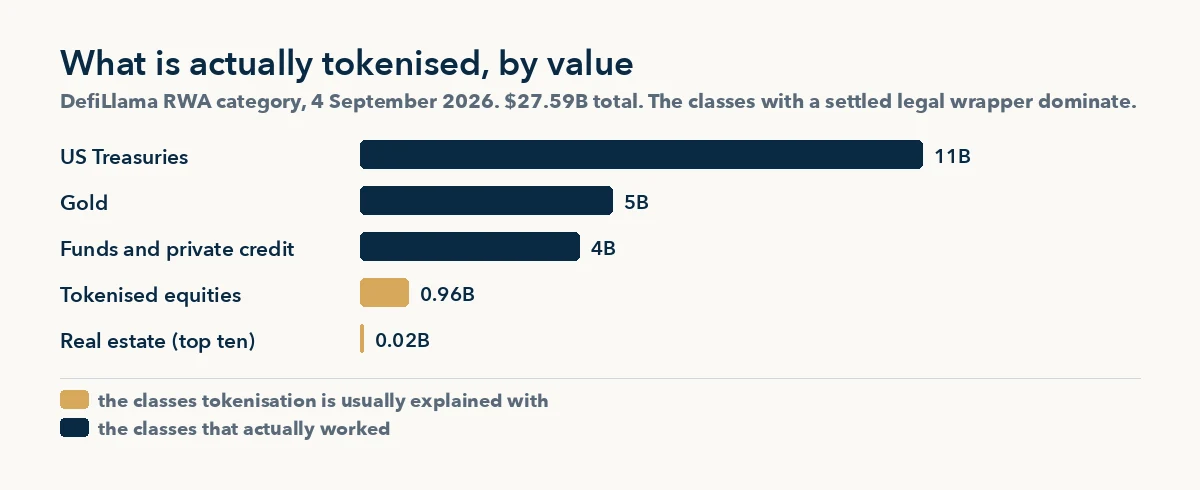
What the market’s own shape tells you
- Treasuries are 40,7% of tokenised value. $11,24 billion. The asset needs no appraisal, the legal form is standard, and the yield is the product. Nothing about it is a blockchain problem, which is exactly why it worked first.
- Gold is 18,3%. $5,05 billion in two products. One vault, one auditor, one unit. The simplest possible claim and the second largest category.
- Tokenised equities are $961 million. The single largest product in that class. Equities have registrars, corporate actions and jurisdictional trading rules, and the gap between them and Treasuries is what that complexity costs.
- Real estate is absent from the top ten entirely. The asset class most often used to explain tokenisation is the one where valuation, transfer taxes and title make step 2 hardest.
Servicing never ends, and that is the real cost
After launch the issuer still has to verify new holders, keep the register accurate, publish valuations, pay distributions and process redemptions, in every jurisdiction where a holder lives. None of that is automated by the token; the token only enforces the rules someone else maintains.
This is where the honest comparison with a conventional fund gets uncomfortable, because a transfer agent already does all of it. Tokenisation changes settlement speed, fractional size and who can reach the product, and it does not remove the operating burden. Projects that budget for a launch rather than for an operation are the ones that stall at step 6.
What this does not cover
This is the sequence, not legal advice, and the specifics change by jurisdiction and asset. Nothing here tells you whether your asset qualifies as a security where you are issuing, what licence the distribution requires, or how a court in that jurisdiction would treat the token if the entity failed. Those are the questions counsel exists for, and they are the ones that decide the outcome.
For where the existing products sit and how large each is, see our ranking of RWA tokenization platforms by assets. For the distribution question once a product exists, our notes on marketing an RWA or stablecoin product cover who the buyer actually is, and the stablecoin ranking shows where tokenised funds now overlap with payment tokens.
Frequently Asked Questions
How do you tokenize a real-world asset?
Six steps in order: pick a fractionable asset, build the legal entity that holds it, define who may hold the token, choose a standard that enforces that on transfer, connect an off-chain price or valuation source, then run identity checks and servicing permanently. Only step four is engineering work.
Which token standard is used for real-world assets?
ERC-3643 is the common choice for permissioned assets. It ties transfers to an on-chain identity registry, so an ineligible address cannot receive the token at all. That matters because eligibility rules have to hold on transfers the issuer never sees, which a plain fungible token cannot enforce.
Why do most tokenized assets end up being Treasuries?
Because the hard steps are already solved for them. Treasuries need no appraisal, the fund structure is standard, and the yield is the product. They account for $11,24 billion, or 40,7% of the $27,59 billion tokenised. Gold follows at 18,3% for the same reason: one vault, one unit, one auditor.
Can you tokenize real estate?
It is done, and no real estate product appears in the ten largest tokenised assets. Valuation needs a valuer each time, transfer taxes apply in many jurisdictions, and title systems are not built for fractional holders. The asset class used most often to explain tokenisation is the one where the legal step is hardest.
What do teams underestimate most?
Servicing. After launch someone must verify new holders, maintain the register, publish valuations and process redemptions in every jurisdiction where holders live, permanently. The token enforces rules but does not maintain them. Budgeting for a launch rather than an operation is the most common way these projects stall.
Related reading
European issuers will meet the disclosure regime described by the European Securities and Markets Authority before any of the on-chain work matters.