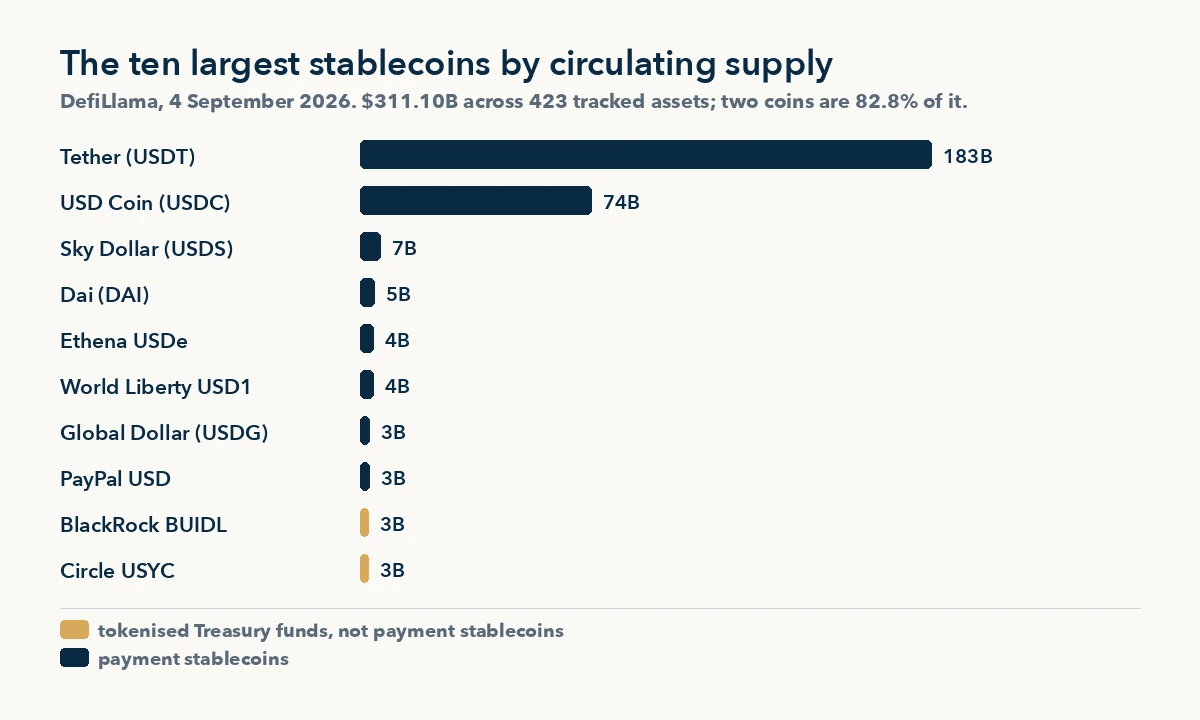
The ten biggest stablecoins by circulating supply hold $289,24 billion of a $311,10 billion market spread across 423 tracked coins, so the top ten are 93% of it. Tether stands at $183,34 billion and USD Coin at $74,34 billion, which together is 82,8%. Two entries in that top ten are not really stablecoins in the old sense: they are tokenised Treasury funds that ended up in the same table. Figures read from DefiLlama on 4 September 2026.
| Stablecoin | Ticker | Circulating | Share | Backing |
|---|---|---|---|---|
| Tether | USDT | $183,34B | 58,9% | Fiat and equivalents |
| USD Coin | USDC | $74,34B | 23,9% | Fiat and equivalents |
| Sky Dollar | USDS | $6,59B | 2,1% | Crypto collateral |
| Dai | DAI | $4,81B | 1,5% | Crypto collateral |
| Ethena USDe | USDe | $4,31B | 1,4% | Crypto collateral, hedged |
| World Liberty Financial USD | USD1 | $4,24B | 1,4% | Fiat and equivalents |
| Global Dollar | USDG | $3,19B | 1,0% | Fiat and equivalents |
| PayPal USD | PYUSD | $3,02B | 1,0% | Fiat and equivalents |
| BlackRock USD fund | BUIDL | $2,78B | 0,9% | Tokenised Treasury fund |
| Circle USYC | USYC | $2,62B | 0,8% | Tokenised yield fund |
How this ranking of the biggest stablecoins by circulating supply was built
Order is set by circulating supply in dollars, as reported by DefiLlama on 4 September 2026. Its tracker held 423 pegged assets totalling $311,10 billion that day. The backing column repeats the mechanism the tracker records: fiat reserves, crypto collateral, or a claim on a fund. No yield, redemption terms or attestation quality is scored here, because none of it is comparable from a single figure.
Coins pegged to something other than the dollar are included in the $311,10 billion total but none reached the top ten. Algorithmic designs with no collateral are counted where the tracker still lists them, which is why the total is larger than the sum of the reserve-backed coins alone.
If you run a project here, not just research one: If you are launching a stablecoin, the ranking above is largely a function of where it is listed and tracked. We handle the CoinMarketCap and CoinGecko applications, including the data feeds they ask for. CoinMarketCap fast-track listing.
Two entries are tokenised funds, not stablecoins
BlackRock’s BUIDL at $2,78 billion and Circle’s USYC at $2,62 billion sit in ninth and tenth place. Neither is a payment token. Both are shares in a fund holding short-term government paper, and both pay yield to the holder, which a payment stablecoin by design does not.
They appear here because the category boundary moved rather than because anyone made an error. A token that holds a dollar of Treasuries and trades at a dollar looks identical to a stablecoin from the outside, and trackers classify by behaviour. The practical consequence is that any market-size figure you read now mixes two products with different regulators, different buyers and different reasons to exist. We separated the fund side of it in our ranking of RWA tokenization platforms by assets, where BUIDL is the largest entry rather than the ninth.
What the concentration means in practice
- Two coins are 82,8% of the market. Tether and USDC together hold $257,68 billion. Everything else, 421 assets, shares the remaining $53,42 billion.
- The third place is one fortieth of the first. Sky Dollar at $6,59 billion is the largest crypto-collateralised coin and holds 3,6% of what Tether does. The gap is the whole argument about why decentralised stablecoins have not displaced reserve-backed ones.
- Corporate issuers now sit mid-table. PayPal USD at $3,02 billion and World Liberty Financial’s USD1 at $4,24 billion are both larger than several long-running DeFi designs. Distribution beat mechanism.
- For a project choosing a settlement asset, the depth question has one answer at the top and a much harder one below it. Below third place the liquidity on any single venue is thin enough that pair selection matters more than the coin.
Where the published figures drift
Summaries of this market circulating in September 2026 put Tether near $190 billion and USDC near $78 billion. The tracker reports $183,34 billion and $74,34 billion. Both published figures run about 4% and 5% high, which is small in percentage terms and roughly $10 billion in absolute terms.
The drift is not carelessness so much as staleness: supply moves daily, and a number quoted without a date is a number from whenever someone last looked. That is worth knowing if you are sizing a treasury or writing a deck, because a rounded figure repeated three times acquires a confidence it never earned. Every figure above can be re-read at the source in under a minute.
What this ranking of the biggest stablecoins by circulating supply does not settle
Supply measures adoption, not safety. It says nothing about who holds the reserves, how often they are attested, what happens in a redemption run, or which jurisdictions will still permit the coin next year. The largest entry has been the largest through several periods when its disclosure was disputed, so size and trust are clearly separable here.
It also says nothing about where any of these actually trade in depth, which is the question that decides whether a pair works for your users. That sits in our list of the top 30 decentralized exchanges and, for routing across chains, in the comparison of cross-chain DEX venues.
Re-reading the biggest stablecoins by circulating supply
Every figure above ages from the moment it is written, so the part of this page that keeps working is the procedure rather than the table. What follows is how to repeat the reading, how to check an issuer before you hold its coin, how to pay people in one, and what to do on a day when a coin behaves in a way the supply number never warned you about.
Pull the figure yourself before quoting
Open the tracker, read the supply, and write the date next to it on the same line of your notes. A figure without a date is the source of almost every wrong number in this market, including the ones this page corrects. If a document you are writing will still be read in three months, either state the reading date in the text or commit to updating it, because a rounded figure repeated without one acquires a confidence it never earned.
Cross-read one more source before publishing anything that depends on the number. Where two trackers disagree, the disagreement is nearly always about what counts: tokenised funds included or excluded, wrapped versions counted twice, or a chain the other one does not index. Find the definition before deciding which figure is wrong, because usually neither is.
Record the method next to the numbers: which category on the tracker, which date, and whether you took the total it displays or summed the rows yourself. Two people reading the same page a week apart will otherwise produce figures that differ, and neither will be able to say why. The method is the part that stays valid after every number on the page has changed.
Checking an issuer before you hold it
Supply tells you how much other people trust a coin, which is a poor substitute for reading the terms yourself. Find who may redeem, in what size, on which days, and through which entity. Many coins that trade freely can only be redeemed by an approved counterparty above a minimum, which means everybody else is depending on a market maker rather than on the issuer.
Then read the reserve disclosure: who holds the assets, what those assets are, who attests and how often, and whether the most recent report is recent at all. An attestation is not an audit and does not pretend to be. Check where the issuer is regulated and what that regime says about holders when something fails, because a claim on a fund and a claim on a bank deposit are not the same instrument.
Contract level checks matter as much as paperwork. Verify the token address from the issuer’s own site rather than from a search result, and check whether the contract can freeze or seize a balance and who holds the key that can. None of this is a reason not to hold the coin; it is a reason to know what you are holding.
Choosing a settlement coin for payouts
If you pay contractors or partners in a stablecoin, the question is not which coin is largest but which one your counterparties can convert without a loss. Ask each recipient which coin and which chain their exchange or bank route accepts, and pay in that. A payment in a coin somebody has to swap twice arrives short, and they will remember the shortfall rather than the transfer.
Fix the chain as well as the coin in the agreement, along with who pays the network fee and what happens if a transfer goes to the wrong network. Send a small test payment to every new counterparty before the first real one. The test costs a few minutes and catches the address, the network, the memo field where one is required, and the recipient’s ability to receive at all, which is where almost every lost payment comes from.
Agree the price reference too. A payment denominated in dollars and settled in a coin trading slightly off par leaves somebody carrying the difference, and an agreement that does not name the reference leaves that argument open. Name the source, name the time of day, and state which side absorbs a shortfall below a stated threshold.
Custody rules and who signs off
Treasury rules are worth writing before they are needed. Decide the maximum share of the treasury that may sit in any single coin, who approves a move above a set size, and how many signatures a transfer requires. A multisig whose keys are all held by one person is a single signature with extra steps, so record who holds each key and check the list whenever somebody leaves.
Keep the operational balance and the reserve apart, on separate addresses with separate approvers. If a partner insists on being paid in a coin your policy does not cover, treat that as an exception somebody signs for rather than a decision the person making the payment takes alone.
What to do when a peg slips
A coin trading below a dollar is either a liquidity problem on one venue or a solvency problem at the issuer, and the first hour rarely makes clear which. Check the price on a second venue and in a large pool. A gap that appears on one exchange and nowhere else is a venue problem. A gap visible everywhere and widening is the other kind.
Have the response decided in advance so that nobody improvises. Stop outgoing payments in that coin, tell counterparties you have stopped and why, pause anything that pays out automatically, and move the operational balance only through routes you have used before. Swapping into a thin pool during a panic is how a small loss becomes a large one. Write down what you did and when, because you will need that record afterwards.
Tracking supply drift over a quarter
Read the same figures on the same day each month and keep them in one sheet: supply per coin you hold, the category total, the share the largest two hold, and the number of assets the tracker counts. What matters is the direction over a quarter, not the daily move. A coin whose supply falls steadily for months is telling you that holders are redeeming, which is information the price will not give you while the peg holds.
Note alongside each reading anything that would explain it: a new listing, a redemption window, a regulatory decision, a chain deployment. Without those notes the sheet becomes a column of numbers nobody can interpret six months later. With them it becomes the argument you use when somebody asks why the treasury policy changed.
Frequently Asked Questions
What are the biggest stablecoins by market cap in 2026?
On 4 September 2026: Tether at $183,34 billion, USD Coin at $74,34 billion, Sky Dollar at $6,59 billion, Dai at $4,81 billion and Ethena USDe at $4,31 billion. The ten largest hold $289,24 billion of a $311,10 billion market spread across 423 tracked assets.
How big is the stablecoin market?
$311,10 billion across 423 pegged assets on 4 September 2026. Concentration is extreme: two coins hold 82,8% and the top ten hold 93%. Trackers differ on the total because some now include tokenised Treasury funds, which behave like stablecoins but pay yield and answer to different regulators.
Why is BlackRock’s BUIDL listed as a stablecoin?
Because trackers classify by behaviour. BUIDL holds short-term government paper and trades at a dollar, which looks identical to a reserve-backed stablecoin from outside. It is a fund share that pays yield, which a payment stablecoin does not. At $2,78 billion it is ninth here and first in the separate RWA ranking.
Are published stablecoin market caps accurate?
They drift, usually high. Figures circulating in September 2026 put Tether near $190 billion and USDC near $78 billion against tracked values of $183,34 billion and $74,34 billion, so about 4% and 5% over. Supply changes daily, and a number quoted without a date is simply older than it looks.
How large are decentralised stablecoins compared with Tether?
Small. Sky Dollar, the largest crypto-collateralised coin, holds $6,59 billion, which is 3,6% of Tether’s supply. Dai adds $4,81 billion and Ethena USDe $4,31 billion. Fifteen years of design work in that direction has produced roughly one twentieth of the reserve-backed market.
Related reading
For how tokenised funds are marketed to allocators rather than to traders, see our notes on marketing an RWA or stablecoin product.