With crypto launchpads compared on what they publish about themselves, the four majors line up as CoinList ($1.2B+ raised across 85+ completed raises), Fjord Foundry ($1B+ raised and 100k+ total participants), Polkastarter (49,559 accounts holding its POLS token) and DAO Maker (no launch metrics on its site at all). Every platform figure here was read from the platform’s own site on 4 September 2026, and the market figures come from CryptoRank’s data on public token sales.
The market behind them has shrunk hard: 37 public token sales worldwide in the second quarter of 2026 raised $58 million between them, against 105 sales and $390 million in the first quarter. Choosing a launchpad in that market is less about the biggest logo and more about which one publishes anything checkable, and three of the four do.
What are crypto launchpads?
A crypto launchpad is a platform that runs public token sales for new projects, in IDO, IEO or ICO formats, and supplies the buyers from its own registered audience. The project gets capital and a first holder base on one day; the platform gets fees, and in some cases an allocation of the token.
Launchpads differ on three axes that matter to a project: how much money their audience can realistically commit, how allocation works (open, tiered, or gated behind staking the platform’s own token), and how the price is set. The sections below compare the four major platforms on exactly those points, using only what each one publishes.
Crypto launchpads compared: the four major platforms in 2026
1. CoinList (vetted token sales)
CoinList publishes the most complete record of the four: a raise count, a total and an investor count. It runs vetted token sales alongside pre-IPO equity and funds. The raises it features on its own pages are large: Solana at $1.76 million in March 2020, Ondo at $10 million in May 2022 and Aztec at $4.5 million in December 2025.
- Raised: $1.2B+ across 85+ completed raises
- Audience: 12M+ verified investors
- Best for: projects that can pass vetting and want a large, verified audience
- Watch out: sales are restricted by jurisdiction
2. Fjord Foundry (LBP and fixed price)
Fjord publishes participants and volume but not how many sales produced them. Its distinguishing feature is choice of sale model: a liquidity bootstrapping pool, a fixed price sale and a tiered sale, with overflow marked as coming soon.
- Raised: $1B+
- Audience: 100k+ total participants, $1.5B+ traded
- Best for: teams that want to pick the price mechanism, especially an LBP when demand is hard to predict
- Watch out: no published sale count, so the total cannot be read per project
3. Polkastarter (IDO, staking-gated)
Polkastarter publishes token-holder counts, which describe its own token rather than its launch record. Allocation in its IDOs depends on POLS Power, earned by staking POLS with a seven-day lockup or by providing liquidity. The recent launches on its homepage are small: $50,000 for AI Voice Agents, $100,000 each for WELF, DeSci Agents and Casper AI, and $150,000 for SUI Agents.
- Holders: 49,559 accounts holding POLS
- Typical raise: $50,000 to $150,000 in recent launches
- Best for: small first raises aimed at an existing community of POLS holders
- Watch out: the audience is that token’s holders, a narrower group than a participant count implies
4. DAO Maker (launchpad plus DeFi products)
DAO Maker runs its launchpad alongside airdrops, farms, vaults and staking. It publishes no raise total, no sale count and no audience figure on its site, which makes it the one platform of the four that cannot be checked from its own pages at all.
- Raised: not published
- Audience: not published
- Best for: projects that already have references from teams that sold there recently
- Watch out: every figure you use for it will come from a third party
The order of magnitude differs enormously between platforms sold under the same word, roughly thirty to a hundred times between CoinList’s featured raises and Polkastarter’s recent ones. Size your plan against the platform you can realistically access, not against a headline total accumulated since 2021. Averaged across the whole market, the 37 sales of Q2 2026 raised $1.57 million each, and that average is pulled up by a handful of large ones.
Every figure in the table is taken from the platform’s own site. Where a platform publishes nothing, the cell says so rather than borrowing a number from a third-party roundup.
| Platform | Raised | Sales | Audience | Sale model |
|---|---|---|---|---|
| CoinList | $1.2B+ | 85+ completed raises | 12M+ verified investors | Vetted token sales alongside pre-IPO equity and funds; restricted by jurisdiction |
| Fjord Foundry | $1B+ | not published | 100k+ total participants, $1.5B+ traded | Four models: liquidity bootstrapping pool, fixed price, tiered, and overflow marked as coming soon |
| Polkastarter | not published | not published | 49,559 accounts holding POLS | IDO with allocation by POLS Power, earned through staking with a seven-day lockup or providing liquidity |
| DAO Maker | not published | not published | not published | Launchpad alongside airdrops, farms, vaults and staking; no metrics on the site |
How to choose a crypto launchpad
Shortlisting is a research task and choosing is a procurement one. Before the first call, write down what you need the platform to supply: buyers of a certain size, a jurisdiction you can accept, and a date that fits your listing plan. Any platform that cannot meet all of those is out regardless of how its totals read.
- Ask for the numbers nobody publishes: sales completed in the last twelve months, the share of applicants accepted, and the median amount raised rather than the total.
- Watch how the answer arrives. A platform that sends figures in writing is easy to work with later; one that hedges or points to a cumulative total is showing you what reporting will look like.
- Call references from projects that sold in the last year: what they were told about allocation, what actually filled, and whether the audience held the token afterwards.
- Check the audience, not the registrations: how many wallets took part in the most recent sales, and what the platform does about bots.
- Record every answer in one place, so the decision rests on a written comparison rather than on rapport from four calls.
Get the full fee structure in one document: the fixed fee, the percentage of the raise, any token allocation to the platform and the vesting on that allocation. A platform taking tokens on the same terms as buyers is aligned with you; one taking tokens that vest ahead of buyers is not, and that single clause shapes the first weeks of trading more than the sale price does.
If you run a project here, not just research one: Getting onto a launchpad is one step; getting onto exchanges afterwards is where most launches stall. We handle listing applications and the market-making requirements that come attached to them. exchange listing support.
Fixed price vs liquidity bootstrapping pool: which should you choose?
A fixed price sale sets the token price in advance. It is predictable for the team and rewards whoever transacts fastest, which in practice means bots. Choose it when you need certainty and have enough demand to fill the sale.
A liquidity bootstrapping pool starts high and falls until buyers appear, so the market sets the price and sniping is unprofitable, at the cost of a price nobody can promise in advance. Choose it when you cannot predict demand. A tiered sale allocates by commitment level, and Polkastarter’s staking-gated IDO rewards holders of its own token, which suits a project that wants that specific audience and nobody else.
Risks and safety checks
- Unpublished fees. None of the four publishes fees, and none publishes acceptance rates, so a count of completed raises says nothing about how many projects applied.
- Stale totals. Cumulative figures mix a market that no longer exists with the current one, which is how a platform can show a billion raised while its recent launches clear six figures.
- Jurisdiction limits. Restrictions are the most common reason a sale that looked full on paper clears less than expected, and they surface at verification, which is late.
- Hidden obligations. Some platforms require a minimum community size, a marketing commitment or a market-making arrangement at listing, costs that never appear in the fee discussion.
- Contract terms. Read the exclusivity, the cancellation terms, the refund position if the sale does not fill, and what the platform may say about you publicly.
Decide in advance what you will do at each level of subscription: extend, reprice, reduce the allocation or proceed at the lower amount. A partly filled sale with a published plan reads as a decision; the same outcome explained afterwards reads as a failure being managed. Tell participants the same day, because the result is visible on chain regardless. Then measure the platform on the weeks after the sale: wallets still holding after the first vesting date, volume from sale participants, and the share of your community that arrived through it.
Treat the sale window as an event with a rehearsal. Agree the timetable, the messages each side will send and the support channel before launch day, and have someone from the platform reachable in real time. Publish your own terms in your own channels so participants do not depend on the platform’s copy of them. Answer the questions that always arrive before the window opens: what happens to unsold tokens, when trading opens, what vesting looks like for every group, and which countries cannot take part. The same question asked publicly and answered late reads as evasion.
Budget the months after the sale before signing anything, since the platform’s obligation ends when the window closes and yours does not. A sale is one day of demand, and the plan built around it decides whether that demand survives the quarter.
Market trends in 2026
The market is small and shrinking fast. The figures below come from CryptoRank and describe public sales across IDO, IEO and ICO formats worldwide, not the output of any single platform.
| Period | Public sales | Raised |
|---|---|---|
| Q2 2024 | not published | $375M |
| Q2 2025 | not published | $135M |
| Q1 2026 | 105 | $390M |
| May 2026 | 13 | not published |
| Q2 2026 | 37 | $58M |
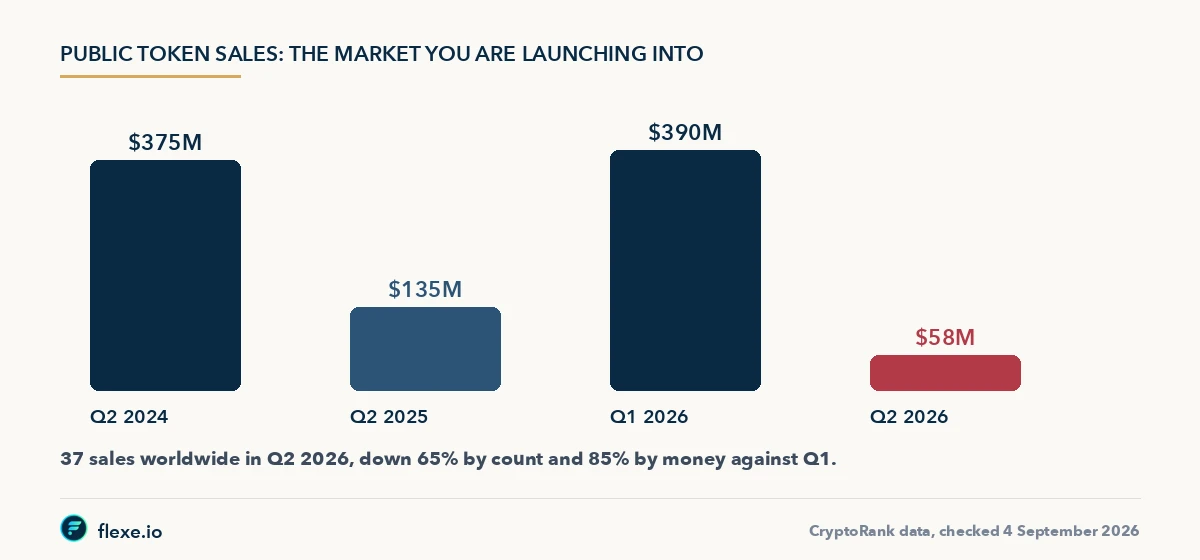
Two consequences follow for anyone planning a raise. Competition for attention among launching projects is a fraction of what it was, which is good. And the platforms compete for a much smaller pool of projects, which means their terms are more negotiable than their pages suggest. May 2026 produced 13 sales, the fewest in any month since December 2020.
How this comparison was built
For this page, crypto launchpads compared means platform-reported figures only: raise totals, sale counts, audience numbers and sale models were read from each platform’s own site on 4 September 2026. Where a platform publishes nothing, we say so instead of filling the gap from third-party roundups. Market-wide numbers come from CryptoRank’s quarterly data on public token sales. Neither source covers fees, acceptance rates or post-sale performance, which is why those appear here as questions to ask rather than figures.
Frequently Asked Questions
Which crypto launchpad raises the most?
CoinList raises the most by published cumulative totals, at $1.2 billion or more across 85+ completed raises, with Fjord Foundry stating $1 billion or more. Both figures cover several years and are not comparable to what a project raises today. Recent individual launches on Polkastarter cleared $50,000 to $150,000, which is the more useful benchmark for a first sale.
How many token sales happen in 2026?
Thirty-seven public token sales took place worldwide in the second quarter of 2026, raising $58 million, against 105 sales and $390 million in the first quarter. May 2026 produced 13 sales, the fewest since December 2020. Any launch plan built on the volume of 2021 is planning for a market that is not there.
How much does a crypto launchpad charge?
None of the four major launchpads publishes its fees, so any figure you find comes from a third party rather than the platform. Ask for the full fee structure in writing, including any token allocation to the platform and its vesting, along with the acceptance rate and the number of sales completed in the last twelve months.
Which sale model is better for a small raise?
A liquidity bootstrapping pool suits a small raise when you cannot predict demand, because the price falls until buyers appear and sniping bots gain nothing from being first. A fixed price sale suits you if you need certainty and have enough demand to fill it. Tiered and staking-gated models reward the platform’s existing token holders.
Does a launchpad replace marketing?
No, a launchpad does not replace marketing, and this is where we have a stake, so weigh it accordingly. A launchpad supplies buyers on sale day from its own audience. It does not supply the awareness that makes people want the token, and it stops the moment the sale closes. The platforms publish nothing about what happens to projects afterwards.
Planning the launch around the sale
For what a launch costs and where the budget goes, see our guide to token marketing and the breakdown of splitting a launch budget across channels. For how few projects are actually in this market with you, see how many token launches can buy marketing.