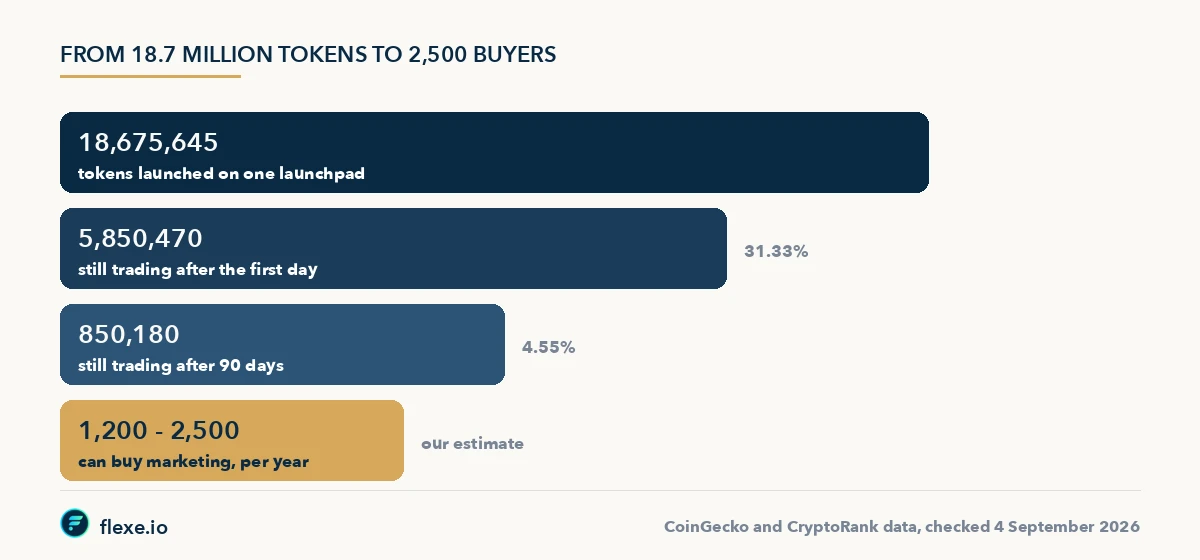
Between 14 January 2024 and 18 June 2026, 18,675,645 tokens launched on pump.fun. Of those, 68.67% stopped trading on the day they were created and 4.55% were still trading after 90 days. In the whole of the second quarter of 2026, the world held 37 public token sales. The gap between those two numbers is the answer to a question the industry keeps getting wrong: how many buyers of crypto marketing actually exist. Not millions of projects. Somewhere between 1,200 and 2,500 a year.
How many tokens actually launch?
CoinGecko tracked every pump.fun token with at least one recorded trade and grouped them by lifespan, meaning the number of days between creation and the last trade an aggregator saw. The distribution is the clearest picture of mass token issuance that exists in public.
| Lifespan | Tokens | Share |
|---|---|---|
| Same day | 12,825,175 | 68.67% |
| 1 day | 2,184,433 | 11.70% |
| 2 to 3 days | 770,249 | 4.12% |
| 4 to 7 days | 642,614 | 3.44% |
| 8 to 14 days | 460,697 | 2.47% |
| 15 to 30 days | 382,289 | 2.05% |
| 31 to 90 days | 560,008 | 3.00% |
| Over 90 days | 850,180 | 4.55% |
Within 48 hours, 80.37% have stopped trading. This is not a market with a high failure rate. It is a conveyor belt on which death is the default state and survival is the exception, because creating a token there costs almost nothing and takes almost no time.
How many of those are actually projects?
A public token sale is the cleanest available signal that a team rather than a script is behind a launch: someone had to prepare an offering, meet a platform’s requirements and raise money from people who could refuse. CryptoRank counts them quarter by quarter, and the trend is severe.
| Period | Public sales | Raised |
|---|---|---|
| Q2 2024 | not published | $375M |
| Q2 2025 | not published | $135M |
| Q1 2026 | 105 | $390M |
| May 2026 | 13 | not published |
| Q2 2026 | 37 | $58M |
Q2 2026 fell 65% against the previous quarter by deal count and 85% by money raised. The thirteen sales completed in May 2026 were the fewest in any month since December 2020, when there were four, a fall reported across the sector at the time. Disclosed fundraising has fallen more than fourteenfold from the Q1 2025 peak.
So how many buyers of crypto marketing are there?
Here we are estimating rather than measuring, and we will say so plainly. The right operation is a union of three overlapping lists, not a sum of them, because the same project appears on more than one.
Public sales run to roughly a thousand projects a year. First-time exchange listings across the industry ran to about 1,400 listing events in 2025, but since a token typically lists on two to four venues, that is 400 to 700 unique tokens. Venture rounds run at roughly 1,500 to 2,000 deals a year, and a large share of those go to companies with no token at all: exchanges, wallets, custody, infrastructure. They buy marketing, but they are not launches.
Corrected for overlap, that leaves 1,200 to 2,500 unique launches a year with the means to buy paid promotion. Set against total issuance, the share of launches with a marketing budget is a few hundredths of one percent. Which produces the conclusion nobody states out loud: the overwhelming majority of dead tokens never had a budget and never could have had one. What dies at this scale is not projects with bad marketing. It is scripts.
What this changes about a launch budget
The headline that 99% of tokens die does not describe a launch with a team, an audit and a funding round behind it. It describes a different population entirely, and carrying that number across is a sampling error dressed up as caution.
It also means the buyer market is small and professional. Two and a half thousand projects a year worldwide is not a market for packaged solutions, and a supplier offering everyone the same bundle is serving somebody other than you.
The third point is the uncomfortable one for us. Marketing does not rescue a launch with nothing behind it, and we turn those down. Promotion decides whether a working product gets found; it does not decide whether the product works. If your project is still going to market after the second quarter of 2026, the selection has already happened. The question is no longer whether you survive. It is whether the fifteen hundred people who genuinely need what you built ever hear about it.
There is a practical consequence for how a launch reads its own numbers. Benchmarks taken from mass issuance describe a population where the median project has no team, no product and no intention of existing next week. Holding your launch to that bar makes almost any outcome look acceptable, which is why it gets quoted so often. The comparison worth making is against the hundred or so launches that ran a public sale in the same quarter as you, because those are the projects competing for the same attention, the same listings and the same creators.
Frequently Asked Questions
Is it true that 99% of crypto tokens die?
Across 18.67 million pump.fun tokens, 4.55% were still trading after 90 days and 68.67% stopped on their first day. That sample is almost entirely mass issuance from launchpads where creating a token costs pennies. Launches that ran a public sale and listed on an exchange behave differently, and the headline figure should not be applied to them.
How many token launches were there in 2026?
There were 105 public sales in the first quarter and 37 in the second, with May producing 13, the fewest since December 2020. Mass issuance over the same period ran at roughly 21,000 tokens a day. These are two different markets and their numbers are not comparable, which is why most published statistics about token launches contradict each other.
Does the collapse in sales mean you should not launch?
The opposite, if you have a product. Competing for attention in a quarter with 37 sales is structurally easier than in a quarter with 429, and inventory prices at outlets and with creators soften in a downturn. The conditions are bad for anyone counting on a crowd and good for anyone counting on being heard.
What is a realistic minimum launch budget?
Campaign budgets start from $4,000 for a focused single-channel campaign, and a full-stack launch across PR, KOL, paid media, community and content runs $50,000 to $500,000 over three to six months. Below the lower figure, putting everything into one channel beats spreading it across all of them, which is the most common way a small budget disappears.
Where does the estimate of 1,200 to 2,500 come from?
It is the union of three lists: public token sales, unique tokens with a first-time exchange listing, and venture rounds that involve a token. The lists overlap heavily, so we take the union rather than the sum, and we give a range rather than a single figure. No direct measurement of this quantity exists, which is why it is presented as an estimate.
Planning a launch into this market
If you are working out where a launch budget should go, our guide to token marketing covers the sequence, and splitting a launch budget across channels covers the order in which to fund things. For what individual channels actually cost, see crypto PR pricing and crypto KOL pricing.