Most launch budgets are divided by channel count. Four channels, four equal parts, and every part too small to leave its own learning phase. The result is a campaign that produces a little of everything and not enough of anything, which is the single most common way launch money is wasted.
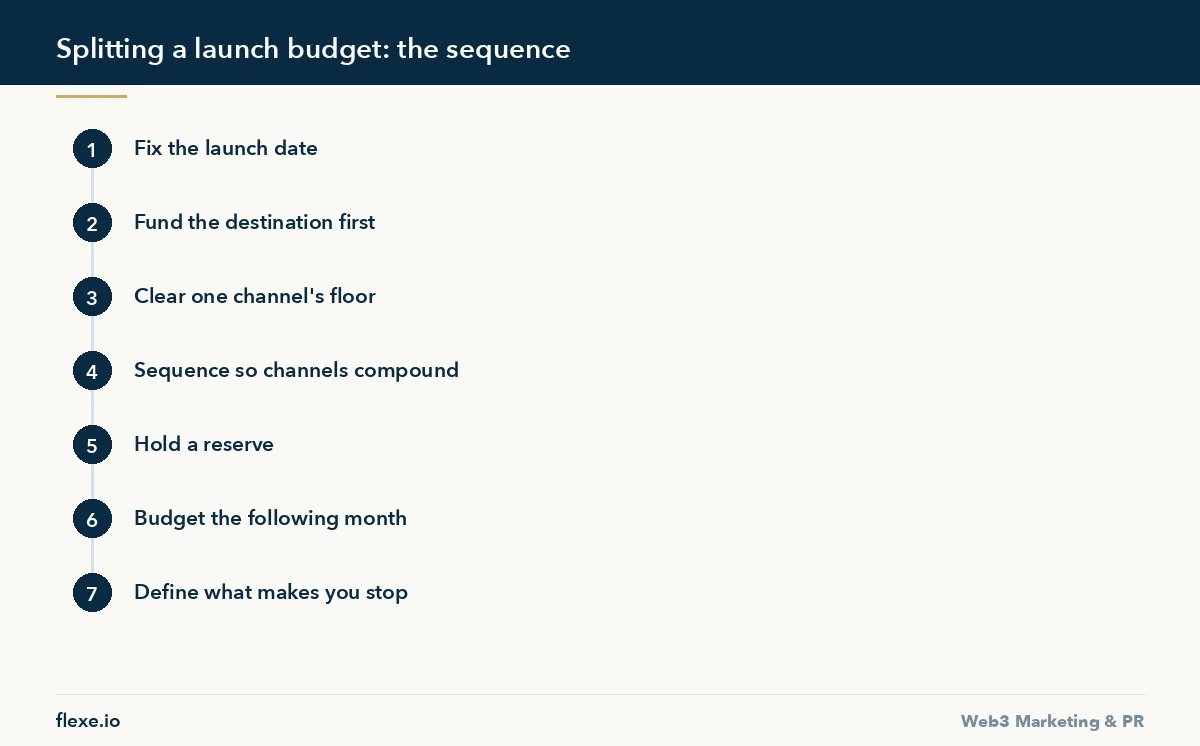
A budget that works is built from sequence rather than from categories. Here is the order and the reasoning behind it.
1. Fix the date first
Everything downstream is priced against a date. Media need lead time, creators need booking, certification for mainstream advertising can take weeks, and exchange timelines are not yours to control.
Across our own campaigns, a fixed launch date is the strongest predictor of outcome we have, ahead of budget size. A flexible date means every channel is bought at short notice, which is the expensive way to buy all of them.
2. Pay for the destination before the traffic
Liquidity depth, a landing page that loads on a phone, working analytics, a staffed community and documentation someone can read are not marketing costs in most plans, and they decide the conversion rate of everything that follows.
Traffic arriving at a thin pool or an empty channel converts at close to nothing, and the spend is gone. This line comes out of the budget first, before any channel is funded.
3. Fund one channel properly rather than four thinly
Every paid channel has a floor below which it cannot work: an auction needs volume to exit its learning phase, a creator campaign needs enough accounts to survive one underperforming, a media push needs enough placements to be visible.
Below those floors, splitting the budget guarantees that no channel clears its own. Our data shows a materially higher failure rate for campaigns that spread a small budget across every channel at once, which is a scoping problem rather than a budget problem: the same money concentrated on one channel behaves differently.
4. Sequence the channels so each feeds the next
The order that compounds is: community small and alive first, then media coverage and creators to produce the first real visits, then paid retargeting against the audience those visits created, then broad paid prospecting once you know what a converting visitor looks like.
Run in reverse, the same money buys a wide anonymous audience with nothing to retarget and no credibility behind it. The two comparisons behind this order are in KOL campaign or paid ads and PR first or community first.
5. Hold back a reserve
Keep a meaningful share unallocated. Something will work better than expected and deserve more, something will be rejected or delayed, and something will go wrong publicly and need a response.
A fully committed budget cannot double down on the thing that worked, which is the highest-return decision available during a launch. It also cannot fund a crisis response, and those arrive on their own schedule.
6. Budget the weeks after, not only the day
Launch day is a spike. What decides whether the pair keeps trading and the community keeps talking is the following month, and exchanges watch exactly that when the next application arrives.
Plan for continuation from the start: community staffing, retargeting the people who came and left, and the second wave of coverage that only becomes possible once there is something to report.
7. Decide what would make you stop
Write down, before spending, the number that means a channel is not working and the date you will check it. Without that, budgets are defended rather than reallocated, and the channel that produced impressions and no wallets keeps running because stopping it feels like admitting a mistake.
Attach the check to a conversion event rather than to reach, and measure creators at thirty days rather than at twenty four hours, since the ranking frequently reverses. The method is in how to measure whether a KOL campaign worked.
A workable default
Destination and depth funded first and excluded from the channel split. Then roughly a third to creators and media, a third to paid traffic weighted towards retargeting, a fifth to community staffing across the launch month, and the remainder held as reserve.
Those proportions move with the project. What does not move is the principle: fund fewer things properly, in an order where each one supplies what the next needs, and keep enough back to respond to what actually happens.
Channel selection, floors per channel and reporting are on our crypto traffic acquisition page.