A crypto influencer channel is a placement unit, and the four main types buy fundamentally different things: a Telegram channel sells attention from a subscribed audience, a YouTube channel sells consideration time, an X account sells distribution, and a Discord presence sells access. Projects routinely compare crypto influencer channels on follower count, which is the one attribute that does not transfer between them. This guide to crypto influencer channels covers what each type actually delivers, how each is measured, and how to decide which one a campaign needs.
Key Takeaways
- Follower counts are not comparable across channel types. A 20,000-subscriber Telegram channel and a 20,000-subscriber YouTube channel are different products.
- Telegram delivers the highest immediate action rate and the shortest memory. A post is effectively gone within hours.
- YouTube delivers the longest consideration time and keeps working for months after publication.
- X delivers the widest distribution to people who follow nobody in your niche, and the least depth.
- Screened network engagement sits near 1.7 percent on X. Channels advertising far higher across many accounts are usually measuring reciprocal activity.
What does each channel type actually deliver?
The useful question is not how many people a channel reaches but what state those people are in when they see the message. That state differs more between channel types than any audience number suggests.
| Channel | Buys you | Half-life of a post | Measured by | Weak at |
|---|---|---|---|---|
| Telegram channel | Immediate action from a subscribed audience | Hours | Clicks and joins in the first day | Anything requiring consideration |
| YouTube channel | Consideration time, often ten minutes or more | Months | Watch time, comments, delayed conversions | Speed and cost |
| X account | Distribution beyond your existing audience | Days | Impressions, replies, quote posts | Depth and retention |
| Discord presence | Access to an organized community | Persistent but low visibility | Member actions over weeks | Reach beyond members |
This is why a launch announcement and a protocol explainer should not go to the same channel type. The announcement needs Telegram’s immediacy; the explainer is wasted there and works on YouTube for months.
How are Telegram channels priced and measured?
Telegram channels are bought per post, usually with a guaranteed position at the top of the feed for a set period. The audience is subscribed rather than algorithmic, which means the reach is predictable and the decay is fast.
Measure a Telegram placement on first-day clicks and joins, because that is when essentially all of the effect occurs. A placement that produced little in the first 24 hours will not recover, and reporting a week later mostly measures other channels.
The platform’s scale supports this: Telegram reported one billion monthly active users in March 2025 and more than 500 million daily actives, with a native non-custodial wallet announced in July 2026 that shortens the path from a post to an on-chain action.
The specific risk is subscriber inflation, which is cheaper on Telegram than anywhere else. View counts relative to subscriber count are the fastest check: a channel with 50,000 subscribers and 800 views per post is selling a number, not an audience.
How do YouTube channels compare?
YouTube is the only channel type that buys sustained attention. A viewer who watches eight minutes of an explanation has engaged more deeply than any number of impressions can represent, and the video keeps accumulating views long after the payment.
The costs are production time and slower feedback. A YouTube placement judged after a week will look like a failure against a Telegram placement judged the same way, because most of its value arrives later.
Check the ratio of views to subscribers and the comment quality rather than subscriber count. Channels with large subscriber bases and thin recent view counts are trading on history.
What does an X account buy?
X buys distribution to people outside your existing audience, because its algorithm surfaces content beyond followers. That makes it the most useful channel for reaching people who have not yet heard of a project and the least useful for retaining them.
Our active X roster runs 85 verified accounts with 8.7 million combined reach, an average of 102,199 followers per account and 12,615 median views per post, at a screened average engagement rate of 1.74 percent. That figure is worth holding as a reference, because networks advertising four percent across hundreds of accounts are either measuring differently or not screening.
A screened campaign on that network produced 507,000 impressions over 18 days at a 2.0 percent engagement rate alongside a 4.2 percent increase in holders. A separate engagement-focused campaign for MARGEX lifted engagement by more than 270 percent and organic reach by more than 430 percent.
How do you choose between crypto influencer channels?
Work from the action you need rather than the audience you want. If the campaign needs people to do something today, Telegram. If it needs people to understand something before deciding, YouTube. If it needs people who have never heard of you to hear of you, X. If it needs an existing community to adopt something, Discord.
Most campaigns need two of these in sequence rather than all four at once: X to create awareness, then Telegram to convert it, with YouTube running underneath for anyone who wants the detail. Buying all four simultaneously on a small budget produces four measurements too thin to learn from.
The vetting checks are the same regardless of channel type and are covered in our guide to crypto influencer networks: engagement relative to audience size, whether that engagement is reciprocal, and whether the audience overlaps with your buyers.
For named accounts on each channel, see our list of the top crypto influencers in 2026.
What to check before booking a channel
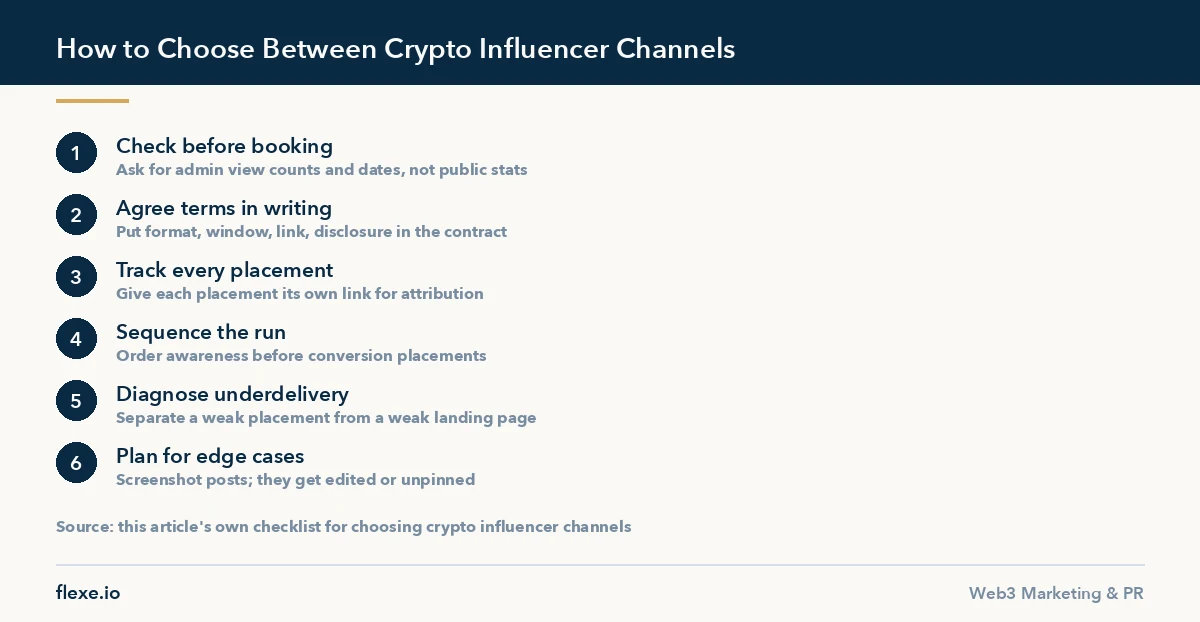
Ask the owner for admin side view counts on the last several posts, with the dates those posts ran, rather than the figures a visitor can read from outside. The admin view shows how each post performed against the subscriber base and where recent subscribers arrived from. Ask which of those posts were paid, because a feed that carries promotion after promotion has already trained its audience to scroll past anything that looks like an advertisement.
Confirm who writes the copy and who approves it. Some owners insist on rewriting a draft in their own voice, which usually improves the result, and some will publish whatever arrives, which usually does not. Agree the posting slot in the owner’s local time, whether the post is pinned, how long it stays pinned, and what pushes it down afterwards. Those details decide how much of the subscribed audience ever sees it.
Check for ownership overlap before paying for what looks like two placements. One operator often runs several channels in the same niche from a single admin account, and the subscriber lists behind them repeat heavily. Buying two of them buys the same readers twice at full price. Asking directly is usually enough, since an owner who denies it and is later contradicted by identical posting patterns has told you something useful anyway.
How to agree terms and payment
Put the commercial terms in writing even for a single post. The publication window, the exact format, the destination the link points to, the disclosure wording, and the removal policy all belong in the same message, because each of them is a thing that goes wrong often enough to be worth naming. A screenshot of an agreed message thread has settled more disputes in this market than any formal contract.
Split the payment so that part of it settles only after proof of publication. Paying in full before anything appears is ordinary practice with established owners and a standing risk with unknown ones. Agree in advance what proof means: a link to the live post, a screenshot showing it in place, the timestamp, and the view count at the end of the agreed window. Without that, a dispute becomes one person’s word against another’s.
Decide what happens if the post is deleted early. Many owners clear sponsored posts on a schedule, which is reasonable and needs to be known before you plan anything around the placement staying visible. Agree whether an early removal means a repost or a partial refund, and write that down in the same thread as the price. Owners who refuse to discuss removal at all are worth skipping, whatever their numbers look like.
Tracking placements across crypto influencer channels
Give every placement its own link. One shared link across a run makes the whole spend unattributable, and no amount of analysis afterwards recovers which channel produced what. On Telegram that extends to invite links: a placement pointing at a group needs its own invite so that joins can be counted per post rather than as one undifferentiated rise in members.
Record the baseline in the hour before publication. Subscriber counts, site sessions, group members, and the number of people arriving from search all move for reasons unrelated to your placement, and without a reading taken just before the post goes live there is nothing to measure the change against. Take the same readings at the same intervals afterwards for every channel in the run.
Read placements at the same age rather than on the same date. A Telegram post measured on day one and a video measured after a week are not comparable numbers, and a report that puts them side by side will always rank the fast format above the slow one. Fix the reading points in advance and keep them per format.
Sequencing a multi-channel run
Order the placements around the action you need rather than around which owner replies first. Awareness placements come before the ones meant to convert, with enough distance between them that the second lands on an audience which has already seen the name once. Collapsing the whole run into a single afternoon produces one spike, no sequence, and no way to tell which post carried it.
Time each placement to the region the channel actually serves. A post published while the subscriber base is asleep gets the same reported reach and a fraction of the action, because the feed has moved on by the time anyone opens it. Ask the owner when their posts usually perform, and treat that answer as more reliable than any general rule about posting hours.
When a placement underdelivers
Separate a weak placement from a weak destination before doing anything else. If the clicks arrived and nothing happened afterwards, the channel delivered and the page did not, and rebooking more channels repeats the loss at a larger size. If the clicks never arrived, the question moves back to the channel, the format, and whether the post appeared where and when it was supposed to appear.
Where the fault is clearly on the owner’s side, a late post, a broken link, the wrong image, or a format that does not match what was agreed, ask for a repost inside the same window rather than a refund. A repost recovers the campaign; a refund recovers the money and leaves the gap in the plan. Keep the original screenshots either way, because the second version will not show what the first one did.
Resist the urge to replace a disappointing placement with several cheap ones. Spend moved to unverified channels at short notice is how a run that produced one weak result ends up producing several, and inventory that is available immediately at a low price is usually available for a reason.
Edge cases worth planning for
Assume the post will not stay as published. Links get edited, images get swapped, text gets shortened, and pinned posts get unpinned early, sometimes by an admin who did not handle the booking. Screenshot the post at publication and again at the end of the window, and check the link from a device that is not yours, because an owner testing their own link while logged in sees something the audience does not.
Plan for the owner going quiet. An operator who stops replying after payment is a known pattern, and the defence is procedural rather than legal: small first bookings with new channels, staged payment, a second contact at the channel where one exists, and records kept in one place so that a colleague can pick up the thread. Reputation here travels through private groups, and asking two other buyers before booking costs an afternoon.
Watch for forwarded reach. A post copied into a network of mirror channels inflates the view count without adding readers, and the inflated figure is what appears in the owner’s report. Compare the reported views against the clicks your own link recorded, and treat a large gap between them as a measurement problem to raise with the owner rather than as evidence that the audience was uninterested.
Meme accounts behave differently from regular creators, and our guide to working with crypto meme pages explains the pricing and posting habits to expect.
Frequently asked questions
Which channel type gives the fastest results?
Telegram, by a wide margin. Essentially all of a Telegram placement’s effect lands within the first day, which makes it the right choice for announcements and the wrong choice for anything requiring the audience to think.
How do you spot an inflated crypto channel?
Compare views to subscribers and check whether engagement is proportionate. On Telegram, views far below subscriber count indicate purchased subscribers. On X, engagement far above the screened network average of about 1.7 percent usually indicates reciprocal activity rather than interest.
Is one large channel better than several small ones?
Several small ones in adjacent niches usually reach more distinct people, because audiences within a single niche overlap heavily. One large channel is better when the goal is frequency rather than coverage.
Should placements be disclosed?
Yes, and increasingly it is a regulatory requirement rather than a courtesy. Undisclosed promotion that is later discovered damages the project more than the channel, since the project is the party with something to sell.
Where to go next
For how vetted creator campaigns are built and reported, see crypto influencer marketing. For how creators earn and what that means for what they can say about you, see how crypto creators earn.
Choosing a channel mix? Send the brief on Telegram at https://t.me/flexe_io_agency and we will come back with a vetted shortlist and verification scores within 24 hours.
Nothing here is financial advice. Network figures are first-party data from our own campaign records.