Crypto creator monetization runs through four mechanisms: direct tips, affiliate revenue, paid placements, and revenue share from the platforms they publish on. Each carries a different disclosure obligation and a different effect on audience trust, and the mix a creator chooses determines what a project can realistically ask of them. This guide to crypto creator monetization covers how each works, what it means for creators, and what it means for projects buying their attention.
Key Takeaways
- Tipping is the smallest revenue source and the strongest trust signal, because it is voluntary and public.
- Affiliate revenue scales best and damages trust fastest when undisclosed.
- A creator’s monetization mix predicts what they will and will not say about a project.
- Undisclosed paid promotion is a regulatory problem in a growing number of jurisdictions, not merely an etiquette one.
- Projects should ask how a creator earns before asking what a placement costs.
How does crypto micro-tipping work?
Micro-tipping lets an audience send small amounts directly to a creator, usually through a bot, a wallet link, or a platform feature. The amounts are individually trivial and the signal is not: a tip is a voluntary payment for something already received, which is the clearest evidence that content has value.
As a revenue source it is modest for almost everyone. Its practical use is as a measurement instrument. A creator whose audience tips has demonstrated something that follower counts cannot, and for a project evaluating creators that signal is worth more than the reach figure beside it.
The friction is real. Tipping requires the audience to hold the right asset on the right network, which limits it to audiences that are already active on-chain.
Which crypto micro-tipping services do creators actually use?
Four routes cover almost all of it: a chat tip bot inside Discord or Telegram, a Lightning address for Bitcoin, a raw wallet address in the bio, and a hosted payment link built for merchants. They differ less in features than in two things that matter to a creator: who holds the money before it is withdrawn, and whether you can tell who sent it.
| Route | Named example | Fee position | What the creator gives up |
|---|---|---|---|
| Chat tip bot | tip.cc on Discord | No platform fee on a tip; withdrawals pay network fees | Custody. Balances sit inside the bot until withdrawn, and the Discord account is the wallet |
| Lightning address | Alby (Alby Hub, Alby Go) | 0% added transaction fees on the free self-custodial tier; Pro is $3.9 a month for custom addresses and unlimited sub-wallets | Everything except Bitcoin. No altcoin or stablecoin tips |
| Wallet address in the bio | Any wallet, no service involved | Network fee only | Attribution. You cannot tell who tipped or which post caused it |
| Hosted payment link | NOWPayments (350+ coins, 75+ fiat) | From 1% plus network fees | The feel of a tip. It is merchant checkout software, so the flow reads as a purchase |
| Platform-native tipping | Varies, and changes without notice | Set by the platform | Control. Platforms have added and removed crypto tipping repeatedly, so it is not something to build income on |
For a project deciding what to sponsor, the custody column is the useful one. A creator whose tips arrive in a self-custodial Lightning wallet is running their own economics. A creator whose income sits inside one platform’s bot is one policy change away from losing it, which tends to make them more dependent on sponsorship and less able to turn a campaign down.
How do affiliate and referral programmes work in crypto?
Affiliate programmes pay a creator for actions their audience takes: a signup, a deposit, a trade, or continued activity over time. In crypto the most common structures are revenue share on trading fees and one-time payments per funded account.
Blockchain gaming has adopted the same model, paying for installs and for players who remain active past a threshold. The structure suits games because the value of a player is measurable over time rather than at the moment of arrival.
The incentive problem is straightforward. A creator earning a share of trading fees benefits when their audience trades more, which is not always what serves the audience. This is not a reason to avoid affiliates; it is a reason to read a creator’s recommendations knowing where their revenue comes from.
| Mechanism | Typical scale | Trust effect | Disclosure needed |
|---|---|---|---|
| Micro-tips | Small | Strongly positive | None |
| Affiliate revenue share | Large and recurring | Negative if hidden | Always |
| Paid placement | Variable, front-loaded | Neutral if disclosed | Always |
| Platform revenue share | Moderate | Neutral | Usually automatic |
| Own product or service | Largest ceiling | Positive | Obvious to audience |
What does a creator’s revenue mix tell a project?
It tells you what they can afford to say. A creator whose income is mostly affiliate revenue from exchanges cannot easily publish a critical piece about those exchanges. A creator supported by tips and their own products can, and that independence is what makes their endorsement worth buying.
This is the practical reason to ask about monetization during vetting rather than treating it as the creator’s private business. The question is not whether they earn money but whether their revenue conflicts with the message you want to be associated with.
The same logic runs through vetting generally, alongside the engagement checks covered in our guide to crypto influencer networks.
What are the disclosure obligations?
Paid promotion and affiliate relationships require disclosure in most major jurisdictions, and enforcement in crypto has tightened rather than relaxed. The safe standard is disclosure that a reasonable person would notice without looking for it, in the same post rather than in a profile or a linked page.
For projects this is a contractual matter, not a hope. An agreement that does not specify disclosure has left the risk with whoever is more visible, which is usually the project.
Requirements differ by country and change; this is general information rather than legal advice.
How should projects approach crypto creator monetization?
Pay for the format that matches what you want. A one-time placement buys an announcement. An affiliate arrangement buys ongoing incentive to keep mentioning you, which is powerful and requires monitoring. A long association with a creator who already uses the product buys credibility that neither of the others can.
Avoid arrangements that ask a creator to conceal how they are paid. Beyond the regulatory exposure, audiences discover it, and the discovery damages the project more than the creator.
For the creators with the largest verified audiences, see our list of the top crypto influencers in 2026.
Auditing crypto creator monetization before you pay
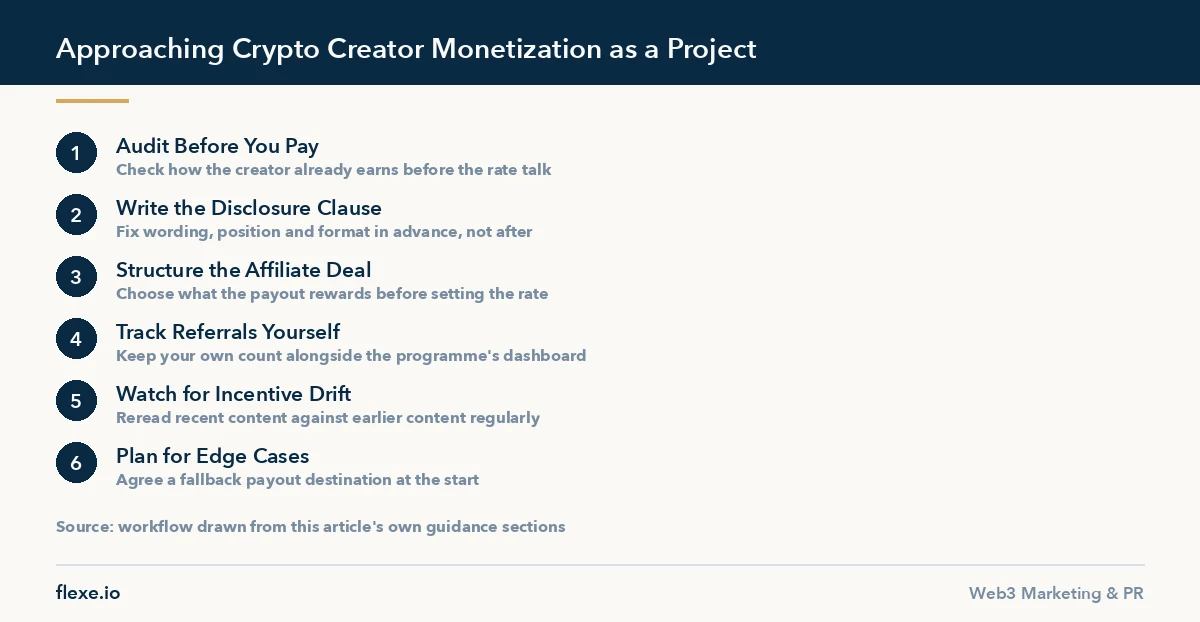
Ask the question directly during vetting: how does this creator earn, and from whom. The answer is usually visible without asking, in pinned links, referral codes in video descriptions, tip addresses, and the products they sell themselves. Assemble that picture before the rate conversation, because it decides which requests are realistic and which ones the creator will decline for reasons they may not explain.
Look for concentration risk. A creator whose income depends on one exchange programme has an interest that outweighs any single sponsorship, and a request touching that relationship, even indirectly, will lose. A creator with several independent sources can take a position on more subjects, which is the practical value of independence rather than an abstract point about ethics.
Check what they have declined. Creators who have publicly turned down categories, or who mark certain content as unpaid, are telling you where their line sits, and that line is more useful than any rate card. It also tells you how your own placement will be read, since a paid post in a feed that refuses most paid posts carries weight a feed of promotions cannot.
Write down what you find. A short record per creator, listing the revenue sources visible at the time, the programmes they promote, and the categories they avoid, is what makes the second campaign faster than the first. It also prevents the common failure of approaching the same creator twice with a request they already declined, which ends the conversation before the rate comes up.
Writing the disclosure clause
Specify the disclosure wording, its position, and the format it appears in. A clause saying the creator will comply with applicable rules moves the risk without reducing it, because compliance is exactly the thing in dispute when something goes wrong. Wording agreed in advance, placed in the same post rather than in a profile or a linked page, removes the argument entirely.
Extend the clause to every surface the placement touches. A video description, a pinned comment, a repost on another platform, and a clip cut from the original all carry the same obligation, and the clip is the one that usually travels furthest without it. Where a creator resists, the resistance itself is information about how they treat other sponsors.
Structuring an affiliate deal that holds
Decide what the payment rewards before deciding the rate. Paying on signup rewards volume, paying on a funded account rewards a narrower kind of persuasion, paying on a first action rewards urgency, and paying on sustained activity rewards the audience match you actually wanted. The structure shapes the content more than the rate does, because a creator working toward the payable event will write toward that event.
Write the clawback and the attribution window into the agreement. Without a clawback, a wave of accounts that arrive and vanish is paid for in full; without a stated window, every later conversion becomes a negotiation. Agree as well what happens when the arrangement ends, since a referral link left in an old video keeps producing signups long after the relationship closed.
Match the payable event to something you can verify independently. A programme paying on an action only the creator’s dashboard can see invites disputes, and one paying on an action visible in your own records does not. Where the event has to come from a partner, ask for the raw export rather than the summary, and agree how often it arrives.
Tracking referrals without trusting the dashboard
Keep your own count alongside the programme’s. The creator sees one dashboard, you see another, and the two disagree often enough that reconciliation should be part of the monthly routine rather than a response to a complaint. Agree in advance which figure settles a dispute and how quickly each side reports, because these disagreements arrive at payment time and get resolved badly under pressure.
Watch the quality of what arrives, not only the count. Accounts that register and never act, arrivals concentrated in a few hours, referrals that never appear in any other channel, and a pattern repeating exactly across months are all worth checking before the next payment clears. A creator whose referrals behave like the rest of the audience is worth more than one delivering larger numbers that do nothing afterwards.
What to do when incentives drift
Long affiliate relationships drift toward whatever pays, and the drift is gradual enough to go unnoticed. The check is to reread the recent content against the earlier content: if the mentions have become more frequent, less qualified, and harder to distinguish from the surrounding posts, the arrangement is consuming the credibility that made it worth having in the first place.
The repair is usually structural rather than conversational. Capping the frequency of paid mentions, moving part of the payment to a fixed retainer, rotating which products are promoted, or ending the arrangement and returning to one-off placements all reduce the pressure that caused the drift. Leaving it in place and asking for restraint rarely changes anything, because the incentive still points the other way.
Edge cases in creator payments
Platform policy changes without notice, and a creator whose payout route disappears mid-campaign has a problem that becomes yours if the payment was routed through it. Agree a fallback destination at the start. The same applies to a creator who changes wallets between invoice and payment, where a confirmation through a second channel is worth the delay it costs.
Payment in the project’s own token raises questions that should be settled before the placement rather than after. What price the allocation is counted at, when it can be moved, what happens if a listing slips, and who carries the difference if it falls are all answerable in advance and expensive to argue about later. A creator relaxed about all of it is telling you how little they expect to receive.
Invoices matter more in this market than the informality suggests. A placement paid from a project treasury to a personal wallet with nothing written behind it is difficult to explain later, to an auditor or to the next person who holds your job. Ask for an invoice even when nobody involved expects one, and keep it with the campaign record rather than in a message thread.
Creators earn more when the project side is organized, and our guide to YouTube crypto marketing shows what sponsors expect from a video deal.
Meme accounts earn on their own terms, and our crypto meme page guide breaks down how those placements are priced.
Frequently asked questions
Can crypto creators make a living from tips alone?
Very few can. Tipping works best as a supplementary source and as a signal of audience quality rather than as a primary income. Creators who rely on it usually combine it with their own products.
Are affiliate links bad for a creator’s credibility?
Disclosed, no; hidden, severely. Audiences accept that creators earn money and object to being misled about how. The damage comes from the concealment rather than the arrangement.
How do blockchain gaming affiliate programmes pay?
Usually per install or per player who stays active past a defined threshold, sometimes with a share of in-game spending. The threshold matters more than the rate, since a programme paying on install rewards volume rather than retention.
Should a project run its own affiliate programme?
Only with the monitoring to support it. An affiliate programme creates a standing incentive for people to promote you in ways you do not control, which is an asset when supervised and a liability when not.
Where to go next
For how vetted creator campaigns are structured and measured, see crypto influencer marketing. For growing a community with incentives rather than placements, see task campaign design.
Working with creators? Send the brief on Telegram at https://t.me/flexe_io_agency and we will come back with a vetted shortlist within 24 hours.
Nothing here is financial advice, and disclosure requirements vary by jurisdiction.