A crypto influencer network is a managed pool of vetted accounts that a project can book through one contract instead of negotiating with each creator individually. The value of crypto influencer networks is not their size but their screening: an unvetted pool of 500 accounts is worth less than a screened pool of 80. This guide covers how networks are structured, what screening actually removes, and how to judge one before booking.
Key Takeaways
- Judge a network by what it rejects, not by how many accounts it lists.
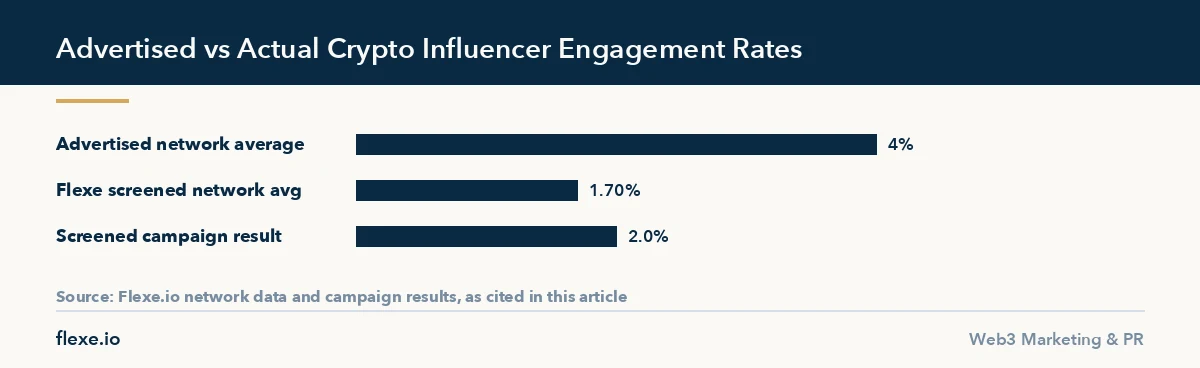
- Engagement rate is the screening metric that matters, and a realistic network average sits near 1.7 percent rather than the 4 percent often advertised.
- Reach is additive on paper and overlapping in reality. The same followers appear across accounts in the same niche.
- Networks are efficient for coverage and poor for depth. A single embedded creator outperforms twenty scheduled posts.
- Ask which tools the network screens with. Vague answers mean no screening.
How is a crypto influencer network structured?
A network sits between projects and creators, holding pre-negotiated terms with each account so a campaign can be assembled without individual deals. Three models exist in practice. Managed networks vet and represent a fixed roster. Marketplaces list anyone who signs up and leave vetting to the buyer. Agency pools sit in between, curating a roster but sourcing outside it when a campaign needs something specific.
The distinction matters because it determines who carries the risk when an account turns out to be inflated. In a marketplace, the buyer does. In a managed network, the network does, which is why managed networks are smaller.
What does screening actually remove?
Screening removes accounts whose audience is purchased, whose engagement is reciprocal rather than genuine, and whose followers do not overlap with the advertised niche. These three problems account for most of the difference between a network’s claimed reach and its delivered result.
Our active X roster runs 85 verified accounts with 8.7 million combined reach, an average of 102,199 followers per account and 12,615 median views per post. The screened average engagement rate across that network is 1.74 percent. That figure is worth stating plainly because it is far below what is usually advertised, and a network claiming a 4 percent average across hundreds of accounts is either measuring differently or not measuring at all.
Accounts are checked through three independent tools before entering a campaign. Asking a network to name its screening tools is the fastest way to establish whether screening happens, since the answer is either three specific names or a paragraph about experience.
Why is combined reach in crypto influencer networks misleading?
Combined reach adds every account’s followers together and assumes no overlap. In a niche as concentrated as crypto, overlap is substantial: the people following one mid-size trading account follow several others.
The practical consequence is that a campaign across twenty accounts in the same niche does not reach twenty times one account’s audience. It reaches the same core repeatedly, which has value for frequency and none for coverage. Spreading across adjacent niches costs more per placement and delivers more distinct people. For what a placement in each channel type actually buys, see crypto influencer channels compared.
| Network type | Vetting | Best for | Main risk |
|---|---|---|---|
| Managed network | Network’s responsibility | Coverage with a quality floor | Smaller roster, less flexibility |
| Open marketplace | Buyer’s responsibility | Price and breadth | Inflated accounts reach the campaign |
| Agency pool | Shared | Campaigns needing a specific fit | Depends on the agency’s incentives |
| Direct deals | Yours entirely | Depth with a few creators | Slow, does not scale |
What results are realistic from crypto influencer networks?
A screened campaign on our network produced 507,000 impressions over 18 days at a 2.0 percent engagement rate, alongside a 4.2 percent increase in holders. A separate engagement-focused campaign for MARGEX lifted engagement by more than 270 percent and organic reach by more than 430 percent.
Read the second pair carefully. Percentage lifts are calculated from a starting point, and a large multiple on a small base is a different achievement from a small multiple on a large one. Any network quoting percentage improvements without the starting figure is quoting the easier half of the number.
How do you evaluate a network before booking?
Five questions separate networks that screen from networks that resell.
- Which tools do you screen with? Specific names or no screening.
- What is your average engagement rate, and across how many accounts? A high average across a large roster is implausible.
- What is your rejection rate? A network that rejects nothing is a list, not a network.
- Can I see the overlap between the accounts you propose? Networks that have never checked will say so.
- What happens if an account underdelivers? The answer defines who carries the risk.
Before booking a network, compare its roster with our ranking of the top crypto influencers, which lists verified followers and median views per post.
Writing the brief a network can use
A network can only assemble the right roster from a brief that states the outcome rather than the activity. Say what the campaign must achieve, which audience it must reach, the window it must land in, what must never be said, and which claims need legal review first. Briefs that ask for a number of posts receive a number of posts, which is how campaigns end up delivering placements and nothing else.
Include the product itself. A creator who has used the thing writes differently from one working off a description, and the cost of giving every booked account access is small next to the difference it makes. Say which parts are still changing, since a post describing a feature that shipped differently is a correction nobody wants to publish.
Put it in one document and name one contact. Briefs that live across several messages arrive at the creators in pieces, and the piece that gets lost is usually the one about what may not be said. A single dated file, sent once and updated in place, also settles later arguments about what the network was actually asked to deliver.
Booking crypto influencer networks without surprises
Ask for the named accounts before signing rather than a description of tiers, and check them yourself against the criteria the network claims to apply. A roster described by size band instead of by handle is the most common way an inflated account reaches a campaign that was sold as screened, and the report will not tell you afterwards.
Get the substitution rule in writing. Accounts drop out, and the question is whether a replacement needs your approval or simply appears in the final report. Agree that any substitute meets the same screening and that you see the name before the post rather than after it, with the same tracked link discipline applied.
Approving posts before they go live
Ask for drafts with enough time to read them, and review for accuracy rather than for style. Rewriting a creator’s voice destroys the reason you booked them, while letting an incorrect claim about supply, custody or returns go out creates a problem that outlives the campaign. Correct the facts, check the disclosure, and leave everything else alone.
Set a response deadline on your own side too. Draft approval is where campaigns lose days, and a creator holding a slot for a project that takes a week to reply will fill it with something else. Name one person who approves and give them the authority to do it without a meeting.
If something incorrect is already live, ask for a reply in the thread rather than a deletion. A correction underneath the original keeps the post working and reads as diligence, while a post that disappears takes the reach with it and invites the assumption that something worse was wrong. Agree that rule before the campaign starts rather than in the hour it is needed.
Pacing placements across the campaign window
Publishing everything on one day looks decisive and wastes the frequency that a concentrated niche gives you. Spread the placements so the same audience sees several posts across the window, and keep a few slots unbooked for whatever the campaign learns in its first week. Those reserved slots are usually the best-spent part of the budget.
Sequence the accounts deliberately. Starting with the most credible account in the niche and following with broader ones gives the later posts something to reference, while starting with the largest and working down reads as a paid rollout to anybody who follows several of them at once.
Check the placement dates against your own calendar and against the market’s. Posts that land in the same hour as a large listing elsewhere are read by nobody, and placements stacked on the day of your own announcement compete with the announcement rather than supporting it. Move the slot rather than accepting the date the roster happened to offer.
Tracking links and who owns them
Build the tracked links yourself and hand them to the network rather than accepting theirs. Links created by the party being measured are a reporting problem waiting to happen, and a shortener you do not control can stop resolving the moment the relationship ends. One link per account, created before the brief goes out, named so you can still read it later.
Agree that raw post metrics reach you as screenshots on a fixed schedule as well as in the final report. Posts get edited and deleted, and a report referencing a post that no longer exists cannot be checked against anything at all.
The report to demand afterwards
Ask for the account list with each post’s link, the metrics per post rather than a total, the delivery dates against the ones agreed, and every substitution with its reason. Totals hide the distribution, and the distribution is the entire finding: a campaign whose result came from two accounts out of twenty has told you exactly what to book next time.
Then compare the delivered figures with what was projected at booking. Percentage improvements quoted without a starting figure and combined reach quoted without an overlap estimate are the two numbers that survive into reports because nobody asks for the other half. Ask for that half in the contract rather than after the campaign has closed.
Ask for the raw export rather than the presentation. A slide deck reorders the campaign into a story, while a plain list of accounts, dates, links and figures can be sorted, compared with the previous campaign and reused as the baseline for the next brief. Networks that screen properly hand it over without argument, and the reluctance itself is informative.
When placements underdeliver or vanish
Decide the remedy at booking, since the conversation afterwards has no basis otherwise. Reasonable terms are a replacement placement of similar size, a credit against the next campaign, or the removal of that account’s fee, and a network that will not commit to any of them in advance has told you who carries the risk.
If a post is deleted inside the agreed live period, raise it in writing the same week with the screenshot you took at the time. Enforcement after the fact depends entirely on records made while the post existed, which is the argument for capturing metrics on a schedule rather than at the end.
Running a network beside direct deals
The two approaches solve different problems and work well together. Use the network for coverage across a window and keep a small number of direct relationships for depth with creators who actually use the product, then let the direct creators publish first so the network placements land into a conversation that already exists.
Keep the measurement identical across both so the comparison means something: same event, same window, same link structure. After two campaigns you will know which accounts deserve a direct relationship next time, and that list is worth considerably more than the roster you were originally sold.
Check that the same account is not reaching you twice. Rosters overlap between networks and a creator you already work with directly can appear inside a package as a new placement, paid for a second time at a different rate. Ask for the list early enough to spot it, and take the duplicate out before signing rather than disputing it in the report.
NFT brands often pick individual faces instead of a network; see our picks of NFT brand ambassadors to follow.
For the accounts themselves, see our ranked list of top crypto accounts on X with follower counts read on the check date.
Frequently asked questions
Is a network better than booking creators directly?
For coverage, yes; for depth, no. Networks are efficient when a campaign needs many placements in a short window. A creator who genuinely uses the product and says so repeatedly outperforms a scheduled network post, and that relationship is built directly.
What engagement rate should a crypto account have?
Context matters more than the number. Large accounts show lower rates than small ones, and a screened network average near 1.7 percent is realistic. Rates far above that across many accounts usually indicate reciprocal engagement rather than genuine interest.
How many accounts should one campaign use?
Fewer than most projects expect, spread wider than most projects plan. Concentration in one niche buys frequency; distribution across adjacent niches buys reach. Decide which one the campaign needs before counting accounts.
Do networks guarantee results?
Reputable ones guarantee delivery of placements and report on outcomes; they do not guarantee outcomes. Any network guaranteeing a holder increase or a price effect is describing something other than marketing.
Where to go next
For how vetted KOL campaigns are built and measured, see crypto influencer marketing. If the campaign is aimed at growing a community rather than announcing a launch, task campaign design covers the alternative.
Planning a KOL campaign? Send the brief on Telegram at https://t.me/flexe_io_agency and we will come back with a vetted shortlist and verification scores within 24 hours.
Nothing here is financial advice. Network figures are first-party data from our own campaign records and are not an independently audited ranking.