Learning how to moderate a crypto Discord starts here: moderation is a security function that happens to look like community work. The people arriving in a busy server are not only members and spammers; a meaningful share are there to take money from the members, and they are patient, organised and good at it.
Most teams learn this by losing someone’s funds. What follows is how to moderate a crypto Discord, starting with the setup that prevents the common cases, and the working practice that keeps a moderation team from quitting three months in.
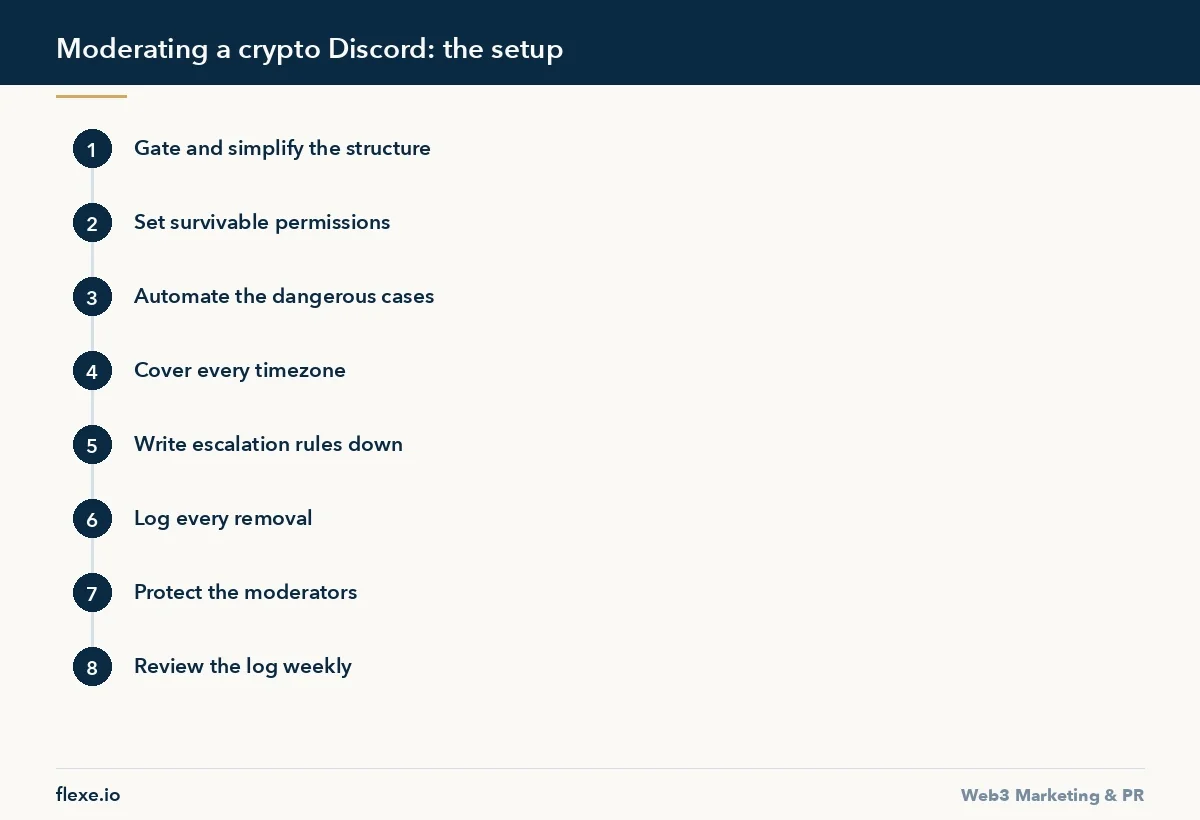
1. Lock the server structure before it grows
New members should land in a read-only channel containing the rules, the official links and the verification step, and see nothing else until they pass it. Everything past that gate should have a clear reason to exist.
Servers accumulate channels the way desks accumulate paper. Twelve channels with three active means a new member cannot find the conversation, and it means nine channels nobody is watching for the messages that matter.
2. Set permissions so a compromised account is survivable
Assume one moderator account will eventually be taken over. Limit who can post links, who can mention everyone, who can create invites and who can change channel permissions, and keep the highest privileges on the smallest possible number of accounts.
Require two-factor authentication for every role with moderation powers. Discord supports enforcing this at the server level, and the majority of publicly reported Discord compromises in crypto trace back to a single privileged account without it.
3. Automate what a person should never have to catch
A moderation bot should handle raid detection, new-account restrictions, link filtering, duplicate message detection across channels, and automatic removal of anything containing a wallet address posted by a non-admin.
That last rule alone removes most of the mechanism by which server members are drained. Add an explicit, permanently pinned statement that the team will never send a direct message first, and that no official process ever requires a seed phrase or a wallet connection through a link in a message.
4. Cover the hours when nobody is looking
Attacks are timed for when the team is asleep. A server whose moderators share one timezone has a predictable eight-hour window, and the people running scams have worked that out.
Recruit across regions specifically to close it. Two moderators in distant timezones are worth more than five in one city, whatever the total hours look like.
5. Write the escalation rules down
A moderator needs to know, without asking, what to do about a scam link, a member accusing the team of fraud, a dispute between two regulars, and a message that might be a legal problem. Each needs a defined action and a named person to escalate to.
Undocumented moderation produces inconsistency, and inconsistency is what community arguments about fairness are actually about. Written rules also protect the moderator, which is why they stay.
6. Ban with a record and a route back
Log every removal with the reason and the evidence in a private channel. Appeals happen, mistakes happen, and a decision nobody can reconstruct becomes a public argument the team cannot win.
Distinguish a scammer, who is banned permanently and silently, from a member who was rude, who gets a timeout and an explanation. Treating both identically loses real members and teaches the room that moderation is arbitrary.
7. Protect the moderators
Moderating a crypto server during a drawdown means absorbing hostility for hours, usually unpaid and usually alone. Burnout is the normal outcome and it takes the server’s institutional memory with it.
Rotate shifts, cap hours, keep a private channel where moderators can hand off and complain, and have a team member visibly back them in public when a decision is challenged. A moderator who is contradicted in front of the room by the founder stops making decisions.
8. Review the log weekly
Half an hour a week reading what was removed and why tells you which attack is currently working, which rule is unclear, and which moderator is carrying too much of the load.
Scam patterns change every few weeks. A filter written three months ago and never revisited is filtering something nobody is doing any more, which is how a server that was well configured last quarter gets hit this quarter.
Bring a new moderator in slowly
Give a new moderator message removal and nothing else for the first weeks. Bans, role changes and channel permissions wait until you have watched them handle a dispute they did not start. Most of the damage moderation teams do comes from someone acting decisively on a situation they have never seen before, and the cost of that lands on a member rather than on the moderator.
Require the security setup before the role is granted: two-factor authentication on the account, a password used nowhere else, a look at the active sessions, and no shared logins between the people covering the same shift. A role handed to an account that is already reused across a dozen servers puts your server’s safety somewhere outside your control.
Pair them with an experienced moderator for a full shift before they work alone, and hand over the written escalation rules on the first day rather than after the first mistake. Someone who has watched a scam wave handled correctly will handle the next one the same way, which is the entire value of the shadow shift.
Agree scope and payment in writing
Moderation is usually paid work, and most of the disputes come from what nobody wrote down. Fix the covered hours in one named timezone, the response expected during those hours, what happens when a shift cannot be covered, and the date and method of payment. Loose arrangements produce gaps in coverage at exactly the hours attacks are timed for.
State what a moderator may never do, such as speaking for the project on price and listings, or accepting payment from members for visibility and roles. Naming it in advance turns an awkward conversation into a reference to a document, and it gives you clean grounds for removal on the day somebody does it anyway.
Write the exit as well. When somebody leaves, roles come off the same day, any bot token they could reach is rotated, and the audit log for the week before they went is read properly. Most of that is a few minutes of work that nobody does, which is how a former moderator keeps quiet access to a server for months.
Treat bot configuration as a log
Every filter change should be dated and recorded with its reason in the same private channel the removals go to. A server where several people edit automation ends up with rules nobody can explain, and the rule that has been silently deleting legitimate questions stays in place precisely because no one remembers adding it.
Review the false positives weekly alongside the removal log. A filter that catches a word appearing in half the genuine support questions costs the server more than the spam it stops, and members almost never report being filtered. They read the silence as being ignored and they stop posting, which looks like a quiet week rather than a fault.
Keep a test channel where new rules run before they touch the main room. Raid protection that locks the server on a perfectly normal influx of new members after an announcement is a self-inflicted outage, and the middle of the announcement is the worst possible moment to discover how the threshold behaves under real load.
How to moderate a crypto Discord alone
Solo coverage is the normal situation for an early project, and the answer is to cut the surface rather than to work longer hours. Fewer channels, verification before anybody can post, slow mode in the busiest room and direct messages between members restricted at the server level reduce the work to something one person can actually watch.
Knowing how to moderate a crypto Discord without a team also means accepting closed hours and saying so. A pinned notice that the server is quiet overnight, with posting restricted until the morning, is a better outcome than an unwatched room where a scam link sits at the top of the channel for six hours.
Everything else waits until there is a second person. Full coverage attempted alone ends the same way every time, with the only person who understood the room leaving and taking the context with them, and the replacement starting from nothing in the middle of whatever is happening that week.
Handle a compromised account in minutes
When a privileged account starts posting links, the order of operations matters. Remove the role first, then delete the messages, then invalidate the invites that account created and rotate any bot token it could reach. Posting a warning before the role comes off gives the attacker a window to continue while the whole server stops to read it.
Put the notice in every channel rather than only the announcement one, and pin it. Members who saw the link before removal need to know what to revoke, and the same message should repeat the standing rule that the team never sends a direct message first and never asks anyone to connect a wallet through a link.
Afterwards, read the audit log across the whole period the account was live, not only the minutes you noticed. Compromised accounts are usually used quietly first, changing one permission or quietly creating an invite several days before anything visible happens, and the visible part is rarely the whole of it.
Edge cases the rules will miss
A large holder who is abusive in public is the case most teams get wrong. The rule either applies or it does not, and applying it visibly costs less than the alternative, which is a room that has learned the rules bend for the size of the wallet. That lesson is very hard to unteach once the members have drawn it.
Language channels create a second problem, because a moderator who cannot read the language cannot see what is happening in it. Either recruit somebody who reads it or close the channel. An unwatched channel in a language nobody on the team understands is where organised scam operations set up first, and they stay for months.
Then there is a founder posting a link in the middle of an incident, which is indistinguishable from the attack in progress. Agree in advance that nobody on the team posts during an incident except through the moderator on duty, and that anybody breaking that gets removed first and asked about it once the room is safe.
Run a verification gate you can support
Verification stops most automated joins, and every version of it locks out real members sometimes. Pick the lightest gate that does the job and staff the failure case, because a new member who cannot complete verification has no channel to ask in by definition. A visible appeal route in the landing channel is part of the gate rather than an extra.
Decide what happens when the verification bot goes down, because it will. Either new members queue until it returns, which is safe and silent, or the gate opens, which is an unmoderated influx nobody planned for. Choosing in advance means the answer is a setting rather than a decision made at speed by whoever noticed.
Avoid gates that ask anybody to connect a wallet to prove anything. Whatever the intention, it trains the room to accept exactly the request every drainer makes, and it makes the standing rule about wallet connections impossible to state cleanly. A role granted after a question and a captcha costs the server nothing by comparison.
Decide what never happens in Discord
Some conversations should leave the platform entirely. Anything involving a member’s funds, a recovery request or a document belongs in a ticket handled by two people, not in a direct message from a moderator who happens to be awake. Say so publicly, so that a moderator offering to help privately is itself recognisable as a warning sign.
Write the same rule for the team. Nobody on the project initiates contact about a problem a member reported in public, and nobody continues a support conversation privately without a second person present. This is the pattern that makes impersonation work, and closing it costs the team nothing except the habit.
Record the outcome of anything that left the server. A ticket resolved in a call, a refund agreed or a member asked to stop posting all need a line in the private log, because the next argument about what was promised happens weeks later and the only person who remembers has since left the team.
How to moderate a crypto Discord: what moderation cannot do
It cannot make a silent server active, and adding rules to an empty room only makes it emptier. Moderation keeps a functioning community safe; it does not create one. The growth side of that is in how to build a Telegram group from zero, and the mechanics transfer directly.
It also cannot substitute for the team answering questions. A server where moderators handle everything and the project never appears is a support queue, not a community, and the members can tell the difference.
For projects that need this staffed rather than documented, coverage, escalation and moderator recruitment are what our crypto community management page covers.