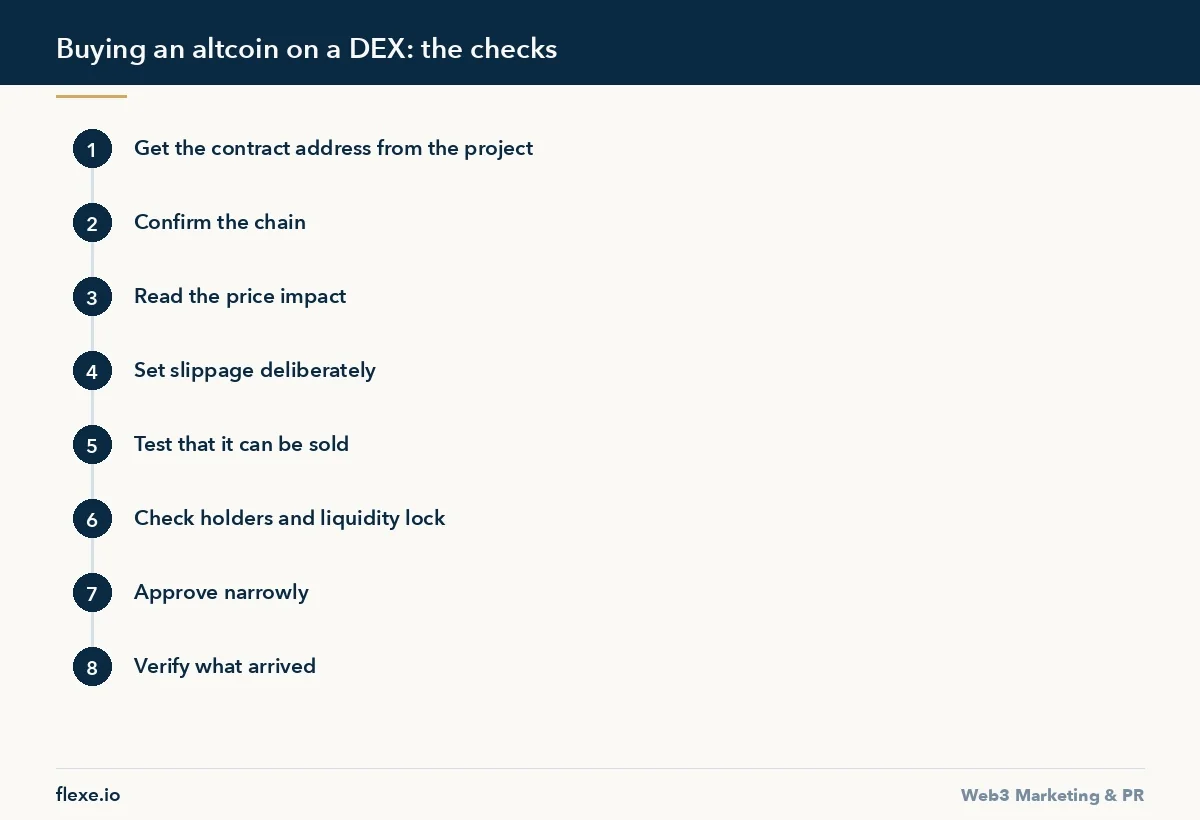
To buy altcoins on a DEX safely, you take the contract address from the project, confirm the chain, read the price impact before the fee, set slippage deliberately, test that the token can be sold, check who holds it, approve narrowly and confirm what arrived. That order removes most of the risk that is actually avoidable.
Most money lost on these trades is not lost to a scam token. It is lost to buying the wrong contract, accepting a price impact nobody read, or holding something that cannot be sold back at any reasonable size. Every step below targets one of those three.
What you need before you start
- A separate wallet holding nothing you are unwilling to lose on this trade.
- The native gas token of the chain, more than a single transaction’s worth.
- A bookmarked interface rather than one found through search.
- The contract address, copied from the project’s own documentation.
- A size and a maximum price impact, both written down before you open the interface.
A separate address limits what a bad approval can ever reach and keeps the position readable, because everything in that wallet relates to one activity. It costs a few minutes to set up. A wallet without gas cannot approve, sell in a hurry or move the position, and the moment you most need to exit is usually when fees are highest. Paid search results and cloned front ends are a standing problem, so check that the connection prompt names the domain you expect before signing anything.
Read the wallet prompt rather than the page. The interface describes what it intends to do, while the signature request states what will actually be authorised, including the spender and the amount involved. Where the two disagree, the prompt is the accurate one, and the page is either out of date or not the thing it appears to be.
Decide the size before opening the interface. A figure chosen while a price is moving is chosen badly, and writing down the amount and the price impact you will not exceed turns the trade into something you either execute or abandon.
How to buy altcoins on a DEX step by step
1. Get the contract address from the project, not the search box
Anyone can deploy a token with any name and symbol, and the search results inside an exchange interface are not curated. Copying an address from a search box is the single most common way people buy something else entirely. Take the address from the project’s own documentation or a tracker page that the project links to, then paste it in.
Check: if the address you pasted and the token the interface resolves do not match, stop.
2. Check you are on the right chain
The same project may exist on several chains with different addresses, and one of those versions is usually far more liquid than the others. Buying the thin one means buying at a worse price and being unable to leave. It also matters which version is canonical. Unofficial bridged copies exist for most tokens with any following, they trade, and they are not the asset you think you are holding.
3. Read the price impact before the fee
Price impact is how far your own trade moves the price against you, and on a thin pool it dwarfs every fee in the transaction. A swap fee is a fraction of a percent. Price impact on an illiquid altcoin can be double digits. If the interface warns about high impact, that warning is the most useful number on the screen: it is telling you the pool cannot serve the size you entered.
4. Set slippage deliberately, not high
Slippage tolerance is the worst price you will accept. Raising it to make a failing transaction succeed does not fix anything, it just authorises a worse fill, and on a thin pool it invites a sandwich where someone trades ahead of you and sells into your order.
Check: if a trade will not go through at a sane tolerance, the correct response is a smaller size, not a wider tolerance.
5. Check the token can be sold
Some tokens are constructed so that buying works and selling does not, through transfer restrictions, blacklists or punitive sell taxes. The buy transaction gives no indication. The reliable test is behavioural: buy a small amount, then immediately sell part of it. If the sale executes at a sensible price, the mechanism works.
Cost: two sets of fees, which is the cheapest insurance available.
6. Look at who holds it
A handful of wallets holding most of the supply means the price is set by whoever decides to sell first, regardless of what the chart looks like. Check the pool as well. If its liquidity is not locked and one address controls it, that address can withdraw it, and the token becomes untradeable in a single transaction.
Time: the holder distribution on a block explorer takes thirty seconds to read.
7. Approve narrowly
Buying requires approving a contract to move your funds. Interfaces default to an unlimited allowance because it saves a transaction later, and that allowance persists after the trade. Approve the amount you are actually spending where the interface allows it, and review outstanding approvals periodically. A stale unlimited approval to a contract that is later compromised is a live risk long after you stopped thinking about the trade.
8. Confirm what you received
After the transaction, check the token contract in your wallet against the address you intended to buy. Wallets display names, and names are not unique. This is the step that catches the earlier mistakes while they are still small.
Projects on the other side of this trade can read what makes it go smoothly in our token listing sequence, and the launch distribution that brings buyers in the first place is on our crypto traffic acquisition page. If you are on the liquidity side of a stable pair instead, our guide to stablecoin liquidity pools covers the checks in that order.
| Step | What goes wrong if skipped | The check |
|---|---|---|
| Contract address | You buy a copy with the same name and symbol | Address from project documentation, matched in the interface |
| Chain | You hold a thin or unofficial bridged version | Canonical deployment with the deepest pool |
| Price impact | Your own trade moves the price by double digits | Impact warning read before the fee |
| Slippage | A worse fill and a sandwich on a thin pool | Sane tolerance, smaller size if it fails |
| Sellability | Buying works and selling does not | Small buy, then sell part of it |
| Holders and pool | Liquidity withdrawn in one transaction | Holder distribution and lock status |
| Approval | A stale unlimited allowance stays live | Approve the amount spent, review later |
| Receipt | Wrong token held under a familiar name | Contract in wallet matched to intended address |
Reading the quote and handling failed transactions
The interface shows a route, a rate, a minimum received and an estimated fee, and the minimum received is the number to read. It already includes your slippage setting, so it states the worst outcome you have agreed to accept rather than the outcome the headline rate is advertising. If that figure is uncomfortable, the trade is too large for the pool or the tolerance is too wide.
Aggregators split an order across several pools to improve the rate, which helps on size and adds contract surface at the same time. On a small buy the better price rarely justifies the extra contracts touching your funds, and the simple route through the deepest pool usually wins.
Compare the quote against a second interface before committing to anything large. If two front ends disagree substantially on the same pair at the same moment, one of them is routing through something thin. This takes under a minute and scales directly with the size of the order. Check which pair you are trading against too: a token quoted against a wrapped native asset and the same token quoted against a stablecoin sit in two different pools with different depth, and on a thin market that choice moves the fill considerably more than the fee does.
A failed transaction still costs the fee. Failures usually mean the price moved past your tolerance while the transaction sat in the queue, the approval was missing, the gas limit was set too low, or the pool could not fill the size you asked for. Resubmitting the same transaction unchanged produces the same failure at the same cost, so read which of those it was before pressing anything again.
A pending transaction that will not confirm can be replaced by sending a new one with the same nonce and a higher fee, either the same swap or an empty transfer to yourself that cancels it. Clear one before submitting the next rather than stacking attempts. Never raise the fee and the slippage tolerance together to force a stuck trade through: together they hand an unusually good trade to whoever is watching the mempool.
New launches and getting back out
The first minutes after a pool opens are the worst conditions available to a buyer: the pool is at its thinnest, price impact is at its highest, and automated buyers are ahead of you by design rather than by luck. The checks above are impossible to run against a pool that is seconds old.
Buying in pieces rather than in one order reduces price impact on a thin pool and produces the sell test from step five as a side effect. The first piece establishes whether the token can be sold at all. Ignore the countdown: a token that only works if bought inside the first minute is a queue you are joining late.
Test the exit before you need it, and at a size that means something. A token that sells cleanly in a small amount can still be impossible to leave in the size you actually hold, because price impact scales with your position against a pool that did not grow while you were accumulating. Check pool depth against your holding rather than against a market capitalisation figure on a tracker: on an illiquid altcoin, what the pool will pay can be a small fraction of the quoted value.
Common mistakes
- Copying the contract address from a search box instead of project documentation.
- Raising slippage to force a failing trade through instead of cutting the size.
- Leaving an unlimited approval open long after the trade.
- Putting the whole position in at once, so the sell test never happens.
- Checking depth only after deciding to leave instead of before the buy.
How long it takes and what it costs
Reading holder distribution takes thirty seconds, comparing a quote against a second interface takes under a minute, and a separate wallet costs a few minutes once. The sell test costs two sets of fees. A swap fee is a fraction of a percent, price impact on an illiquid altcoin can be double digits, and a failed transaction still charges its fee.
Records and what to do when something goes wrong
Save the transaction hash, the contract address, the amount and the date at the moment of the trade. Reconstructing it later from a block explorer is tedious. Record approvals separately, because an allowance is a standing permission and that list is exactly what you need when a protocol is exploited. Keep the source of the contract address too: it is the only reliable way to show later whether you bought the canonical token or a bridged copy.
If you bought the wrong contract, check whether it has a market at all before attempting to sell it. Many never have one, and the explorer shows that for free. If the token cannot be sold, revoke the approval anyway. Revoking recovers nothing, but it stops the contract moving anything else that later arrives in the same wallet. Then stop using that wallet for anything you care about.
If the interface behaved strangely, or tokens arrived at an address you did not enter, treat the wallet as compromised rather than the trade as unlucky. Move whatever remains to a fresh address funded with its own gas and revoke outstanding approvals from the old one where you still can. There is no support desk and no reversal. Every recovery service that appears afterwards is a second loss arranged by people who watched the first one.
What this sequence to buy altcoins on a DEX does not protect against
- A project that simply fails. Contract checks say nothing about whether the thing succeeds.
- Liquidity leaving later. A locked pool today can be released on a published date you did not read.
- Price. Every check here concerns execution and custody, none concerns whether the asset is worth buying.
- Front-end compromise. A hijacked interface can present a correct address and route elsewhere.
Frequently Asked Questions
How do you avoid buying a fake version of a token?
Take the contract address from the project’s own documentation or a tracker it links to, paste it into the interface, and confirm the resolved token matches. Anyone can deploy a token with any name and symbol, and search results inside an exchange interface are not curated, so the search box is the riskiest place to start.
Should slippage tolerance be raised when a trade fails?
No. Raising tolerance only authorises a worse fill, and on thin pools it invites sandwich attacks where someone trades ahead of you and sells into your order. If a trade will not execute at a sane tolerance, reduce the size instead, and never raise the fee and the tolerance together.
How do you check a token can be sold?
Buy a small amount and immediately sell part of it. Some contracts allow buying and block selling through transfer restrictions, blacklists or punitive sell taxes, and the buy transaction shows no sign of this. The test costs two sets of fees, which is the cheapest insurance available on an unfamiliar token.
Why does price impact matter more than the swap fee?
Because it is usually the larger cost. A swap fee is a fraction of a percent, while price impact on an illiquid altcoin can be double digits. When the interface shows a high impact warning, the pool cannot serve the size you entered, and a smaller order is the fix.
What should you do if a DEX purchase goes wrong?
Limit the exposure of everything you still hold. Revoke the approval even if the token cannot be sold, stop using that wallet, and move remaining funds to a fresh address if the interface behaved strangely. There is no reversal, and any recovery service that contacts you afterwards is a second loss.