Crypto content writing is research-led writing of articles, website copy, announcements and threads for blockchain products, and we deliver it fact checked and ready to publish. Facts checked on 10 November 2026. Flexe has run 800+ campaigns since 2018, and this crypto content marketing service is built for teams that need pages buyers find in search, read to the end and act on.
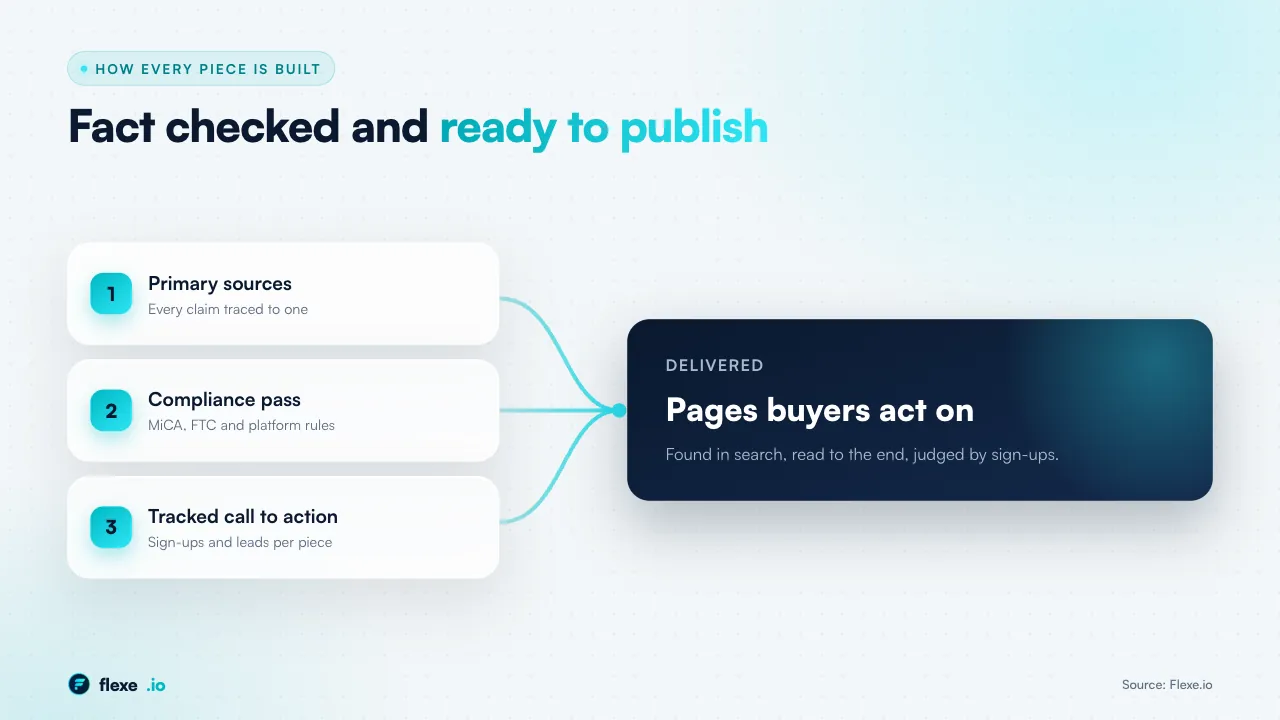
We write for token issuers, DeFi protocols, exchanges, wallets and infrastructure teams that sell to developers or retail users. Every claim is traced to a primary source, and every promotional piece gets a compliance pass against MiCA, FTC and platform rules. We report sign-ups and leads from the content itself, which is how cryptocurrency content writing should be judged.
Sources rechecked on 10 November 2026: Google Search Central, the FTC Endorsement Guides, the EU MiCA text and X platform rules.
What we write for crypto teams
We write what a crypto buyer reads before choosing a product, from search results to launch posts. Every draft comes from a blockchain content writer who has read your docs and listed open questions for your team.
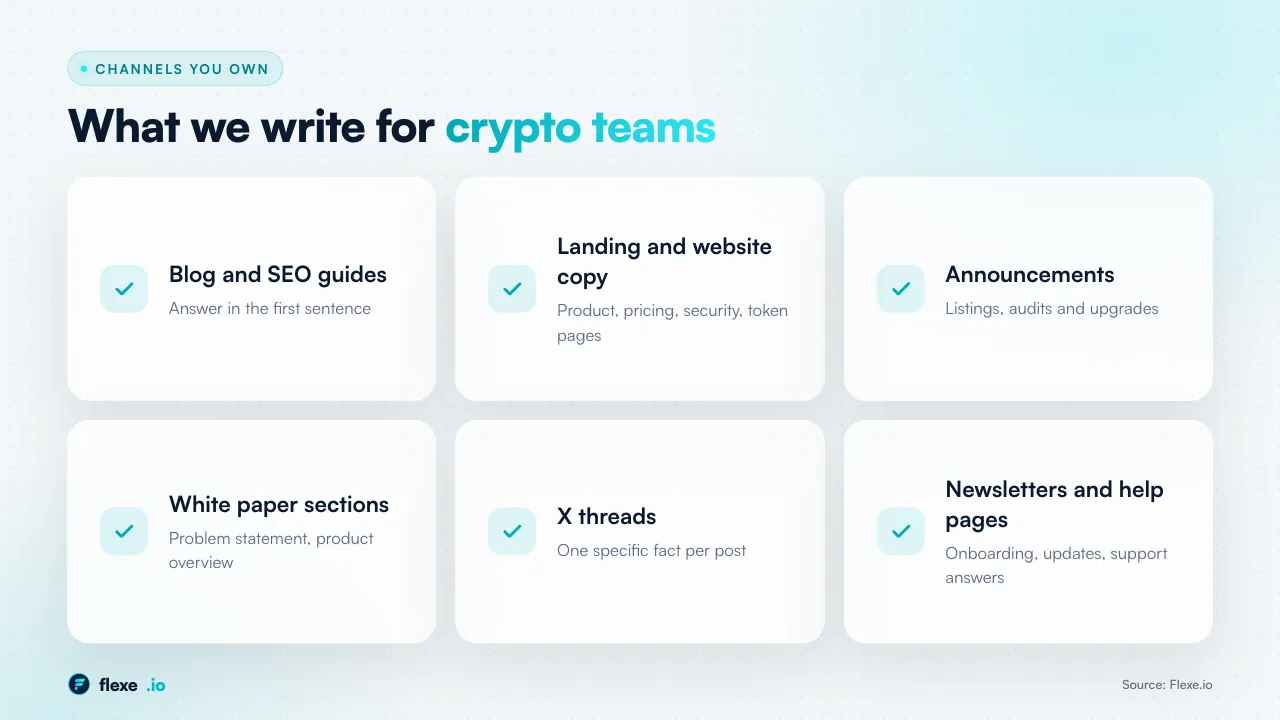
- Blog articles and SEO guides built around queries your buyers type, with the answer in the first sentence.
- Landing and website copy for product, pricing, security and token pages that developers and newcomers both follow.
- Announcements and press releases for listings, audits and upgrades, in the format of our crypto press release guide.
- White paper sections such as the problem statement and product overview, coordinated with our white paper writing service.
- X threads for your own account, one specific fact per post, written to X’s rules against bulk and duplicative posting.
- Newsletters and email sequences for onboarding, product updates and bringing back dormant wallets.
- Help center and explainer pages that answer support questions before users open a ticket.
Placement on third-party outlets is a separate service: for bylined articles on crypto media, our organic articles on demand service handles outlet selection and publishing. This page covers writing for channels you own, such as your site, blog, docs, newsletter and X account.
How a content engagement runs
A content engagement runs in seven steps, and the order matters more than the speed. Most content writing on cryptocurrency, and most crypto content marketing, fails for one of two reasons: the copywriter crypto founders hired did not understand the product, or nobody checked the numbers before publishing.
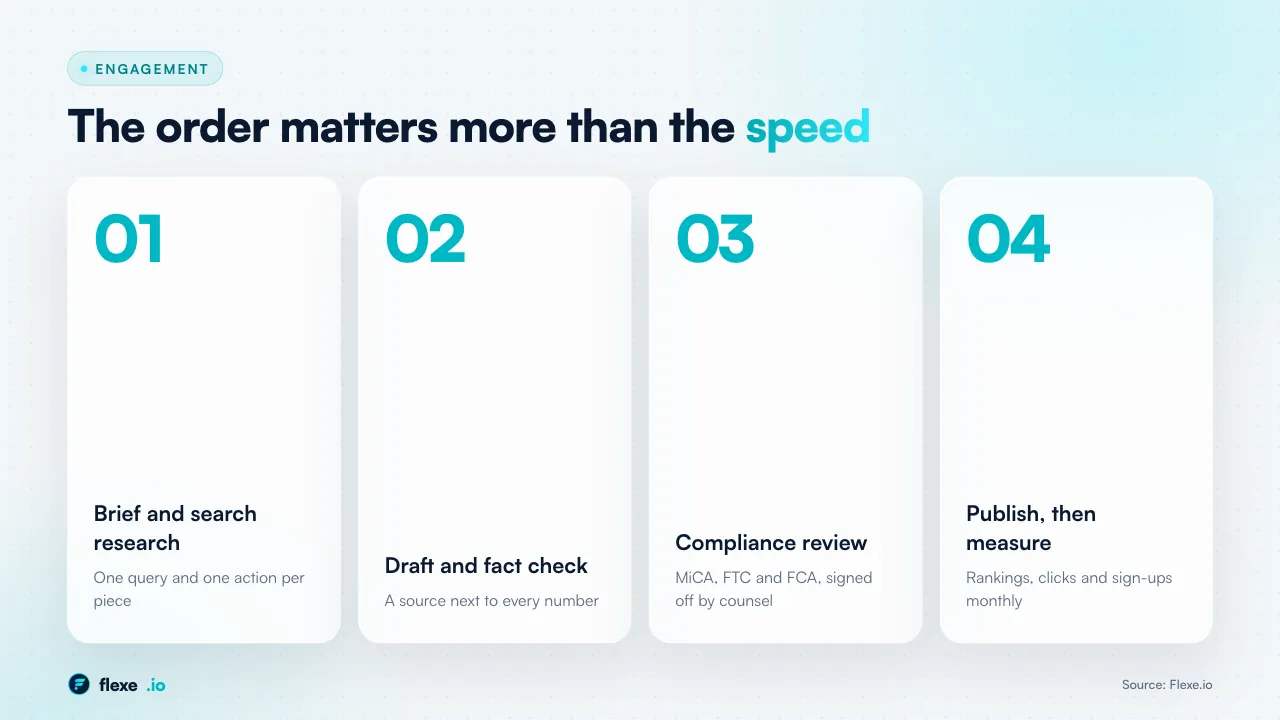
Brief and search research
The brief starts from your buyers’ searches and questions, and your feature list comes second. We collect the queries, Reddit threads and AI answers your audience already sees, then map each planned piece to one query and one action. The brief also fixes tone, banned claims, approved product facts and who signs off each draft.
Draft and fact check
Crypto article writing at this stage means a draft with a source next to every number, date and name. Model drafts tend to repeat stale token values and outdated team roles, so we recheck token figures, team roles, audit dates and fees against primary sources on the day of publishing.
The byline always names a real person, because Google’s rater guidelines of 11 September 2025 call AI content with made-up author profiles deceptive. If AI assisted a piece, the page can say so, as Google’s guidance on helpful content asks.
Compliance review before publishing
Compliance review checks every promotional sentence against the rules of the markets you sell into. For EU readers that means the MiCA Article 7 tests, and for US readers the FTC rules on paid endorsements. UK promotions need the FCA risk warning that has been mandatory since 8 October 2023. Your legal counsel signs off the final wording, because we are writers and not a law firm.
Publish, then measure
Publishing includes the title, meta description, internal links, schema and a tagged link behind every call to action. We then log rankings, clicks and sign-ups for each piece every month. Pages that miss their target get a rewrite or merge proposal, and next month’s plan changes with the data.
Crypto copywriting examples: weak versus strong
The lines below are illustrative examples written for this page, not client work, and the product details are invented. They show what crypto copywriting changes when a vague claim becomes a checkable one. Readers distrust vague crypto wording, so copywriting for crypto has to earn attention with numbers, limits and sources.
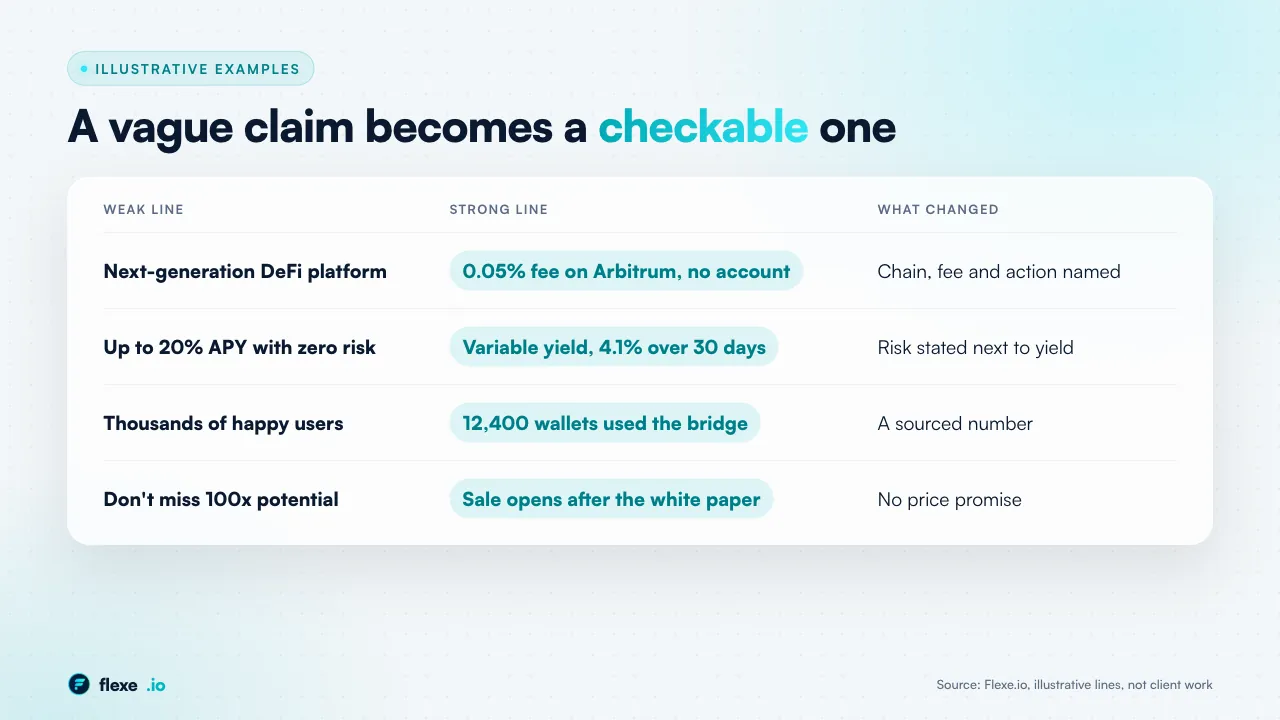
| Weak line | Strong line | What changed |
|---|---|---|
| “The next-generation DeFi platform for everyone.” | “Swap tokens on Arbitrum for a 0.05% fee, with no account to create.” | Names the chain, the fee and the action |
| “Earn up to 20% APY with zero risk.” | “Variable yield, 4.1% over the last 30 days, paid in USDC. You can lose funds if the pool is exploited.” | Fair, clear and not misleading, with the risk stated |
| “Thousands of happy users trust us!” | “12,400 wallets used the bridge in September, per our public dashboard.” | A sourced number instead of an unverifiable claim |
| “Token launch soon, don’t miss 100x potential.” | “The token sale opens after the white paper is published at [URL].” | No price promise; MiCA bars marketing before the white paper |
| “GM fam, huge alpha incoming.” | “We cut withdrawal fees from 0.5% to 0.1% on 1 October. Here is the saving on a $1,000 swap.” | A thread hook with one specific fact |
Each strong line passes two tests: a reader can verify it in a minute, and a compliance reviewer can match it to a dashboard, fee table or white paper. The weak lines ask for trust first, which is what the MiCA and FTC tests catch.
Crypto content writing that ranks and stays compliant
A page that ranks in 2026 satisfies two readers: Google’s systems for money topics and the regulator of each target market. Content that can affect financial stability falls under what Google calls Your Money or Your Life topics. Its helpful content guidance, updated 5 October 2026, says such content must be highly accurate and consistent with expert consensus.
What Google does with AI-written pages
Google does not ban AI-written pages, but it has removed a large share of low-quality ones. On 26 April 2024 Google reported that search showed 45% less low-quality, unoriginal content after the March 2024 update, against the 40% it expected (Google, The Keyword). That figure covers all content types, and Google gave no breakdown for crypto or for AI. Enforcement continues: per the Google Search Status Dashboard, the September 2026 spam update rolled out from 24 September to 8 October 2026, and the November 2026 core update started on 10 November 2026.
The rule behind it is scaled content abuse, which Google’s spam policies of 28 August 2026 define as many pages made mainly to manipulate rankings, however they are created. Google’s guidance on generative AI content, updated 1 October 2026, says models “predict a likely sequence of words” and can get facts wrong. It calls a manual fact check critical, down to titles, meta descriptions, structured data and image alt text.
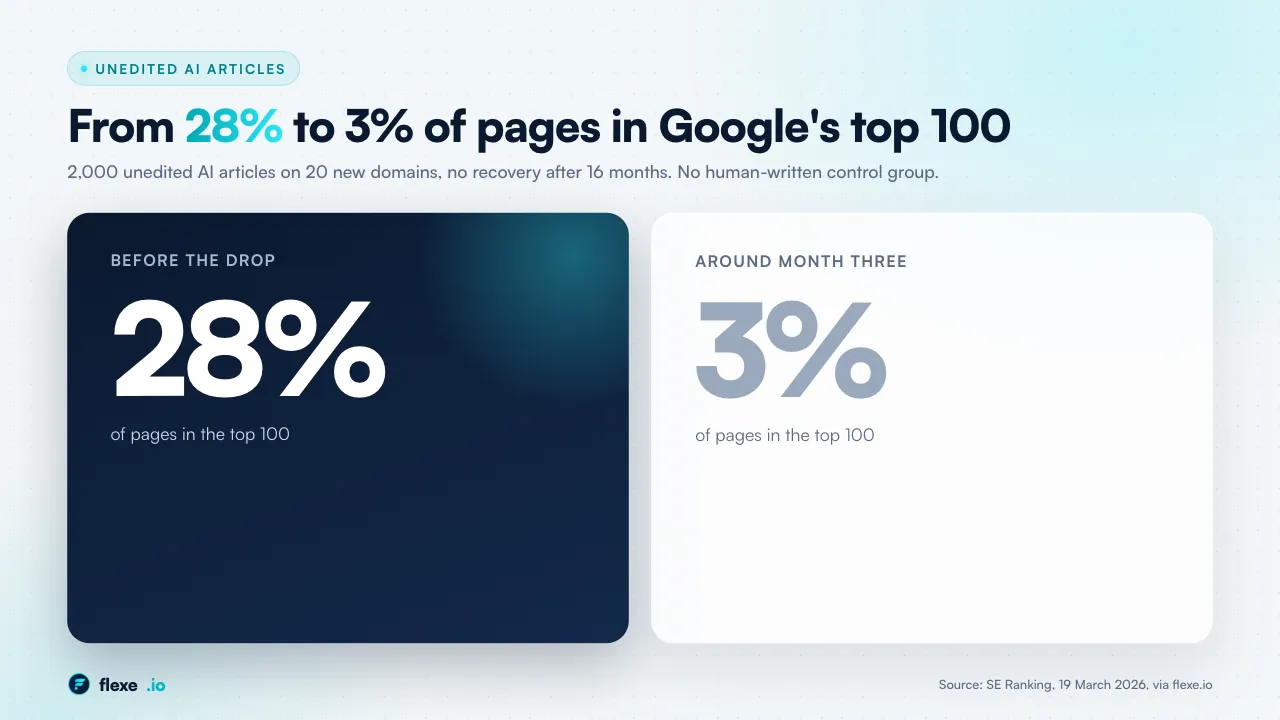
SE Ranking reported on 19 March 2026 that 2,000 unedited AI articles on 20 new domains fell from 28% to 3% of pages in Google’s top 100 around month three, with no recovery after 16 months. The test had no human-written control group.
What every crypto article must contain
A crypto article that ranks and survives review contains six things, listed below in the order we check them. We read nine agency service pages for this topic on 25 October 2026, and none of them described a compliance step or explained how AI is used in their writing.
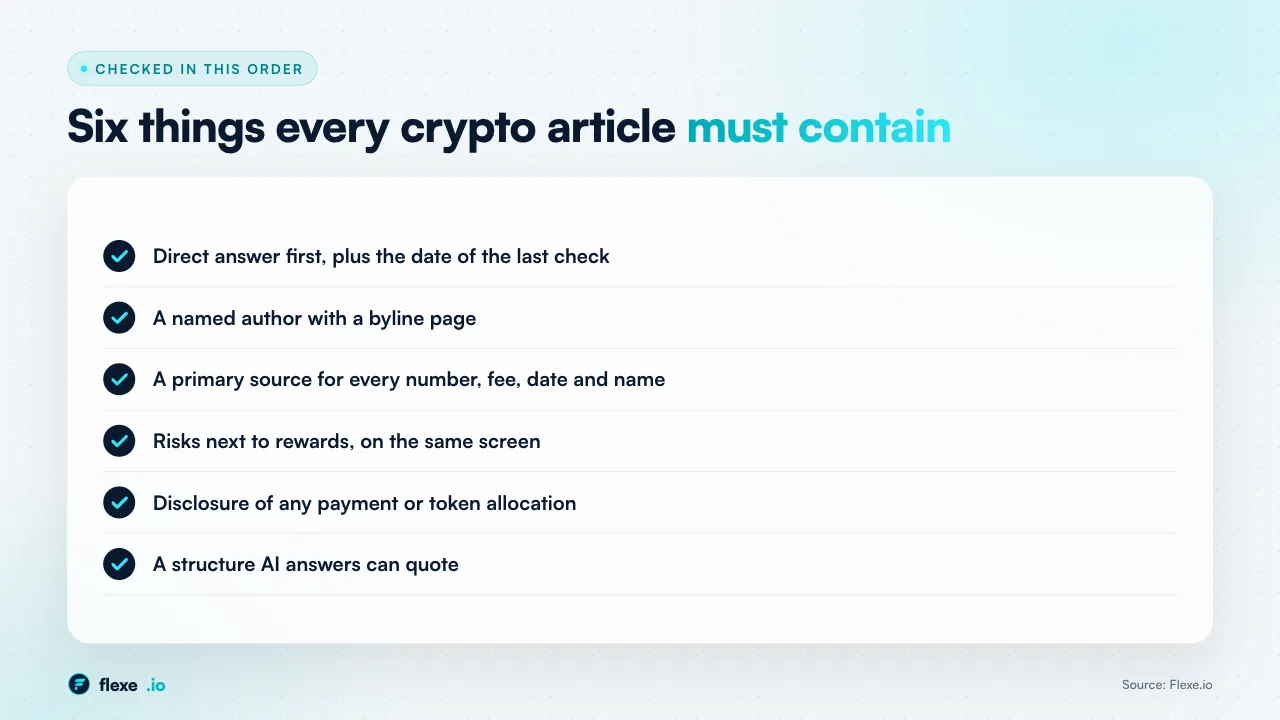
- A direct answer to the search query in the first sentence, plus a visible date of the last check.
- A named author with a byline page, since Google asks whether it is obvious who wrote the content.
- A primary source for every number, fee, date and name, rechecked on the day of publishing.
- Risks stated next to rewards, in the same font size and on the same screen.
- Disclosure of any payment, token allocation or free product behind the piece.
- A structure that AI answers can quote, as explained in our crypto AEO guide.
Disclosures that MiCA and the FTC require
MiCA Article 7 has applied since 30 December 2024 to crypto-assets other than asset-referenced and e-money tokens. A marketing communication must be clearly identifiable, fair, clear and not misleading, and consistent with the white paper (Regulation (EU) 2023/1114). It must state that no competent authority in the EU has reviewed or approved it, and nothing may be marketed before the white paper is published.
In the US, the FTC Endorsement Guides require a material connection to be disclosed clearly and conspicuously, and FTC staff ask for plain words such as “ad” or “sponsored”. The FTC rule on consumer reviews, in force since 21 October 2024, bans fake testimonials (16 CFR Part 465). X’s paid partnership policy bars paid creator promotion of crypto in the EU and Australia, although X Ads may still allow it.
What determines the price of a content campaign
We quote each campaign per channel, such as your blog or your X account, after the free plan. The price depends on research depth, technical difficulty, compliance exposure and how many people approve each draft. A cryptocurrency content writer who has to read audit reports and reconcile tokenomics figures spends far more hours per piece than one rewriting a news item.
| Price factor | Lower effort | Higher effort |
|---|---|---|
| Research | Product with clear docs | New protocol with sparse docs |
| Technical depth | Wallet onboarding guide | ZK proof or MEV explainer |
| Compliance | Developer tutorial | Yield, staking or token sale copy for the EU and UK |
| Approvals | One editor signs off | Product, legal and founders review each draft |
| Channels | One channel | Blog, X and newsletter together |
Volume pricing for copywriting crypto articles buys word count and leaves research out, because a writer paid for several articles a day has no hours left to check a number. Our content plan shows topics and cadence first, so the budget follows the work.
Who this is for and who it isn’t
The service fits crypto and Web3 teams with a live product, some search traffic and someone who answers technical questions within days. Exchanges, wallets, DeFi protocols and crypto fintech apps gain the most, because their buyers search before they sign up. Teams preparing a token sale also qualify, provided the white paper is published first.
It is a poor fit for projects that want daily volume, rankings by a deadline or copy that promises token returns. A crypto content writing agency that accepts those terms passes the risk of spam actions and regulator attention to you. We decline that kind of work.
Content alone will not rank a new domain, and we say so before any contract, because a site that few relevant sites link to starts every query behind. New domains get better results when writing runs alongside a crypto SEO plan that covers technical fixes and links.
How we measure crypto content marketing by sign-ups
We measure content by the sign-ups, deposits or demo requests that start on the page, and traffic is only a leading signal. Every call to action carries a tracking tag, and conversions are matched to the article that sent the visitor.
The monthly report lists search impressions and clicks from Google Search Console for each piece, plus conversions from your analytics. It also lists the pieces that missed their target and what we will change next.
Where crypto content marketing pays back first
Crypto content marketing pays back first on pages closest to a sign-up: fee and security pages, comparisons with named competitors and help articles about the first deposit. Readers there already searched for your product type, so a tracked call to action shows conversions early. News and broad explainers build reach but convert later.
Get a free content plan within 24 hours. Send your product link and target markets to Flexe on Telegram, and we will reply with topics that match your buyers’ searches. There is no form to fill in and no call required.
Frequently Asked Questions
How much does crypto content writing cost?
At Flexe, each campaign is quoted per channel, such as a blog or an X account, after a free content plan. The final price depends on research depth, technical difficulty, compliance exposure for regulated products and the number of approvers per draft. The cheapest offers often rely on templates and AI drafts with no fact check.
How do I find a good crypto or blockchain copywriter?
Ask a crypto copywriter for published pieces with dates, then check three of their numbers against primary sources. A good cryptocurrency copywriter asks for your docs, your buyers’ questions and your approval chain before writing a word. Avoid anyone who prices only by word count, promises rankings or token performance, or cannot explain how a paid post is disclosed.
Is AI-written crypto content penalized by Google?
Google does not penalize content for being AI-written, and its spam policies target pages made mainly to manipulate rankings, however they are produced. After the March 2024 update, Google reported 45% less low-quality, unoriginal content in results. Crypto faces a higher bar: financial content must be highly accurate, and Google calls a manual fact check of AI drafts critical.
What should a crypto article include?
A crypto article should open with a direct answer, carry a named author and a date of the last check, and cite a primary source for every number. Risks belong next to rewards in the same place. Paid relationships must be disclosed, and EU marketing copy needs the MiCA Article 7 statement. Short, quotable answers also help AI assistants cite the page.
How long until content brings traffic?
Search traffic from a new article usually takes several months to build, and longer on a domain with few links. Google first has to crawl, index and test the page against pages that already rank. We report every piece monthly from the first month, and pieces that have not moved after a quarter get a rewrite or link support.
Can you write about regulated products?
Yes, including staking, yield products, token sales and exchange services, provided your legal counsel approves the final text. We draft copy against the MiCA Article 7 tests, the FCA rules for UK promotions in force since 8 October 2023 and the FTC disclosure rules. Copy that promises returns or hides risks does not pass our review.
Should I hire a blockchain content writer or a crypto content writing agency?
Hire a freelance blockchain content writer when you already have an editor, a compliance reviewer and an SEO plan, and need one format written well. Choose a crypto content writing agency when one team must own research, fact checks, MiCA and FTC review, publishing and monthly reporting across your blog, X and newsletter. Either way, ask who signs the byline before you sign.