Telegram mini app ads put your unit inside an app someone is already using, across an inventory reaching 49 million users in more than 200 countries. What you get is the placement, creative built to the format, moderation handling and a report on what the run delivered. It is a different job from a post in a channel or a banner on a website. The format still runs on request, and it earns its money for an app launch with a destination that lives inside Telegram.
The buyer side of it is below: what the destination and the creative have to satisfy, what you send us, how the budget splits between media and work, what the reporting contains, and the briefs where we say no.
Available on request. We built this out when the format was new and demand has since fallen away, so it is no longer a standard product. If you want it, it can still be run – ask and we will tell you honestly whether it fits what you are launching.
Telegram passed 1 billion monthly users in 2025 according to its founder, and apps on the TON platform have grown alongside that base. Hamster Kombat reported gathering hundreds of millions of users within months of launch, a figure the project published itself and which was never independently verified. Telegram passed 1 billion monthly users in 2025 according to its founder, and a large share have already opened Mini Apps, so the interaction pattern is familiar to them. This allows us to run ads for your project similarly to traditional apps on iOS and Android. We can drive traffic to a Telegram mini app, group, channel, bot, or any external link such twitter profile or your website. The mini apps we can buy placement in reach a combined 49 million users across more than 200 countries. That is the size of the inventory available to a campaign, not the size of Telegram.
What We Do:
– Increase preapproval rate
– Pass moderation
– Create high-converting creatives
– A/B testing – Provide reports
We can also show ads in telegram channels & bots via official Telegram ads. You can find more details Telegram channel promotion.
How a run works when it fits
- Fit check first. We say plainly whether the format suits what you are launching, and often the answer is that another placement does the job better.
- Creatives built for the format. The unit sits inside an app people are already using, so it reads as an interruption unless it is written for that context.
- Moderation. Pre-approval matters more here than creative volume, because a rejection costs the slot rather than a day.
- A/B testing. Two or three variants live at once, judged on the action after the click rather than on the click.
- Reporting. Impressions, clicks and the destination action, whether that is a bot start, a channel join or a site visit.
Where the traffic can point
| Destination | Best used for |
|---|---|
| Telegram mini app | App installs and first-session activity |
| Channel or group | Audience for a launch that has something to read on arrival |
| Bot | A task flow, a checker, or an airdrop entry point |
| External link | A site or an X profile, at a lower conversion rate than in-Telegram destinations |
Two numbers get confused here, so worth separating them. Telegram itself passed 1 billion monthly users in 2025 according to its founder, which is why opening a mini app is a familiar action to almost anyone you would target. The inventory we can actually buy placement in is far smaller: the mini apps in our network reach a combined 49 million users across more than 200 countries. The first number is the reason the format works at all. The second is what a campaign can reach.
What telegram mini app ads require
The requirement list is short and hard. The destination has to exist and work before the creative is written, because the unit sends a user one tap away from it and there is no landing page in between to soften the arrival. A bot that is half-built converts worse than no campaign at all.
There is no advertiser verification to apply for in the way a mainstream network runs one. Instead every placement is moderated by the application that carries it, per creative and per destination, and a refusal costs the slot in the schedule rather than a day of review. That is why pre-approval matters more here than creative volume.
What you send us first
- The destination, live and tested: mini app, bot, channel or external URL, whichever the campaign points at.
- The countries you want reached, since the inventory spans more than 200 of them and relevance falls away fast if the list is left open.
- Copy and claims your counsel has already cleared, including anything about tokens, rewards or earnings.
- Static and animated assets, or a production line in the budget if you want us to build them.
- Access to whatever counts the result on your side, so a bot start or a first session can be attributed rather than estimated.
Setting up Telegram mini apps ads
Telegram mini app ads take about two weeks from brief to live, and most of that time is inventory and moderation rather than production.
- Fit check. We say plainly whether the format matches the brief, and the honest answer is often that another placement does the same job for less.
- Inventory selection. Applications are picked on audience overlap rather than on size, because a smaller one with the right users beats a large one with the wrong users.
- Creative production. Two or three variants written for somebody who is mid-task inside another application, which is the hardest constraint in this format.
- Pre-approval and scheduling. Creatives and destination go to the applications for moderation, then slots are booked against the dates you need.
- Live, then read. Variants run together and the weak ones are cut on the destination action rather than on the click rate.
Creative limits inside an app
The unit interrupts a session, so anything that reads like a banner is skipped and anything that reads like a trick gets reported. What survives is a plain statement of what the destination does and why it is worth one tap. Reward mechanics still perform in this inventory, but they pull users who came for the reward, and that shows up in second-day retention rather than in the click report.
Claims about returns, price or guaranteed rewards do not pass moderation, and rewriting the same claim in softer words costs the slot rather than the review. Variants are prepared in advance for that reason, not produced after a refusal.
Targeting and placement controls
The controls are coarser than on a mainstream network and there are few useful levers, so the choice of applications carries most of the weight.
- Application level selection, which is where audience fit is actually decided.
- Country and language, across the 200 plus countries the inventory covers.
- Frequency and pacing, so a smaller application is not used up in the first two days.
- Destination type, which changes the conversion rate more than any other single choice available here.
Budget and fees for a run
Media is paid by you directly. We do not take a percentage of advertising spend, which means our fee does not grow with your budget and we have no reason to push a number larger than the inventory can absorb.
A focused single-channel run starts at $4,000. Where this sits inside a wider launch, that work runs from $50K to $500K over three to six months and mini app placement is one line in it. Below the floor the problem is not the price but the delivery: too little spend across too few slots buys a volume of impressions that cannot be read as anything.
What the money actually buys
Inventory, creative built for the format, moderation handling, and reporting against the destination action. It does not buy guaranteed placement in a named application, because slots are taken as they come and an application can decline a campaign after accepting the category. Anyone promising a named placement in advance is describing something they do not control.
Where this sits beside other channels
This is one line inside a launch rather than the launch itself. Paid work across blockchain explorers, crypto media and data platforms reaches 12 audience segments that a mini app audience does not cover, and press placement reaches readers who will never tap a unit inside a game. The order that works is coverage and creator posts first, then mini app placement once there is a finished destination to send people to. Telegram mini apps ads work best when the app already gives users a reason to come back.
- Coverage and creator posts to make the name familiar, before any paid unit asks for a tap.
- Mini app placement once the destination is finished and instrumented, not while it is still being built.
- Channel and bot growth pointed at the same destination, so arrivals have somewhere to stay once the run ends.
- A second pass across the applications that delivered, rather than a fresh spread over new ones.
We have run more than 800 campaigns since 2018 and the pattern holds across most of them: the channel that converts is rarely the channel that created the first impression. Budget the two separately, because one pool split thinly across both usually starves the half that was working.
What a first engagement looks like
A scoping conversation, then a written scope naming the destination, the countries, the variants and the fields that will be reported. Fixed fee for the work, media funded by you directly, and nothing in the arrangement that makes stopping expensive. Assets and access come back to you when a run ends rather than staying inside an agency account.
What we ask for is somebody who can approve creative inside a working week. Moderation by the applications is slow enough on its own, and an internal approval queue stacked on top of it is the usual reason a date slips. That date is the single variable with the largest measured effect on the result.
How we measure the outcome
Telegram mini app ads are reported on impressions, clicks and the destination action, split by application and by variant. The click is the weakest number in this format, because the unit sits inside an application where taps are cheap and accidental. The action after the tap is what decides whether the run continues, gets rebuilt or stops.
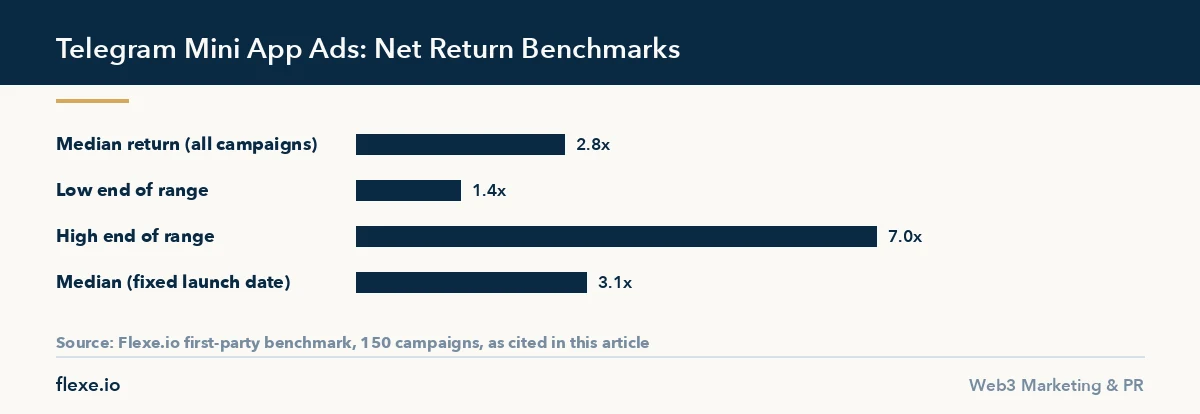
For the wider picture, our first-party benchmark across 150 campaigns is a median net return of 2.8x within 90 days, ranging from 1.4x to 7.0x, with a failure rate of 12 percent that we disclose rather than bury. A fixed launch date moves that median from 1.4x to 3.1x, and splitting one budget across too many channels at once correlates with a 34 percent failure rate.
Failure modes worth knowing
- A destination that is not finished, so traffic arrives at a bot which cannot answer it.
- Pointing at an external site by default, where a destination inside Telegram would convert several times better.
- Picking applications on audience size, which buys reach with no reason to care.
- Judging variants on clicks, which rewards the creative that startles people over the one that brings users.
- Running the format for a token rather than an application. Our active X roster of verified accounts, drawn from 11,859 X KOLs, with 8.7M combined reach usually fits that brief better.
Who should skip this format
Teams with nothing live inside Telegram, projects that need coverage rather than installs, and anyone who wants a guaranteed volume commitment, which this inventory cannot give. If reach is the point, our press work across 790 plus outlets or Telegram channel promotion spends the same money better, and crypto ad placements compares blockchain explorers, crypto media and data platforms with 12 audience segments across the advertising network.
Why it is on request rather than a standard product
We built this out when Mini Apps were new and demand has since fallen away. Keeping it on the menu as a standard product would suggest a level of current volume that is not there. It still runs, and it still works for the right brief, which is usually an app launch rather than a token.
If the placement is still an open question, crypto traffic acquisition sets out every option side by side with monthly visits and what each platform allows.
Frequently Asked Questions
Is this Telegram official ads?
No. Official Telegram Ads is a separate product with its own moderation rules and its own minimum spend, bought through Telegram itself. This is placement inside mini apps across a network of app publishers, so the inventory, the creative formats and the approval process are all different. Projects that want the official channel should budget for it separately.
Why is it available on request?
Demand for the format dropped after the mini app wave passed. We kept the capability and the publisher relationships but stopped presenting it as a standard product, because a price list on the page would imply volume we do not currently see. If your destination fits, we quote it; if it does not, we say so rather than sell the slot.
Is the 49 million figure the size of Telegram?
No. Telegram has over 1 billion monthly users. The 49 million is the combined audience of the mini apps we can buy placement in, across more than 200 countries, which is what a campaign can actually reach.
What converts best?
Destinations inside Telegram. A bot, a channel or another mini app converts better than an external site, because the user never leaves the app and never meets a browser or a wallet prompt mid-flow. If the only destination you have is a website, expect a weaker result here than the inventory figures suggest.
Should we use this or influencers?
If you are launching an app inside Telegram, this. If you are launching a token, creator posts usually reach a more relevant audience for the same money, and we will say so rather than take the media buy. We do not sell guaranteed installs or guaranteed view counts on this inventory.
Ask About a Run
For more information, contact us using the button below.
👇👇👇
Comparing inventory before you commit? Our guide to crypto ad placements sets out explorers, media and mainstream platforms side by side, with audience figures for each.
If the placement is still an open question, crypto traffic acquisition sets out every option side by side – explorers, media, ad platforms – with monthly visits and what each platform allows.