Crypto short video production at Flexe.io means 2 to 6 finished videos a day, published to your own YouTube Shorts, TikTok, Instagram Reels and Snapchat accounts. At this rate it is a production line, not a creative project. What follows is how the line runs week by week, what you send us, what comes back, how the price is set, and the points where the whole thing stops working.
The audience is organic – it comes from the recommendation feed, not from an ad budget.
Why Volume Is the Mechanic
Short-form feeds do not reward a good video, they reward a good video that the algorithm happened to test. Every upload is another test, and the outcome of any single one is close to random. Publishing daily is not a content strategy, it is how you buy enough attempts for the distribution to work.
The consequence is worth stating plainly: most videos will do little, and a handful will carry the whole account. That is the format working normally, not a campaign failing.
Four Platforms, Four Behaviours
| Platform | What it rewards |
|---|---|
| YouTube Shorts | The longest tail – videos surface weeks later |
| TikTok | Reach beyond the existing crypto audience |
| Instagram Reels | Brand presence for a partner or investor who checks |
| Snapchat | A younger audience most crypto brands are not competing for |
What You Get
- 2 to 6 videos daily across the four platforms
- Editing, captions and hooks – sound is off by default in every feed, so the first line has to work silently
- Publishing to your own accounts, so the audience stays yours
- Reporting on views, retention and follower growth
This builds an audience on your own account. Renting someone else’s is influencer marketing; a single flagship piece is a promo video.
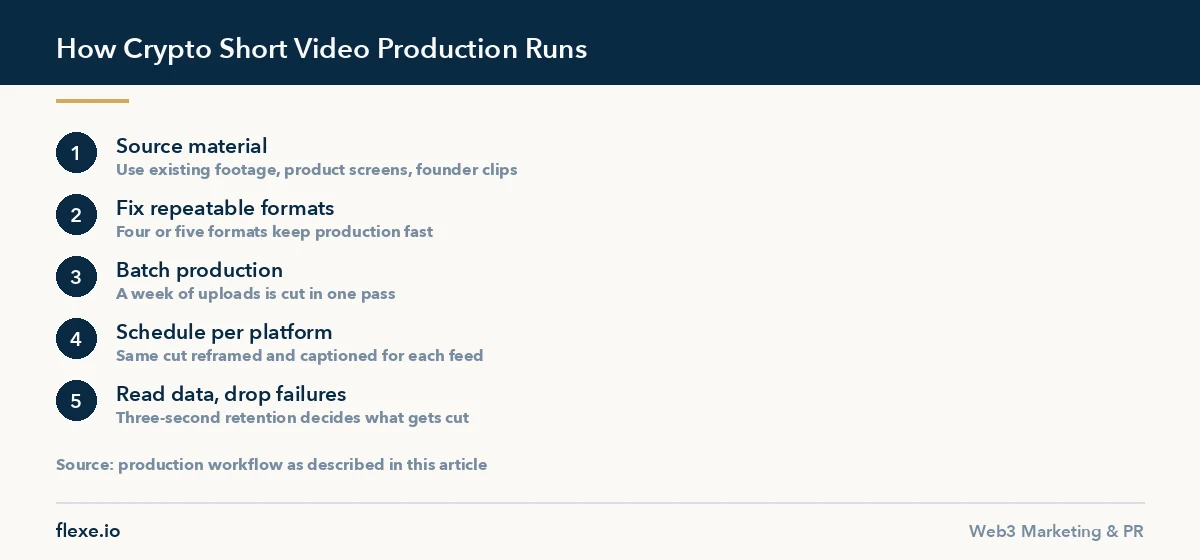
How crypto short video production runs
- Source material. Product screens, existing footage, founder clips, chart moments. Most projects have more usable material than they think and never cut it.
- Formats fixed, not invented weekly. Four or five repeatable formats so production stays fast and the account reads as one voice.
- Batch production. A week of uploads is cut in one pass, which is what makes daily volume affordable.
- Scheduling per platform. The same cut is reframed and captioned per feed rather than cross-posted with another app watermark on it.
- Read the data, drop what fails. Retention in the first three seconds decides everything; formats that lose viewers there are cut rather than defended.
What changes the cost
| Factor | Effect |
|---|---|
| Uploads per day | Two a day and six a day are different production lines |
| Number of platforms | Four feeds means four sets of reframing, captions and scheduling |
| Source material | Usable footage lowers the cost; building visuals from nothing raises it |
| On-camera presence | A founder on camera outperforms motion graphics and costs less to produce |
| Language | A second language is a second edit, not a subtitle track |
What to measure and when it starts working
Three-second retention first, because everything else follows it. Then watch the ratio of views to followers, which tells you whether the feed is showing your videos to people who do not already know you. Follower count is the last thing to move and the least useful early.
Expect the first weeks to look flat. The format works by accumulating attempts, so judgement before roughly a hundred uploads is judgement on noise. YouTube Shorts is the slowest to show its hand and the most likely to surface a video weeks after it was posted.
This builds an audience on accounts you own. Renting someone else audience is crypto influencer marketing, and the two work well together: creator posts bring people to a feed that already has something in it.
The first four weeks
Week one is setup and does not produce a full schedule. We pull whatever footage and product screens already exist, agree four or five repeatable formats, cut a first batch of ten to fifteen videos, and publish at reduced volume so the accounts do not jump from silence to six uploads a day. Week two runs at full rate. Weeks three and four give the first real read on retention, and that is when formats start being dropped.
A working month is one shoot or editing pass per week, videos delivered two to three days ahead of their slot, and a short written read on what the numbers said. Nothing in the schedule depends on one person being free on a particular day, which is the entire point of batching.
What one batch contains
A batch is a week of uploads cut in a single pass, which is what makes daily volume affordable at all. A week on a four-a-day schedule is around twenty-eight finished videos drawn from two or three source sessions, spread across formats already agreed rather than invented on the spot.
- Two or three explainer cuts, where a product screen or a chart carries the point and the text does the talking.
- A founder or team cut whenever someone is available on camera, which consistently outperforms motion graphics.
- One or two reactive pieces tied to something that actually happened in the market that week.
- Recuts of whatever won last month, opened differently rather than reposted unchanged.
- A test slot for a format nobody has tried yet, because a line with no tests in it stops improving by month two.
The mix is written down rather than improvised, and it changes when the retention data says a slot is not earning its place.
What you send us
- Publishing rights on each feed you want covered, granted through the platform business tools rather than by handing over a password.
- Whatever footage exists: product screens, conference clips, founder recordings, old ads, phone recordings of the app in use.
- Brand basics: logo files, fonts, colour values, and the two or three things that must never be said on camera.
- A named approver who can clear a batch inside one working day.
- Anything compliance requires on screen: a disclaimer, a jurisdiction note, a risk line.
Access delays starts more often than footage does. Platform business accounts take time to verify, and Snapchat in particular is slower than most teams expect, so it is worth starting that step before the contract is signed.
Approvals and revision rounds
Batches are approved as batches. You get a link to the week’s videos with captions and cover frames, and one round of notes is included per batch. Notes on a format, a hook or a caption are applied both to that batch and to the template behind it, so the same correction does not have to be made again the following week.
A second round on the same batch is available, and it costs schedule rather than money. Videos held for a second pass usually miss their slot, and in a feed that rewards frequency the slot is worth more than the polish. Where a video cannot be corrected in time it is dropped and the batch ships one short. Changing the direction of the whole account after a month has shipped is a new brief, not a revision.
How formats get chosen and cut
Formats come from what the source material can sustain every week, not from what looks good in a reference reel. If the product has a screen worth showing, screen-led formats carry the account. If the strongest asset is a founder who explains things clearly, talking cuts carry it and the rest support them. Building a format the team cannot feed weekly is how accounts stall in month two.
Cutting a format is decided on three-second retention read across at least six videos of that type, because one weak piece proves nothing. A format below the account average for a full week gets rewritten once. If the rewrite does not move retention, the slot goes to a test instead. Nothing is kept because it matches a brand deck, and nothing is dropped on the strength of a single bad day.
Reporting and the monthly review
Reporting arrives monthly, with a mid-month note if something moves sharply. The review itself takes thirty minutes and covers three things: which formats gained retention, what the views-to-followers ratio did, and which slots are being replaced next month. Anything needing a decision from you is listed with a recommendation attached, so the call is a confirmation rather than a workshop.
The report names the losing formats as plainly as the winning ones. An agency that shows only the videos that worked is handing you a highlight reel, and a highlight reel cannot tell you where next month’s budget should go.
Files and monthly handover
- Every published cut in its native aspect ratio, 9:16 masters plus any reframed versions.
- Caption files and all on-screen text as plain text, so a translator can work straight from it.
- Cover frames and thumbnails per platform.
- Project files for the formats built for you, so another editor could continue the line.
- A monthly sheet with views, three-second retention, watch time and follower change, per platform and per video.
Everything publishes to accounts you own and the archive stays with the project. If the engagement ends, the videos, the formats and the audience remain with you rather than with us.
How the price is set
The quote is built from output rate and from how much has to be created rather than edited. Two uploads a day and six uploads a day are different production lines, not the same line running longer. A focused single-channel engagement at this agency starts at $4,000, and crypto short video production sits near that floor when usable footage already exists and one platform is covered.
Beyond the upload rate, these move the number:
- Source material. Cutting existing footage is cheap. Building every visual from nothing is a different job at a different rate.
- On-camera presence. A founder who records twenty minutes a week produces stronger videos and lowers the cost of making them.
- Languages. A second language is a second edit and a second set of hooks, not a subtitle toggle.
- Platform count. Each feed carries its own reframing, captions, scheduling and reporting.
- Reactive turnaround. Cutting a response to a market event within hours is priced apart from the weekly batch.
How the result is judged
Three-second retention comes first, then the ratio of views to existing followers, which is what tells you the feed is showing the videos to people who do not already know the project. Follower growth is the last thing to move and the least useful thing to read early. A fair verdict arrives at roughly a hundred uploads, which at four a day is about a month of full-rate publishing.
We do not sell view counts. Any agency quoting a guaranteed number is quoting something it does not control: on a comparable organic format of ours the observed range across pieces runs from roughly 10 views to 150,000. That spread is the honest description of how recommendation feeds behave. What is controllable is the number of attempts, the quality of the first two seconds, and how quickly losing formats are cut.
Failure modes worth knowing
The most common is approval speed. A client who takes four days to clear a batch turns a daily account into a twice-weekly account, and the feed reads that as a weaker signal than the content deserves. The second is spreading a fixed budget across every platform at once. In our own campaign data, budget spread across too many channels correlates with a 34 percent failure rate, and the same logic applies here: two feeds covered properly beat four covered at half rate.
The third is defending a format because someone senior likes it. Retention decides, and a format that loses viewers in the first three seconds is cut without a debate. The fourth is treating the account as a news channel. Announcements do not travel in recommendation feeds, and an account made mostly of announcements will sit flat no matter how many uploads it gets.
Who this is not for
If what you need is one polished piece for a website or an investor meeting, this is the wrong line and a promo video is the right one. If you need borrowed attention this month, crypto short video production is slower than paying creators who already hold the audience, and creator work gets there faster.
It is also wrong for a project that cannot commit past six weeks. The format pays back by accumulating attempts, so stopping in week five means paying the setup cost and collecting none of the compounding that comes after it.
Frequently Asked Questions
Why so many videos?
Because the feed decides, not the viewer. Each upload is one test and the outcome of any single one is close to random, so volume is how you buy enough tests for the distribution to work. Two to six a day is the rate at which an account collects enough attempts to be judged inside a month.
Whose accounts are these?
Yours. Everything publishes to your own profiles on YouTube Shorts, TikTok, Instagram Reels and Snapchat, so the audience and the archive stay with the project. Publishing rights are granted through the platform business tools rather than by handing over a password, and if the engagement ends the videos and the followers remain with you.
What if most videos do nothing?
That is the format working normally, not a campaign failing. A handful of videos carry an account and you cannot tell in advance which ones. On a comparable organic format of ours the observed range across pieces runs from roughly 10 views to 150,000, which is the honest description of how recommendation feeds behave.
Do we need to appear on camera?
No, but it helps more than any editing trick. Product screens, charts and motion graphics carry an account perfectly well, and a recognisable person carries it better. A founder who records twenty minutes a week produces stronger videos and lowers the cost of making them, because talking cuts are faster to edit.
How long before it is worth judging?
Around a hundred uploads, which at four a day is about a month of full-rate publishing. Earlier than that you are reading noise and no one can shorten it. YouTube Shorts is the slowest to show its hand. We do not sell guaranteed view counts, because no agency controls them.
Tell Us About the Project
Send the accounts and whatever footage or product screens exist. You get back a content plan and a realistic view of how long it takes before the feed starts working.