A crypto exchange listing is an application to a business that receives several hundred of them a month and turns most of them down. What decides it is rarely enthusiasm for the project; it is whether the paperwork, the token contract and the market data hold up under review. The sections below set out what a venue actually asks for, the order the work happens in, what the fees cover, and what to do when an application is declined.
In the fast-paced world of cryptocurrency, securing the right exchange listing can make all the difference for your project’s visibility, liquidity, and overall success. Exchange listings serve as a crucial milestone in a crypto project’s journey, opening doors to wider adoption and market presence. With thousands of cryptocurrencies competing for attention, having a strategic approach to exchange listings is essential for standing out in this crowded marketplace.
Tailored Exchange Listing Solutions
We specialize in facilitating cryptocurrency exchange listings across the top 60 exchanges ranked on CoinMarketCap. Our comprehensive approach involves:
- Personalized exchange selection based on your project’s specific needs and goals
- End-to-end management of the listing process
- Strategic guidance to maximize the impact of your listing
- Ongoing support throughout the application and integration phases
- Assistance with technical requirements and compliance documentation
Why Our Exchange Listing Service?
Flexe.io carefully analyzes your cryptocurrency project to identify the most suitable exchanges that align with your target audience, trading volume requirements, and long-term objectives. We understand that each project has unique needs – whether you’re looking for global reach, regional focus, or specific trading pair options.
With years of industry experience and established relationships with leading exchanges, we navigate the often complex listing requirements efficiently, saving you time and resources while maximizing your chances of approval.
Market Making Services Available
Beyond securing exchange listings, we also offer professional market making services upon request. Our market making solutions help:
- Enhance trading liquidity for your token
- Reduce price volatility
- Create a healthier trading environment
- Attract more traders and investors to your project
- Improve overall market confidence in your cryptocurrency
Our market making strategies are custom-designed to meet your specific needs, whether you’re a new project looking to establish initial liquidity or an established token seeking to expand market depth.
Price Trackers and Aggregators
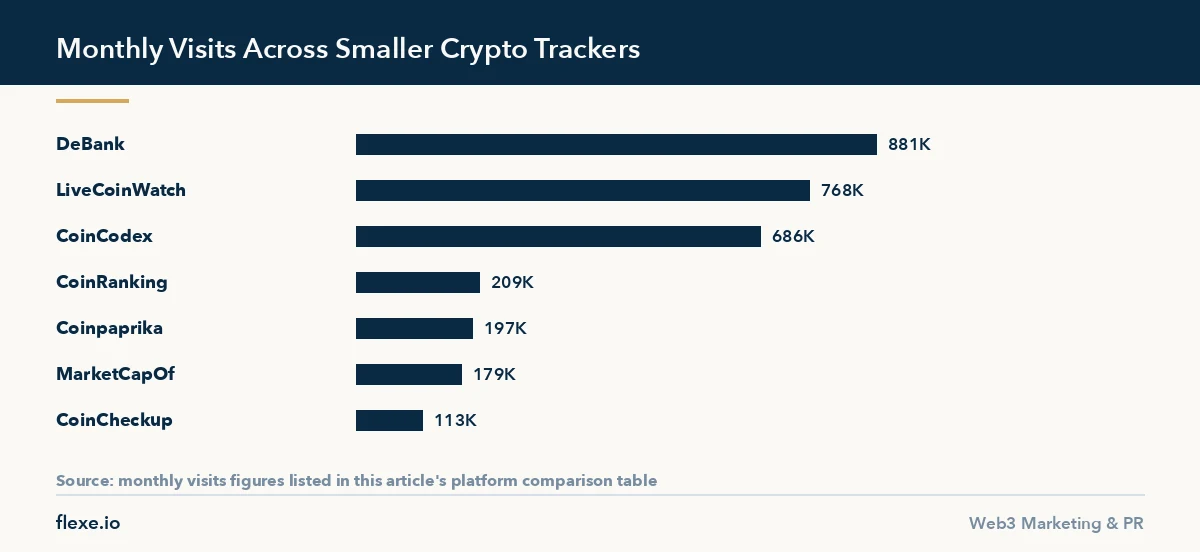
Exchange listings put a token where it can be traded. Tracker listings put it where it can be found. Both matter, and they are bought separately – a tracker will list a token that trades on only one exchange, while an exchange will not.
| Platform | Monthly visits | What a listing gives you |
|---|---|---|
| CoinMarketCap | 38.3M | The reference price feed most other sites pull from |
| StockTwits | 12.2M | A retail investor audience outside crypto-native sites |
| CoinCodex | 686K | Price pages that rank well on long-tail token queries |
| DeBank | 881K | Portfolio integration; the token shows in users’ wallets |
| LiveCoinWatch | 768K | Trending placement, refreshed frequently |
| CoinRanking | 209K | Fast approval; useful early while other listings are pending |
| Coinpaprika | 197K | Detailed asset pages with team and roadmap fields |
| CoinCheckup | 113K | Scoring and analysis pages |
| MarketCapOf | 179K | Comparison pages – “X with the market cap of Y” |
CoinMarketCap and CoinGecko are handled separately because their review processes are stricter and slower than the rest – see CoinMarketCap fast track listing and CoinGecko fast track listing. The smaller trackers above are usually approved within days and are worth doing first, because several of them feed data to larger aggregators.
What a crypto exchange listing requires
Application forms differ from venue to venue, but the questions behind them repeat. A review team is settling three things: whether the entity behind the token can be identified, whether the token behaves the way its documentation claims, and whether listing it creates a compliance problem the exchange has to answer for later. Every field on the form maps to one of those three. Reading a form that way explains why a half-finished answer stalls a file for weeks. The reviewer cannot close their own checklist item, so the application simply waits, and nobody writes to tell you that.
Documents the exchange asks for
The document set is heavier than most teams expect on a first attempt, and assembling it usually takes longer than the review itself. Gathering it in one pass, before a single form is opened, is the difference between one round of questions and four.
- Corporate papers: certificate of incorporation, register of directors and shareholders, and proof of address for the entity that will sign the listing agreement.
- Identity documents for founders and for anyone holding a controlling share, normally a passport plus a recent utility bill or bank statement.
- Token documentation: whitepaper, audit report with the commit hash it was run against, verified contract source, and deployment addresses on every chain the token exists on.
- Supply and vesting: total, circulating and locked amounts, the wallet addresses holding each tranche, and the date each tranche is released.
- A legal opinion on how the token is classified in the markets the exchange serves, which some venues require outright and others accept in a lighter form.
- Operational contacts: a technical contact for the integration and a named person who answers the review team the same working day.
Jurisdiction and compliance questions
Jurisdiction decides more applications than technology does. An exchange serving users in a market where the token could be read as a security will ask for an opinion letter, and failing that will decline quietly rather than explain. A registered entity, sanctions screening on the founders, and treasury funds that do not trace back to a mixer are all checked, and none of it is open to discussion once it has been flagged. Where a project is registered somewhere a venue avoids on principle, the useful answer is to pick different venues rather than spend two months arguing with a compliance desk that has already decided.
Technical integration requirements
The technical side is short but blocking. The exchange needs a node it can sync or a public endpoint it trusts, an explorer that resolves transactions, and confirmation rules it can apply safely to deposits and withdrawals. Tokens with unusual mechanics create real work on their side: rebasing supply, transfer taxes, blacklists, pausable transfers and open mint functions all break the internal accounting an exchange runs, and each one has to be disclosed and then handled in their code. A transfer tax on an otherwise standard contract is the single most common reason a clean file is turned down on technical grounds.
How a listing application moves
Almost all of the calendar is spent before anything is submitted, which is the opposite of what most teams plan for. The review itself is short when the file is complete and endless when it is not.
Order of steps and realistic timing
- Shortlisting venues against the token’s real market, region and pair plan: a few days, and the point at which an unsuitable exchange should be dropped rather than tried anyway.
- Assembling documents and reconciling supply against the chain: one to three weeks, driven almost entirely by how fast the project returns papers.
- Submission and first review: usually one to four weeks of silence, longer around a venue’s own product releases or a market-wide event.
- Follow-up questions: one or two rounds, each closed on the same working day from our side.
- Commercial terms, then technical integration and a deposit window before trading opens: one to two weeks once terms are signed.
Anyone quoting a fixed decision date is quoting something they do not control. What can be committed to is a submission that is complete on the first pass and a follow-up answered within the day, and that is most of the difference between six weeks and four months.
What the client prepares
Four things on the project side account for most of the delay we see, and all four can be settled in a week if someone owns them.
- One decision maker who can sign and who replies within a day. An application with three approvers moves at the speed of the slowest one.
- A single canonical set of numbers for supply, allocation and vesting releases that matches the site, the whitepaper and the chain without anyone having to explain the difference.
- Brand assets at the dimensions each venue specifies, plus a short English description that reads as a factual summary rather than promotion.
- Funds for the venue fee and, where required, the opening liquidity or market making float, available before terms are signed rather than promised after.
- A launch date you intend to keep. Across our own campaign data, a firm date moves median net ROI from 1.4x to 3.1x, mostly because everything else can then be scheduled around it.
Fees and what moves them
Exchange fees are set by the exchange and vary more than any other number in this process. Large venues price in the six figures and often ask for part of it in their own token; mid-tier venues sit far below that; some regional venues charge little at listing and make their money on the market making arrangement instead. Our own fee for a crypto exchange listing is separate and covers preparation, submission and the follow-up work, not the venue’s charge. We say which is which in writing before anything starts, because conflating the two is how projects end up short of funds at the terms stage.
What moves the exchange’s number: volume the token already trades elsewhere, the depth the book can hold from day one, whether the venue wants exposure to your region, and how much of the integration work falls on their engineers. What does not move it is community size or the quality of a deck. For context on the wider budget, our campaigns start at $4,000 for a single focused channel, while a full launch across listings, media and creator work generally runs $50K to $500K over three to six months.
If the application is declined
Exchanges rarely explain a refusal in writing, so the usable signal is in which stage it stalled at. A file that dies after the compliance round is an entity or jurisdiction problem. One that dies after the technical round is a contract problem. One that never draws a single question was almost certainly filtered on volume before a human read it. We work the cause before refiling, because a resubmission with the same contents lands in the same place and makes the next attempt slower rather than faster. Where the cause cannot be fixed at that venue, we say so and move to venues where it is not disqualifying.
What we will not sell you
Guaranteed daily trading volume from a market maker is sold openly in this market. It describes wash trading, exchanges detect it, and the result is a delisting that other venues can see when you apply to them next. We decline that work. Market making as we run it means quoting two-sided prices against a spread and depth target with real inventory at risk, and no promise about how much of it trades on any given day.
We also do not promise approval. The decision belongs to the exchange, and the honest description of our role is that we prepare the file, submit it and answer the review. Across more than 800 campaigns since 2018 that has made the process predictable rather than certain: on the 150 campaigns where we measured outcomes end to end, the disclosed failure rate is 12 percent, and we publish it for the same reason we publish the median.
How the result is judged
A listing judged only by its announcement is judged badly. The measures that still mean something a quarter later are the depth the book holds at one and two percent from mid price, the share of volume that is not the market maker’s own, how many holders arrived through that venue, and whether the pair is still quoted after ninety days. Against our own baseline, median net ROI across 150 campaigns was 2.8x within ninety days, with a range from 1.4x to 7.0x. Tokens that listed before there was any demand to meet sat at the bottom of that range with fairly grim consistency.
Failure modes worth naming
- Listing before there is a reason to buy. The pair opens, the market maker is the only participant of substance, and the chart works against the project from week one.
- Opening on too many venues at once. Liquidity splits, every book looks thin, and arbitrage takes the spread that should have gone to the token.
- Supply figures that change after submission. It reads as either carelessness or concealment, and both add rounds of questions.
- No plan for the announcement. A listing nobody hears about converts nothing, which is why our media inventory of 760 outlets, 228 of them above Majestic Trust Flow 30, and a creator base of 11,859 X KOLs with an active roster of 85 verified X accounts at 8.7M combined reach, are usually booked around the same week.
- Treating the venue relationship as finished at launch. Exchanges review quiet pairs and remove them.
Who this is not for
If the token has no audit, no verified contract, or a supply table that cannot be reconciled against the chain, exchange work is premature and we will say so on the first call rather than bill for a file that will fail. If the plan depends on a guaranteed volume number, we are the wrong agency for it, and no crypto exchange listing bought on that basis survives the first audit a venue runs. If the budget covers the venue fee and nothing else, tracker listings and a launch campaign are the better first purchase, and the CoinGecko fast track listing service is usually where that sequence starts.
Get Started with Your Custom Exchange Listing Strategy
Take the crucial next step in your cryptocurrency project’s growth journey. Contact us today to discuss how we can help your token gain visibility and liquidity through strategic exchange listings tailored specifically to your project’s needs and goals. Our team of experts is ready to analyze your requirements and develop a comprehensive listing strategy that positions your project for long-term success in the competitive crypto marketplace.
Contact us on Telegram to find the best exchange listing options.