A crypto promo video from us is a production job with a fixed sequence: script, storyboard, motion graphics or product capture, and cuts sized 6 to 15 seconds for paid feeds, 30 to 60 for social, 90 to 180 for a landing page. Almost everything that decides the cost is settled before anyone opens an animation tool, because placement, length, the number of cuts and whether anything is built in three dimensions are chosen in week one. Below is the schedule, what you send us, what a revision round covers, the files you receive, how the quote is built and when a video is the wrong purchase.
Nobody reads a white paper before deciding whether to care. A promo video exists to buy the thirty seconds in which someone decides whether your project is worth further attention.
The First Three Seconds
On every platform that autoplays, the opening three seconds decide the rest. A logo animation spends them on the one thing the viewer does not care about yet. The counter is to open on the problem, the number, or the thing that moves – and put the logo at the end, where a viewer who stayed will actually register it.
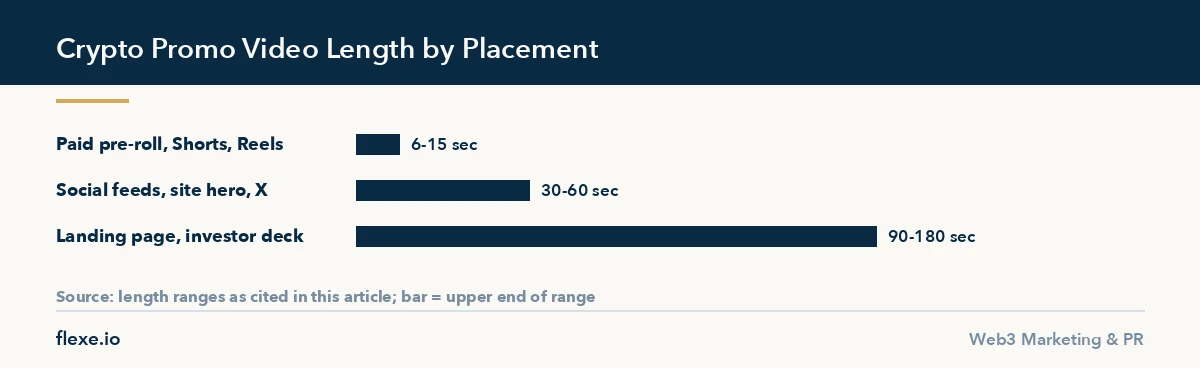
Length by Placement
| Length | Where it runs | What it can carry |
|---|---|---|
| 6–15 sec | Paid pre-roll, Shorts, Reels, TikTok | One idea, one call to action |
| 30–60 sec | Social feeds, site hero, X | Problem, solution, proof |
| 90–180 sec | Landing page, investor deck, conferences | The full argument, including mechanics |
Most projects order one video and try to use it everywhere. A ninety-second explainer cut down to fifteen seconds is worse than a fifteen-second video written as one, because the compression removes exactly the part that made it work.
What You Get
- Script and storyboard before any animation starts – the cheapest place to change your mind
- Motion graphics, screen capture of the real product, or a mix
- Voiceover, or captions for feeds where sound is off by default
- Vertical and horizontal cuts from the same edit
Where the video runs afterwards is a separate question – see crypto traffic for paid placement and short video for social profiles for the ongoing version.
How a crypto promo video is made
- Placement decided first. Length and structure follow from where it runs. This is the decision most projects make last and pay for.
- Script and storyboard. Approved before any animation starts, because changing your mind here costs a conversation and changing it later costs the edit.
- Production. Motion graphics, captured screens of the real product, or a mix.
- Voiceover or captions. Sound is off by default in every feed, so the visual has to carry the argument alone.
- Cuts. Vertical and horizontal from the same edit, plus the short version if a paid placement is planned.
What changes the cost
| Factor | Effect |
|---|---|
| Length and number of cuts | One master plus reframes is cheaper than separate videos written for each placement |
| Motion graphics versus real footage | Screen capture of a working product is faster and usually more convincing than illustration |
| 3D and character animation | The largest single multiplier, and rarely the thing that decides whether a viewer stays |
| Voiceover language and talent | Each language is a separate record and a separate mix |
| Revisions beyond the agreed rounds | Priced separately, which is why the storyboard stage exists |
Budgets across our services start from $4,000. A single promo video is quoted on the brief, and the two things that move the number most are 3D work and the number of distinct placements.
What to measure
Retention at three seconds and at the midpoint, not view count. A video with 50,000 views and a cliff at second four bought nothing. If the video runs as a paid pre-roll, the number that matters is the click rate on the page behind it, because the video is a step and not the destination.
Where the video runs afterwards is a separate decision. Paid placement is crypto traffic acquisition, and the ongoing feed version is short video for social profiles.
The production schedule week by week
A single sixty second video with motion graphics and one voiceover language runs about three to four weeks from brief to final cuts. The brief and placement call take a day. The script is two to three working days and is approved before a storyboard exists. The storyboard is another three to four days, and it is the last cheap place to change your mind. Animation and edit take seven to ten working days. Voiceover recording adds two days per language, including a retake window. Final cuts, reframes and captions take two to three days.
- Brief and placement call: one day
- Script written and approved: two to three working days
- Storyboard approved before animation starts: three to four working days
- Animation and edit: seven to ten working days
- Voiceover per language, retakes included: two days
- Final cuts, reframes and captions: two to three days
Three dimensional work or character animation moves that schedule by one to three weeks on its own, which is why it is decided at the brief and never halfway through.
Two things run in parallel and two things cannot. Brand assets, product recordings and legal wording are collected while the script is written, and voiceover casting can start at storyboard. Animation cannot start before the storyboard is approved, and captions cannot be finalised before the voiceover exists, because the timing follows the read. Projects that compress the schedule by starting animation early spend the saved days twice when the script moves.
What you send us first
The brief is short, and every item on it changes either the script or the edit.
- Where the video will run, named platform by platform, with any placements already bought
- Product access or screen recordings, even rough ones, because captured real screens beat illustration
- Brand files: logo in vector, fonts, colour values and any existing motion guidelines
- The single claim the video has to leave behind, written as one sentence
- Legal wording you are required to include, and any claim you are not allowed to make
- One named approver who can sign off the script without a committee
That one sentence is the item most projects skip and the one that costs the most later. A script written without it turns into a feature list, and a feature list gives nobody a reason to stay past the opening.
If product screens do not exist yet, say so at the brief rather than promising them for week two. A video built around illustrated placeholders is a different production at a different price, and switching from one to the other mid edit is the most expensive change on this page.
What counts as a revision round
Two rounds are included: one on script and storyboard, one on the first cut. A round is a single consolidated set of comments, timecoded where it applies to the edit, arriving together rather than as messages across a week.
Inside a round: copy changes, pacing, colour, music choice, reordering scenes that already exist, caption wording, and swapping a screen capture for a newer build. New scope, quoted before it is done: a different script after the storyboard was approved, new scenes, an added language, an aspect ratio that was not in the brief, a rebrand mid production, and re-recording a voiceover because the script changed after the session. Re-animating an approved scene costs the same whether the reason is a new idea or a changed product, which is exactly why the storyboard stage exists.
Comments delivered as a voice note or a screen share are welcome, but they are still written up into the same consolidated list before anything changes, so both sides can see what was agreed and what was not.
Files and formats you receive
Everything is delivered in shapes you can upload without asking us to export again.
- Master edit as a high bitrate MP4, plus a compressed version sized for feed upload
- Vertical, square and horizontal reframes cut from the same master
- A silent version with burned captions, because sound is off by default in feeds
- Separate subtitle files, so captions can be edited or translated without a re-render
- Thumbnail frames pulled from the edit at the sizes each placement asks for
Project files from the animation software are available on request and quoted separately, because handing over a working project means cleaning it up for someone else to open. Music is licensed for the placements named in the brief, so adding a placement later can mean a new licence rather than a new edit.
Source footage and raw recordings are kept for six months after delivery, which covers the usual request for a re-cut when a new placement appears. After that they are removed. If you expect to keep cutting versions from the same material for a year, say so before production and the archive is written into the scope.
How the quote is built
Budgets across our services start from $4,000 for focused single-channel work, and a crypto promo video is quoted on the brief as a fixed fee against a written scope: length, number of cuts, animation style, languages and included rounds. Half at storyboard approval and half at delivery is the usual split.
The fee covers the edit, the rounds named in the scope and the deliverables listed above. It does not cover media buying, the paid placement itself, licensing beyond the named platforms, or a monthly stream of new versions. Paid distribution is a separate budget and a separate decision, which is why we ask where it runs before quoting the video.
Where productions go wrong
The recurring failures have almost nothing to do with animation quality.
- Placement chosen after the video is finished, which turns the edit into a salvage job
- Approval by committee, where every round adds a competing idea and the single claim disappears
- A product still changing, so every screen capture is stale by the time the cut is approved
- A launch date that keeps moving, the cheapest failure on this list to avoid
- Budget split across many short pieces at once, a pattern that correlates with a 34 percent failure rate in our own data
A fixed launch date is worth more than extra production value. Across 150 campaigns in our own benchmark, projects with a clear launch date show a median net return of 3.1x against 1.4x for those without one.
The pattern under most of those is the same: a decision that belongs in week one gets made in week three. The brief is not paperwork. It is the only stage where a change costs a conversation, and every stage after it converts the same change into re-animation, a new voiceover session, or a set of reframes that no longer match the copy on the page behind them.
Who a video will not help
If there is no traffic budget and no audience to show it to, a video is a file sitting on a server. If the product has nothing to show yet and the script has to describe an intention, the result is a mood piece that convinces nobody. If the job is to explain a complicated mechanism in full, a written page does it better and costs less.
We also state what cannot be bought at any price: guaranteed view counts, guaranteed trending placement and guaranteed engagement. Views can be purchased and are worth nothing. Retention cannot be purchased, which is why retention is what we report.
How the video fits a launch
Since 2018 we have run more than 800 campaigns, and the first-party benchmark across 150 of them shows a median net return of 2.8x within 90 days, a range of 1.4x to 7.0x, and a failure rate of 12 percent that we publish rather than hide. A video contributes to that when it sits in front of paid distribution or an audience that already exists.
The distribution side we run carries a PR inventory of more than 790 outlets, 249 of them above Majestic Trust Flow 30, and a KOL base of 11,859 X accounts with an active roster of 85 verified X accounts at 8.7 million combined reach and 1.74 percent average engagement. That is the plain reason we ask about distribution before quoting a video: the same edit performs very differently depending on whether anything is pushing it, and sizing both together beats delivering a good file into silence.
Distribution is bought separately through crypto traffic acquisition, and the recurring feed version is short video for social profiles. One crypto promo video with a real budget behind it outperforms four with none, and that choice is made at the brief.
Frequently Asked Questions
How long should it be?
It depends on where it runs, and that is not a hedge: 6 to 15 seconds for paid pre-roll and vertical feeds, 30 to 60 for social and a site hero, 90 to 180 for a landing page or an investor deck.
Can one video cover everything?
Badly. A ninety-second explainer cut down to fifteen seconds is worse than a fifteen-second video written as one, because the compression removes the part that made it work. One master with reframes covers a family of placements; one video covering every placement covers none of them well. We also do not promise view counts, since that depends on the media buy behind the file.
Do we need a voiceover?
Not for feeds, where sound is off by default and captions carry the message. For a landing page, an investor deck or a conference screen a voice helps, and the same script usually needs rewriting for it, because text on screen and a spoken line carry different amounts of information per second.
Should the logo be first?
No. On every platform that autoplays, the first three seconds decide the rest, and a logo animation spends them on the one thing the viewer does not care about yet. Put the logo at the end, and open with the product doing something or with the problem the viewer recognises.
What do you need from us to start?
The project, the placement and whatever product screens already exist. Length and format follow from those, not the other way round. Brand files, a working build or a recorded demo, and one person on your side who can approve a script will cover the first week, which is where most schedules are lost.
Tell Us What It Is For
Send the project and where the video will run. Length and format follow from that, not the other way round.