To write a crypto press release that outlets accept, you lead with what happened, keep the headline and the body short, attach a dated source to every number, follow the compliance rules and close with real contacts and ready assets. Writing a crypto press release means producing a document an editor can use without rewriting. Most attempts fail at that, which is why they end up in the paid section, unread, with a nofollow link.
The format has been stable for decades and the rules are not arbitrary: each one exists because editors work at speed. The steps below follow the order an editor reads in.
What you need before you start
- Actual news: a launch, a figure or a decision with a consequence, not a rebrand or a partnership with no product behind it.
- A source for every number: an explorer link, an audit report, a filing or a named research provider, each with a date.
- One or two named people with titles who can give a quote that carries a judgement.
- A boilerplate and a contact: a short company paragraph and a named media contact with an email that a person reads.
- Assets: the logo in usable formats, one image at a publishable resolution and the exact link with tracking applied.
Writing a crypto press release step by step
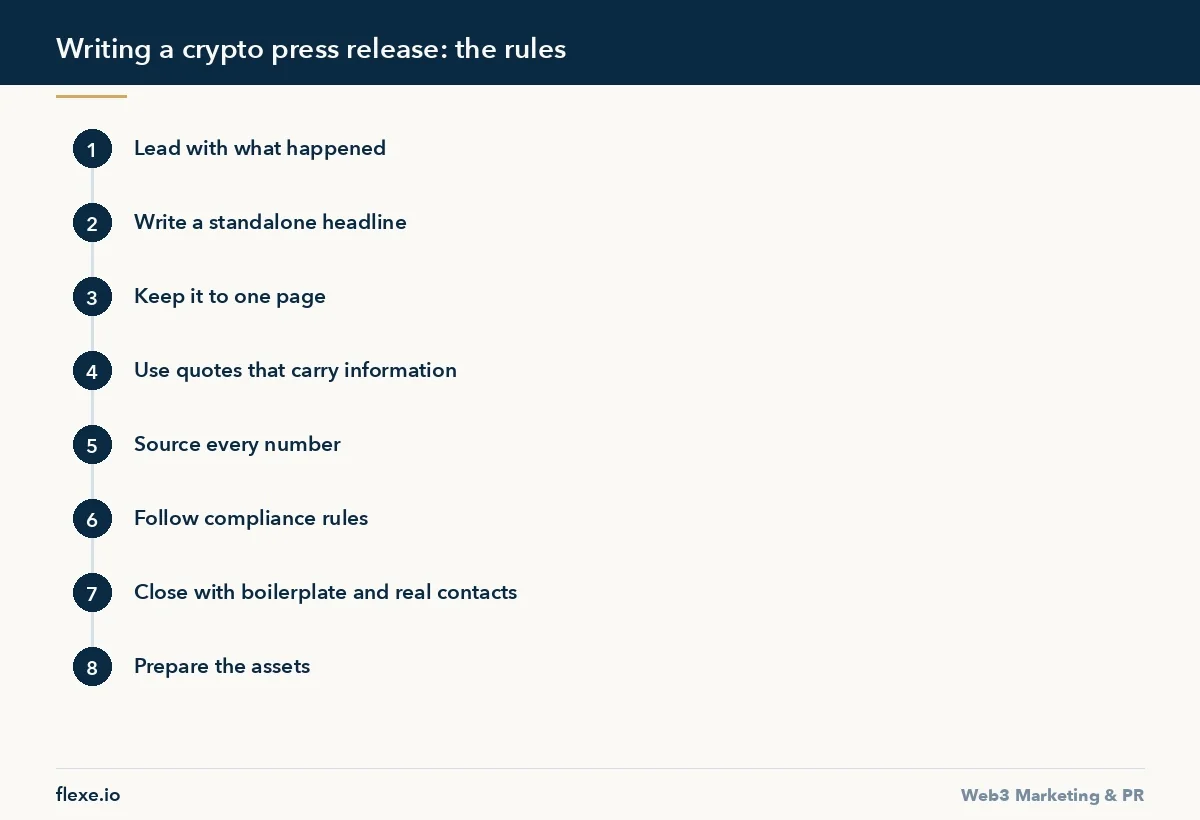
1. Lead with what happened
The first sentence contains who, what and when. Not context, not the mission, not the state of the industry. Everything below the lead runs in descending order of importance, so an editor cutting for length removes from the bottom and the release still works. Writing towards a conclusion at the end is the structure that guarantees the release is cut badly.
Check: a reader who stops after one sentence should know the news.
2. Write a headline that survives being read alone
Keep it under about twelve words, containing the specific fact. Aggregators, feeds and assistants display the headline without the body, so a headline that only makes sense with context does not travel. Name the project and the concrete thing. Vague headlines built on words like unveils and revolutionises say nothing, and they are the reason a release reads as promotional before anyone reaches the first paragraph.
3. Keep it to one page
Four hundred to five hundred words. Long releases are not more thorough, they are less edited, and the additional material is almost always background that belongs on the website. If something cannot be cut, it is probably the news and belongs higher up.
4. Use quotes that say something
One or two quotes, from named people with titles. A quote should carry information or a judgement that would not be credible in the neutral voice of the release: why the decision was made, what was difficult, what happens next. Quotes that restate the preceding paragraph in the first person are the single most common wasted space in crypto releases, and editors delete them first.
5. Attach evidence to every number
Each figure needs a date and a source: an explorer link, an audit report, a filing, a named research provider. Undated numbers are treated as marketing and removed. Avoid superlatives entirely. First, largest and fastest require proof, and a claim that cannot be supported casts doubt on the parts of the release that could have been.
6. Follow the compliance rules for your audience
No price predictions, no return projections, no language framing the token as an investment opportunity. Many outlets will reject the release outright on those grounds, and some jurisdictions require specific disclosure wording. Where a release concerns a token sale, state the restrictions plainly. That keeps it usable by outlets with stricter editorial policies, the ones worth reaching.
7. Close with a boilerplate and real contacts
Add a short standing paragraph about the company: what it does, where it is based, when it was founded. Then a named media contact with an email that a person reads, and the website. A generic address nobody monitors is a common and expensive mistake, because the journalist who wants to expand the release into a real article has no way through.
8. Prepare the assets alongside it
Logo in usable formats, one relevant image at a publishable resolution, and the exact link with any tracking already applied. Missing assets delay publication and produce releases that run without images, which perform worse everywhere. Send the release as text in the email body as well as any attachment, because editors copy from the body.
9. Do a final pass before sending
Read the release aloud from the top and stop at the first sentence that needs the one before it to make sense. That is where an editor cutting for length will break it. Then cover the lead and read again from the second paragraph. If the release still works, the opening was context rather than news, and the news is sitting underneath it waiting to be promoted.
Check every proper noun against its official spelling: the chain, the partner, the product and the titles of the people quoted. A misspelled partner name gets the document returned rather than corrected. Hand it to somebody who was not involved and ask them what happened. If they cannot answer in a single sentence, the lead has failed. Finally, open every link from a device that is not signed into anything you own: a tracking link resolving to a staging page, or documentation behind a login, is found by the first editor and by nobody internally.
Time: a few minutes, and it catches a release nobody can summarise.
The parts of a release at a glance
| Part | What it contains | Rule of thumb |
|---|---|---|
| Headline | The project and the concrete fact | Under about twelve words, readable alone |
| Lead | Who, what and when | One sentence that carries the news |
| Body | Details in descending order of importance | Four hundred to five hundred words in total |
| Quotes | A judgement from named people with titles | One or two, never a restatement |
| Figures | Each number with a date and a source | No superlatives without proof |
| Compliance | Restrictions and any required disclosure wording | No price predictions or return projections |
| Boilerplate and contact | What the company does, where, since when; a named contact | An email that a person reads |
| Assets | Logo, one image, the tracked link | Ready before the send |
Approval, embargo and sending
Getting it approved without losing the news
A release carrying a legal review, a partner review and a founder review will go through several rounds, and each round tends to add qualifiers that weaken the lead. Send the draft to everyone at once with a stated deadline rather than in sequence, and keep one owner who decides which changes are accepted and which are noted and dropped.
Where a partner is named, they approve their own quote and their own boilerplate, and nothing else. Handing a partner control over the whole document turns a release about your news into one about theirs. Lock the version once it is approved: distribution, translations and the pitch all derive from one file, and a late edit that reaches the wire but not the translations puts two accounts of the same announcement into circulation. Give the file a version number.
Sending it under embargo
An embargo is a request rather than an agreement, and it holds only with reporters who have accepted it in advance. Send the draft to named people you have dealt with before, state the lift time with the timezone written out in full, and treat anybody who did not reply as somebody who has agreed to nothing. Give it enough room for a reporter to do actual work and not so much that it leaks.
Have the public version live at the lift time on your own site, with the assets in place and the link working. An embargo that lifts while the announcement page returns an error hands every reader to whichever outlet published first. If the news leaks early, publish immediately. A release competing with an accurate rumour reads as confirmation; the same release hours later reads as a response to somebody else’s story, and the outlets that honoured the embargo will remember.
Building the list it goes to
Split the list between outlets that publish paid submissions and reporters who cover the beat, because those two groups receive different documents. The release itself goes to the first. The second gets a short pitch with the release below it. Verify addresses rather than buying a list: media lists decay as people move outlets, and a send to a large stale list produces bounces that damage the sending domain. Record who received which version and on which date, so that a reply a week later can be answered and the next send is cheaper to plan.
Formatting the email that carries it
The subject line is the headline, with nothing in front of it. The body carries the full text as plain text, the assets sit behind a link rather than as attachments that trigger filters, and the contact details sit at the bottom. Send from a named person on the company domain; a release from a generic marketing address on a free mail provider is filtered or ignored. One follow-up is reasonable, sent after the news is public and carrying something new: a figure that has since landed, a second source or an offer of an interview with the person quoted.
After it runs: corrections, translations and results
When a fact turns out to be wrong
Correct it on your own site first, showing the corrected figure and a note saying what changed and when. Then write to every outlet that ran it, quoting the exact sentence and the exact replacement; editors correct quickly when handed replacement text and slowly when handed an explanation. Do not quietly amend a number already quoted elsewhere. Where the error concerns a token sale or anything a regulator might read, keep the original visible alongside the correction. Removing the page looks worse than the mistake, because the archived copy still exists.
Translations and regional versions
Translate the release properly rather than running it through a tool. Financial wording does not survive machine translation intact, and a mistranslated sentence about a token sale can create a claim the original never made. Each regional version needs its own compliance pass, because the same release can be publishable in one jurisdiction and rejected in another on wording alone. Keep the figures, dates, sources and disclosure wording identical across every version.
What to check after it runs
Count placements and coverage separately. A list of sites that accepted a paid submission is a distribution report; a reporter writing about the event is the outcome the document was produced for. Check which outlets passed a followed link, which republished the headline alone and where the release was cut: the sentence that survives editing tells you what outlets thought the news was. Note how long each outlet took to publish, and keep the release, list, replies and result in one place.
Common mistakes
The most common failure when writing a crypto press release is that there was no news. A release announcing a partnership with no product consequence, or a rebrand, is correctly formatted and still uninteresting, and no distribution list fixes that.
The second is confusing distribution with coverage. A release published on outlets that accept paid submissions is a placement. A reporter writing about the same event is coverage, and the pitch that produces it is a different document, covered in how to pitch a crypto journalist.
- Opening with context or the mission instead of who, what and when.
- Quotes that restate the previous paragraph in the first person.
- Undated figures and superlatives such as first, largest and fastest with no proof behind them.
- A generic contact address nobody monitors.
- A follow-up that only repeats the release, which gets the next one from the same address filtered.
Which outlets pass a followed link, and how to verify it, is in how to tell if a placement passes a followed link. Writing and distribution are on our crypto PR page.
How long it takes and what it costs
Writing a crypto press release is the short part: one page of four hundred to five hundred words, and the test of handing it to an uninvolved reader takes a few minutes. The time goes into approval. Several rounds of legal, partner and founder review are normal, and a partner given control of the whole text usually returns it a week later with the lead rewritten around a company that is not announcing anything.
Schedule from each outlet’s own gap between receiving a release and publishing it. That gap is the only reliable input to the next schedule: an outlet running a week behind simply has to receive the next release earlier. On cost, paid submissions buy placement rather than coverage. The second send to the same list is much cheaper to plan than the first, but only if the record was kept while it was still accurate.
Frequently Asked Questions
How long should a crypto press release be?
A crypto press release should be four hundred to five hundred words, about one page. Longer releases are not more thorough, they are less edited, and the surplus is usually background that belongs on the website. If a passage cannot be cut, it is probably the news and belongs higher up in the release.
What makes outlets reject a crypto press release?
Outlets reject crypto press releases for price predictions, return projections, investment framing, unsupported superlatives and undated numbers. Stricter outlets reject on any one of these, and those are the outlets worth reaching. Some jurisdictions also require specific disclosure wording, and a release about a token sale should state its restrictions plainly.
What should a quote in a crypto press release say?
A quote should carry information or a judgement that would not be credible in the neutral voice of the release: why the decision was made, what was difficult or what happens next. Use one or two, from named people with titles. Quotes that restate the previous paragraph are the first thing editors delete.
Is a press release the same as media coverage?
No. A release published on outlets that accept paid submissions is a placement. Coverage is a reporter choosing to write about the event because the release told them something worth writing about, and it usually starts with a short pitch sent to reporters who cover the beat, with the release below it.
Should a crypto press release go out under embargo?
Only to named reporters you have dealt with before who accepted the embargo in advance, because an embargo is a request rather than an agreement. State the lift time with the timezone in full, have the public page live at that moment, and publish immediately if the news leaks early.