The token launch strategies that work in 2026 are a bonding curve fair launch (0 SOL to create a coin on pump.fun), an LBP or IDO launchpad sale (Fjord keeps 5% of funds raised), a direct CEX listing (Kraken charges no listing fee), a retroactive airdrop (Uniswap gave 400 UNI to each past user), a points program (EigenLayer paid 5% of supply in Season 1), a KOL-led launch (our base holds 11,859 crypto KOLs on X), a community-first presale (one 2026 community grew from 130,000 to 141,000 members) and a phased full-stack launch ($50K to $500K over three to six months). Figures below were checked on 19 September 2026 against official docs and primary announcements.
Most teams do not pick one. They pick a primary launch model that decides where the token first trades, then stack two or three demand strategies on top. The list below separates the two so you can see what each piece costs and what tends to break.
The 8 token launch strategies for 2026
The first four are launch models: they decide the venue, the price discovery method and who gets tokens first. The last four are demand strategies that fill whichever venue you choose.
1. Fair launch on a bonding curve
A fair launch puts 100% of the tradable supply on a curve with no presale and no insider allocation. The pump.fun fee schedule lists coin creation at 0 SOL, a 1.25% total fee on bonding curve trades (0.30% to the creator, 0.95% to the protocol) and 0.015 SOL when a coin graduates to PumpSwap. It is the cheapest way to get a ticker trading, and also the most crowded.
Best for: memecoins, community experiments and teams with no treasury to protect.
What it costs or takes: almost no money upfront; the real cost is attention, because thousands of coins compete for the same traders every day.
Watch out: no vesting means no runway. If the team needs to fund development for two years, a pure fair launch gives it nothing to sell except creator fees.
2. LBP or IDO launchpad sale
A liquidity bootstrapping pool starts the price high and lets it fall until buyers step in, which punishes bots that snipe the first block. Per the Fjord Foundry LBP FAQ, raised collateral goes to the creator minus a 5% Fjord fee, and most LBPs on the platform run 2 to 5 days. Tiered IDO launchpads work differently: they gate access by staking and usually ask for an allocation, a vesting schedule and a marketing commitment. Our comparison of crypto launchpads covers those terms side by side.
Best for: projects that need to raise real money and want a public price before any exchange listing.
What it costs or takes: a platform fee in the single digits of the raise, a tokenomics page buyers can audit, and two to four weeks of pre-sale marketing.
Watch out: an LBP with no pre-built demand simply drifts down to a low price, and that price becomes the anchor for every later listing.
3. Direct CEX listing
Some teams skip on-chain price discovery and list straight on a centralized exchange. The Kraken listing page states that Kraken never charges a fee to list an asset and has no paid fast track. It asks for tokenomics, the contract address, on-chain growth data, security audits, team bios and TGE details, aims to answer complete applications in about two weeks, and says most EVM tokens then go live within 2 to 6 weeks.
Best for: projects with existing users, audited contracts and on-chain traction they can prove.
What it costs or takes: no fee at exchanges like Kraken, but legal review, audits, a market maker and launch marketing still sit on your budget.
Watch out: exchanges reject thin applications. Our exchange listing support starts with the data room, not with outreach.
4. Retroactive airdrop
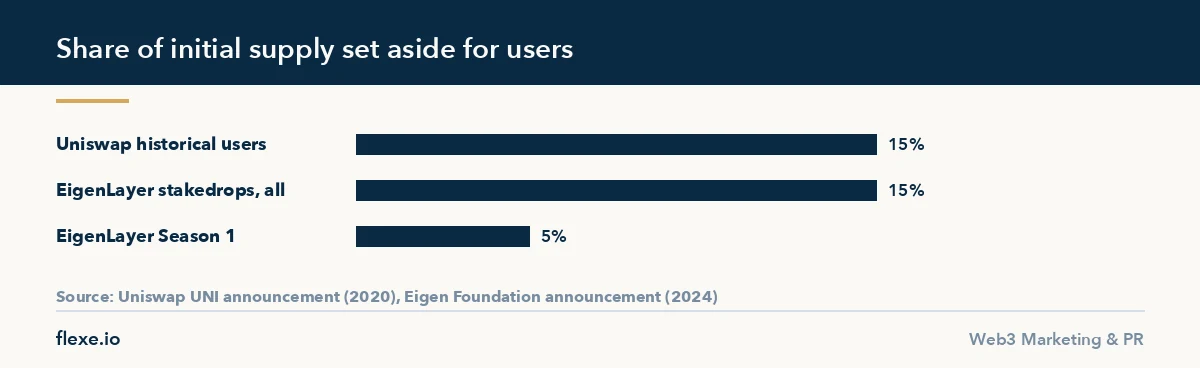
An airdrop rewards people who already used the product before the token existed. The Uniswap UNI announcement is still the reference case: 15% of the 1 billion UNI supply went to historical users, with 400 UNI claimable by each of roughly 251,534 addresses that had called the v1 or v2 contracts before the 1 September 2020 snapshot.
Best for: protocols with real usage history and a supply plan that can afford a double-digit community share.
What it costs or takes: a large slice of supply plus Sybil filtering; the token cost is real even though no cash leaves the treasury.
Watch out: recipients sell. Unless the token has a use on day one, a big airdrop turns into sell pressure within the first week.
5. Points program into a stakedrop
Points programs replace a one-time snapshot with a public scoreboard that runs for months. The Eigen Foundation announcement set aside 15% of initial EIGEN supply for stakedrops, paid 5% in Season 1 from a 15 March 2024 snapshot, and launched the token as non-transferable at first. Points keep users active before TGE, but they also train farmers to leave the moment the program ends.
Best for: restaking, DeFi and infrastructure protocols where deposits or usage are the product.
What it costs or takes: a points backend, clear rules published upfront and a supply allocation large enough to feel fair to heavy users.
Watch out: vague conversion rates. When users cannot estimate what their points are worth, the TGE announcement becomes a complaint thread.
6. KOL-led launch
A KOL-led launch uses crypto creators to build the buyer pool before and during TGE. We work from a base of 11,859 crypto KOLs on X and 11,695 crypto and finance YouTubers, all above 5,000 followers, with an active X roster of 85 verified accounts (8.7M reach, 1.74% engagement). The strategy works when posts are sequenced against the timeline: education first, the sale date second, the listing last.
Best for: any launch model above, as the demand layer; strongest for IDOs and CEX listings with a fixed date.
What it costs or takes: a focused single-channel campaign starts at $4,000; creator fees scale with reach and the number of posts.
Watch out: paid posts without disclosure and a single mass push on listing day. Buyers now read that as exit liquidity.
7. Community-first presale or whitelist
Here the team grows a Telegram, Discord or X community first and sells a whitelist or presale allocation only to members who did something: joined early, completed quests, tested the product. In 2026 we took Fourmeme from 35,000 to 47,000 members, Atleta Network from 130,000 to 141,000 and Tothemoon from 40,000 to 45,000. A warm community is what turns a sale page into a sold-out sale.
Best for: teams with three months or more before TGE and a product people can touch early.
What it costs or takes: community management from $2,000 per month, moderators across time zones and a quest or whitelist tool.
Watch out: bot-filled channels. A member count inflated by farms looks good in a pitch deck and sells nothing on the day.
8. Phased full-stack launch
The full-stack approach combines one launch model with KOLs, PR, paid acquisition and community in planned phases. Our full-stack launches run $50K to $500K over three to six months. Across 150 campaigns we measured a median net ROI of 2.8x within 90 days, with a range of 1.4x to 7.0x. The inconvenient number: 12 percent of those campaigns failed to return their spend, usually because the token or the product was not ready when the traffic arrived.
Best for: funded projects targeting a tier-one listing or a raise above a few million dollars.
What it costs or takes: a budget in the tens or hundreds of thousands and a team that can ship on schedule for six months.
Watch out: marketing cannot fix weak tokenomics. If the supply schedule is wrong, more spend just brings more sellers.
Launch models compared: cost, timeline and risk
The table puts the sourced figures next to each other. Costs are what the venue or mechanism takes, not the full launch budget, which also includes audits, legal work, liquidity and marketing.
| Launch model | Cost or allocation | Timeline | Main risk |
|---|---|---|---|
| Fair launch (pump.fun) | 0 SOL to create; 1.25% fee per curve trade; 0.015 SOL to graduate | Minutes to go live | No runway, heavy competition, sniping |
| LBP (Fjord) | 5% of funds raised | Sale runs 2 to 5 days, plus weeks of prep | Price drifts low with no demand |
| Tiered IDO launchpad | Allocation, vesting terms and marketing commitment set per launchpad | Weeks of application and whitelist | Staker dumping at TGE |
| CEX listing (Kraken) | No listing fee; audits, legal and market maker still apply | About 2 weeks review, then 2 to 6 weeks to launch | Rejection on thin data |
| Retroactive airdrop (Uniswap) | 15% of supply; 400 UNI per address | Snapshot, then instant claim | Recipient sell pressure |
| Points to stakedrop (EigenLayer) | 15% of supply reserved; 5% in Season 1 | Months of points before TGE | Farmers leave after conversion |
Two patterns stand out. The cheapest models in cash terms, fair launches and airdrops, are expensive in supply or in attention. And the model with no venue fee at all, a direct CEX listing, has the highest bar for proof, because the exchange is putting its own users in front of your token.
How to pick token launch strategies for your project
Start from what you already have, not from what worked for the last big launch. Four questions settle most decisions:
- Do you need to raise money at launch? If yes, the choice is an LBP, an IDO or a presale. A fair launch or airdrop raises nothing.
- Do you have users before the token? Real usage history makes an airdrop or points program credible. Without it, you are paying farmers.
- Can your data pass an exchange review? Audits, a published supply schedule and on-chain growth are the entry ticket for a direct listing.
- How long is your runway to TGE? Under six weeks leaves room for a KOL push around a fixed date. Three months or more makes a community presale realistic.
A common working stack for a funded DeFi project is an LBP or IDO as the launch model, a points program for the months before it, and a KOL wave in the last two weeks. For a memecoin, it is a fair launch plus creators and community, with no raise at all. Whatever the mix, write the supply decisions down first: our guide on preparing a tokenomics page shows the fields buyers and exchanges check.
Be honest about fit. A KOL-led launch is our core service, but it is the wrong primary strategy for a protocol whose token has no use yet. In that case the first dollars belong in product and audits, and creator spend should wait until there is something to buy into.
Token launch timeline: when each strategy starts
Strategies fail as often from bad timing as from bad choice. A rough sequence for a launch with a raise and a listing:
- 12 to 8 weeks out: publish tokenomics, open the community, start points or quests if you run them.
- 8 to 4 weeks out: pick the launchpad or file the exchange application, since Kraken alone quotes about two weeks for review.
- 4 to 2 weeks out: education content from KOLs, PR on the product, whitelist or allocation rounds.
- Final 2 weeks: sale date announcements, AMAs, the main creator wave.
- TGE and 30 days after: listing posts, liquidity monitoring, holder retention content.
The full week-by-week plan, with owners for each task, is in our token launch timeline.
Common token launch mistakes
- Spending the whole budget on listing day. Attention that arrives after trading opens mostly meets sellers. Put more than half of creator spend before TGE.
- Airdropping to farmers. Without Sybil filters, a large allocation goes to wallet farms that sell on claim.
- Unclear points conversion. Users who cannot estimate their reward assume the worst, publicly.
- Letting the first price anchor too low. An LBP with no pre-built demand sets a low price that later exchanges inherit.
- Buying reach instead of fit. One large generalist account usually converts worse than ten mid-size creators who cover your sector.
- No plan for day 30. Vesting releases, emissions and support tickets arrive after the launch buzz is gone.
Related reading: DEX vs CEX for a token launch, airdrop vs quest campaign and how to budget a launch campaign.
Frequently Asked Questions
What is the best token launch strategy in 2026?
There is no single best strategy; the best one matches your funding need and user base. Projects that need to raise usually pick an LBP or IDO, protocols with real usage pick an airdrop or points program, and memecoins pick a fair launch. Most teams then add KOLs and community work as the demand layer on top of that launch model.
How much does it cost to launch a token?
Venue costs range from almost nothing to a share of the raise: pump.fun charges 0 SOL to create a coin, Fjord keeps 5% of LBP proceeds and Kraken charges no listing fee. The larger costs are audits, legal work, liquidity and marketing. A focused single-channel campaign with us starts at $4,000, and full-stack launches run $50K to $500K.
Is an airdrop or a points program better for a token launch?
A points program is usually better when you want months of activity before TGE, and an airdrop is better when you already have a long usage history. Uniswap rewarded past users once with 400 UNI each, while EigenLayer ran points and paid 5% of supply in Season 1. Both need Sybil filtering to keep farmers out.
How long before TGE should launch marketing start?
Launch marketing should start 8 to 12 weeks before TGE for a launch with a raise or an exchange listing. That window covers the tokenomics page, community growth, the exchange review of about two weeks at Kraken and the creator wave. A fair launch or memecoin can run on a two to four week window.
Do token launch strategies guarantee a price after listing?
No strategy guarantees a price after listing. Marketing brings buyers, but supply schedules, market conditions and product readiness decide what they pay. In our benchmark across 150 campaigns, the median net ROI was 2.8x within 90 days, and 12 percent of campaigns still failed to return their spend.