Trackers, exchanges and serious buyers all read the same page, and they all reject it for the same reason: the numbers on it cannot be reconciled with the chain. A tokenomics page is not a design exercise. It is a set of claims that someone will check against a block explorer within about four minutes.
This is how to build one that survives that check, and what each element is actually there to prove.
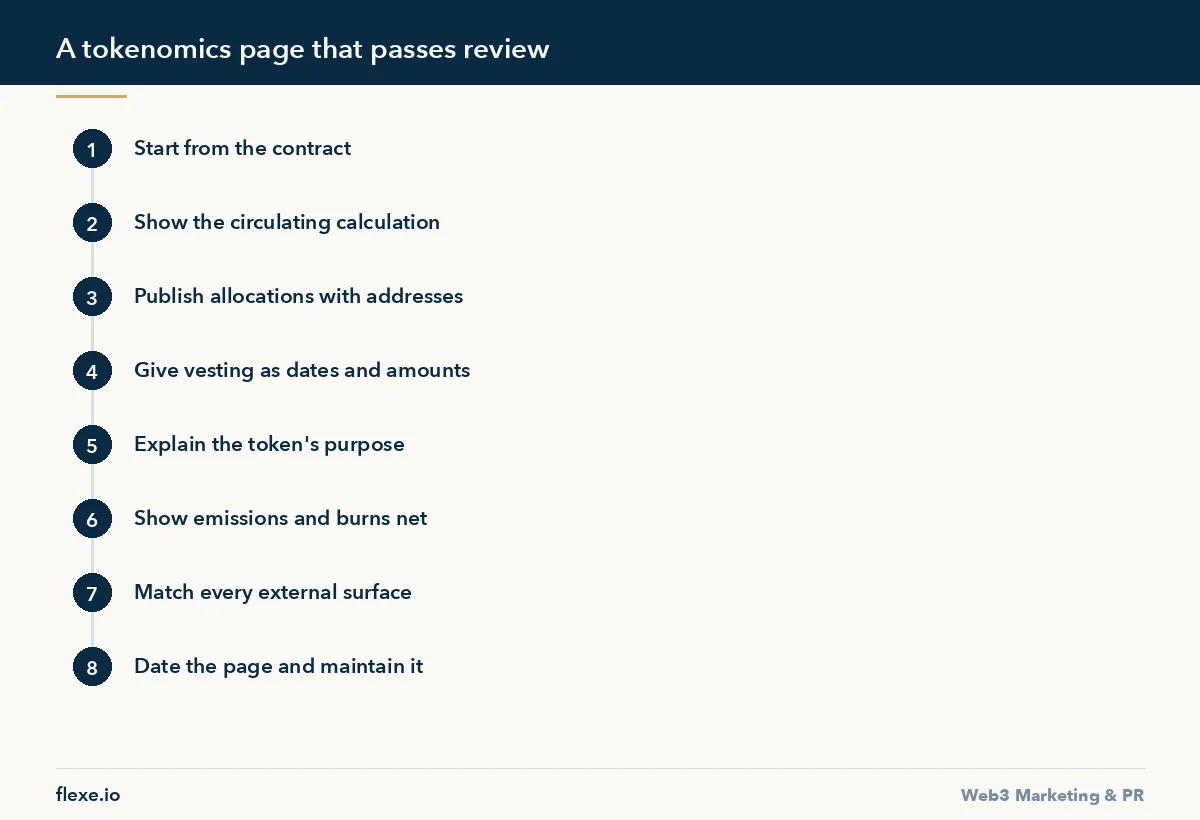
1. Start from the contract, not the pitch deck
Pull total supply from the contract itself, not from an internal document. If the contract is mintable, say so on the page and name who holds the minting rights. If supply was changed after launch, the page should reflect the current state and not the original plan.
A page whose headline supply figure differs from the explorer fails immediately, and reviewers do not usually write back to ask which number is right.
2. Define circulating supply and show your working
Circulating supply is total supply minus everything that cannot move: locked contracts, unvested team and investor allocations, treasury holdings not yet deployed, and burned tokens sent to a provably unspendable address.
Publish the subtraction rather than the result. Every exclusion needs an address a reader can open. Tokens held in a plain wallet the team controls are circulating, whatever the internal policy says about not selling them, and trackers apply that rule strictly.
3. Publish the allocation table with addresses
Break the supply into its buckets: team, investors, treasury, ecosystem and incentives, public sale, liquidity. Give each bucket a percentage, an absolute number, and the address holding it.
The addresses are the part that matters. A pie chart without them is a picture. With them, a reader can confirm the buckets add up to total supply and check that the team allocation is where it claims to be, which is exactly what an exchange reviewer does.
4. Give the vesting schedule as dates and amounts
For each locked bucket, state the cliff, the vesting period, the release frequency and the amount released each time. A reader should be able to work out, without asking, how many tokens enter circulation in any given month for the next two years.
Where vesting is enforced by a contract, link it. Where it is a promise in a document, say that plainly. The difference is large and pretending it does not exist is the fastest way to lose a reviewer’s trust.
5. Explain what the token is for
State the mechanism in one paragraph: what holding the token lets someone do, where demand for it comes from, and what happens to the fees or emissions the system produces. Utility that only exists in a future roadmap phase should be labelled as such.
This section is short in good tokenomics pages and long in bad ones. Length here usually signals that the mechanism is being described in place of being demonstrated.
6. Show emissions and burns as a net figure
If the protocol emits tokens as rewards, give the current rate and the schedule for changing it. If it burns tokens, give the mechanism and the actual amount burned to date, with transactions.
Then state the net effect. A deflationary claim alongside an emissions schedule that outpaces the burn is checkable arithmetic, and someone will do it publicly at the least convenient moment.
7. Match the page to every external listing
The figures on your page, on the trackers, in exchange applications and in the whitepaper have to agree exactly. Trackers cross-check against the contract and against each other, and a mismatch stalls an application while someone works out which source is authoritative.
Keep one internal document as the source of truth and update every surface from it. The tracker submission process, including the supply fields they verify, is covered in how to get listed on CoinGecko and CoinMarketCap.
8. Date the page and keep it current
Put a last-updated date at the top and change it when the numbers change. Circulating supply moves every time a tranche unlocks, and a page that still shows launch figures a year later tells a reader the project is not paying attention to its own token.
Set a calendar reminder for each unlock date. The update takes ten minutes and the alternative is being corrected in public by someone reading the explorer.
What a good page removes
Projected valuations, price targets and comparisons to the market capitalisation of larger tokens do not belong on it. They add nothing a reviewer values and they make the rest of the page read as promotional rather than factual.
The same applies to charts with no axis labels and percentages that do not sum to one hundred. Both are common, both are noticed immediately, and both cost more credibility than the design gains.
For teams preparing this alongside a listing or launch announcement, the media and disclosure side is covered on our crypto PR page, and the contract verification step in how to verify a token contract.