Crypto KOL vetting means answering three separate questions, and no single tool answers all three. Are the followers real, are they crypto-native, and does the account actually reach anyone. Fake and bot followers account for roughly 56.5% of reported influencer fraud, and estimates put 10% or more of the followers of top crypto accounts in that category, so the first question is not optional.
Our crypto KOL vetting screens every account entering our roster through Wallchain, Sorsa and TwitterScore before any budget is committed. What follows is what each one is for, and one number from our own network that contradicts the published benchmarks.
What does each crypto KOL vetting tool measure?
| Tool | What it answers | Blind spot |
|---|---|---|
| Sorsa (formerly TweetScout) | Who follows this account, weighted by influential crypto and VC-linked accounts, plus an estimate of the automated share | Measures the follower graph, not whether anyone acts on a post |
| Wallchain | Whether the audience actually holds and transacts on chain | Says nothing about reach or engagement quality |
| TwitterScore | A proprietary authority score for the account | Closed methodology, so it works as a cross-check rather than as evidence |
The three overlap less than they appear to. An account can pass Sorsa with a clean follower graph, fail Wallchain because its audience never transacts, and still carry a respectable TwitterScore. That combination describes a genuine media personality whose audience will not buy a token, which is a perfectly good account for the wrong brief.
How do you read a bot-detection result?
Sorsa publishes its flagging methodology, which is the reason to trust the output more than a bare score. It weighs account age, follower-to-following ratio, tweet and like counts, whether an avatar exists, bio completeness and username patterns, and the guidance is to treat three or more triggered signals as a flag rather than reacting to any single one.
That threshold matters. A new account with a default avatar is not evidence of anything on its own, and rejecting on one signal will remove real people while leaving sophisticated farms in place.
The engagement benchmark most sources publish is too high
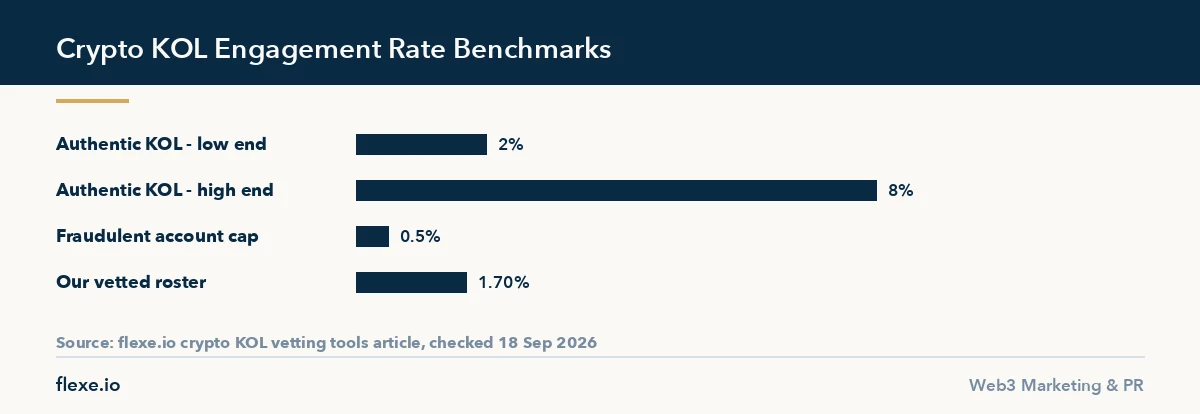
Published guidance commonly puts an authentic crypto KOL between 2% and 8% engagement, with fraudulent accounts struggling to pass 0.5%. Our own measured network does not sit in that band. across the 85 vetted accounts in our active X roster, totalling 8.7M reach, all of which passed the three screens above, the average engagement rate is 1.74%, with an average of 102,199 followers producing 12,615 median views per post.
The gap is worth understanding rather than explaining away. A vetted account delivering views to roughly a tenth of its follower count at under 2% engagement is normal in this category, and a media kit claiming 6% should raise a question rather than confidence. Either the account is measuring engagement against a different denominator, or the engagement is not what it appears to be.
A practical crypto KOL vetting order of operations
- Run bot detection first. It is the cheapest screen and it removes the worst candidates before you spend time on them.
- Check audience composition second. An audience that does not transact on chain cannot convert for a token, whatever its size.
- Compare views to followers, not engagement to followers. The ratio between the two is the fastest tell, and roughly a tenth is the realistic figure to expect.
- Ask for screenshots of the last five posts, not the best five. Selection is where most media kits do their work.
- Price on delivered views. Paying against follower count is paying for the number the account controls rather than the one it earns.
Every account in our roster passes these screens before a budget is committed: our vetted KOL network.
For these checks applied at scale, see our top crypto influencers list, where each account passed three independent checks.
Manual checks no vetting tool performs
Every screen described above reads a database. None of them reads the post. The checks that actually decide a booking involve opening the account, reading recent posts in order, and forming a view about who is replying and why, and that work cannot be bought or delegated to a dashboard. Budget twenty minutes per account for it, and run it only on the accounts that survived the automated screens.
Check whether the account has ever been wrong in public and what happened next. Creators who correct themselves keep audiences that read carefully, and creators who quietly delete are training their audience to ignore everything. Neither behaviour appears in a score, and both tell you what a post about your product will be worth in a month if anything about it needs revising.
Reading the reply section
Open the replies under the last few posts and read them properly. Tools score the follower graph and on-chain behaviour, and neither sees whether people argue with the account, ask specific questions about a product, correct it when it is wrong, or reference something it posted a fortnight ago. A reply section of short generic praise from accounts with no history is visible in seconds and invisible to every score.
Click through to a handful of the repliers. Accounts with no posting history, a default avatar and a following list made up of other promoters are the signature, and once you have seen one such section you recognise the next in moments. Check the dates the replying accounts were created as well, since a cluster of accounts born in the same week under a post is the clearest signal available.
Paid against organic performance
Find the account’s previous promotions and compare them with its normal content. Take the median views and replies of each group and look at the size of the gap. Where sponsored content drops steeply, the audience has learned to skip promotion, and your post will land in the lower group rather than the upper one. No dashboard reports this, and it predicts the outcome better than any authority score.
Read what the account promoted over the last six months as well as how it performed. Frequency matters as much as outcome: an account posting something new every few days has trained its audience to ignore the format whatever the numbers say. That is a judgement about learned behaviour, and the evidence sits in the public feed rather than in any tool’s output. A quiet account that promotes rarely is usually worth more per post.
Crypto KOL vetting when the tools disagree
Disagreement is the normal case rather than the exception, because the three tools answer different questions. Treat a conflict as an instruction about where to spend the manual reading rather than as a verdict to average out. A clean follower graph with weak on-chain behaviour points at a media audience, and that account may suit an awareness brief while being the wrong booking for anything needing a wallet at the end of it.
The pattern that should stop a booking is a strong score on the closed methodology alongside weak results everywhere you can verify by hand. Scores built on undisclosed inputs can be cultivated by anyone who works out what is being measured, and an account optimised for a dashboard while its replies look purchased is precisely the case the manual checks exist to catch. Where a tool and the feed disagree, believe the feed.
Remember that a tool failing an account is not the same as the account being fraudulent. Audiences outside the largest markets are consistently rated low by tools built mainly on one language and one region, and an account with a genuine regional following can look thin on every dashboard. Read those accounts by hand rather than rejecting them, because they are frequently the cheapest real reach available to a project.
Where every screen passes and the account still looks wrong, book a single small test rather than arguing about the instinct. One post, a tracked link, a modest fee and a measured answer cost less than a campaign built on a judgement nobody could put into words. The result also goes into your own record, which is the only dataset measured against your product rather than against somebody else’s benchmark.
Ordering the screens by cost
Run the cheapest screen first and the most expensive last. Bot detection takes seconds and removes the worst candidates, audience composition takes a little longer and removes the accounts whose followers will never transact, and the manual reading takes twenty minutes and decides. Running that order in reverse is how teams spend a morning reading the feed of an account that a two second check would have eliminated.
Set the thresholds before you look at the accounts, not afterwards. Decide what share of automated followers is disqualifying, what ratio of views to followers you expect, and what you will do with an account sitting just under the line. Thresholds chosen after seeing a candidate you already liked are not thresholds, and the screening process quietly becomes a justification for a decision made earlier.
Write down which screens an account failed rather than only the verdict. A rejection recorded as unsuitable tells you nothing in six months, while a rejection recorded against a specific screen can be revisited when the account has changed or when a different brief makes the failure irrelevant. Media audiences rejected for a token launch are often correct for an awareness campaign later. The file is only as useful as the reasons written into it.
Decide who runs each screen when more than one person is involved. Automated checks can sit with anyone, and the manual reading should stay with the person who will also read the campaign result, because the two jobs teach each other. Splitting them across people who never compare notes is how a roster fills with accounts that passed every step and delivered nothing.
Build your own screening record
Keep one row per account with the date screened, the figures each tool returned, the median views and replies you counted yourself, the fee quoted and the reason for the decision. After a few campaigns this answers questions no external tool can: which accounts delivered on your product at what cost per delivered view, and whether the scores that looked reassuring at screening had any relationship to what happened afterwards.
Record the figures as you saw them on the day, with the date attached. Scores move, accounts grow and posts get deleted, and a number written down without a date cannot be compared with anything later. This also protects the record against the common situation where an account’s dashboard figures improve sharply and nobody can say what they were before. A dated row is evidence and an undated one is a memory.
Add the outcome to the same row once the campaign has run. Clicks, conversions and thirty day retention set against the fee paid turn a screening file into a booking file, and the second is worth considerably more. The comparison you eventually want is between what the screens predicted and what the account delivered, and that comparison only exists if both halves live in the same place.
Re-screening before a repeat booking
Re-screen before every repeat booking rather than trusting an earlier pass. Accounts change hands, change topic, change posting frequency and change what they charge, and an account that performed in spring may be running a promotion every other day by autumn. The re-screen is quick on an account you already know, and it catches the decline that turns a previously reliable booking into a disappointment nobody saw coming.
Watch for the account that grew sharply between bookings. A large block of new followers with no corresponding movement in median views is the same signal on a known account as on a new one, and familiarity makes it easier to miss. Compare the current ratio of views to followers against the figure you recorded last time rather than against a general benchmark. Your own earlier row is the most relevant comparison available.
Treat a sudden change in what the account charges as a reason to look again rather than simply to negotiate. Prices rise for good reasons and also for reasons that have nothing to do with delivery, and the figure worth checking is the fee divided by median views. Where that number has moved sharply while the views have not, the account has repriced rather than improved.
Record the failures with the same care as the passes. The account rejected in March may be worth reconsidering later, and a written reason makes that a decision rather than a guess. Rejection notes also expose the shortcuts in your own process, since a reason reading as too small or something felt off is not a screen and will not survive being questioned by whoever pays for the campaign.
Share the file with whoever runs the next campaign. Screening knowledge living in one person’s memory leaves with that person, and the replacement starts from the same shortlists and repeats the same rejections. A file anyone on the team can read is what turns a series of individual campaigns into a process that improves rather than one that restarts. It is also the only part of this work that compounds.
The same test applies to agencies that sell access to a network: we checked ten of them on their own sites in the best crypto KOL agencies in 2026.
Frequently Asked Questions
What is a normal engagement rate for a crypto KOL?
Lower than most published guidance suggests. Sources commonly quote 2% to 8%, but across our active X roster of 85 vetted accounts the average is 1.74%. Treat a claimed rate above 5% as something to verify rather than a selling point.
Is Sorsa the same as TweetScout?
Yes. Sorsa is the former TweetScout, and it scores an account by the influence of the accounts following it while estimating what share of the followers look automated.
How many followers of a crypto account are typically fake?
Estimates put 10% or more of the followers of top crypto accounts in that category, and fake or bot followers account for around 56.5% of reported influencer fraud overall.
Can one tool replace the rest?
No, because they answer different questions. Sorsa reads the follower graph, Wallchain reads on-chain behaviour, and TwitterScore provides an independent authority cross-check. An account can pass one and fail another for legitimate reasons.