A crypto bot on Telegram connects your trading rules to an exchange or wallet and reports every action in a chat. This crypto bot Telegram guide, checked on 10 November 2026, covers named bots that are live today, setup steps, risk limits and the security failures that cost users money this autumn. It is written for active traders and for projects that run bots for their communities.
Key Takeaways
- A crypto bot on Telegram is an interface: the strategy, the exchange API and the risk limits decide the result, not the chat window.
- Telegram-native trading bots such as Banana Gun, Maestro and Bloom hold a wallet for you; strategy platforms such as 3Commas and Cryptohopper add backtesting and send alerts to Telegram.
- Published monthly prices start at $15 for 3Commas Starter and $29 for Cryptohopper Explorer, with no free plan on either pricing page.
- Setting up an exchange connection takes minutes, but a safe setup needs a trade-only API key, an IP allowlist and position limits written before the first live order.
- Custodial bots carry their own risk: on 27 October 2026 Cointelegraph reported that about $953,000 was drained from 48 wallets of nine Bloom users.
- Most bot projects fail on rules, not code: copied templates, oversized positions and ignored alerts lose more money than slow execution does.
Why this matters now
Crypto trading used to mean nights in front of charts, manual entry on several exchanges and late reactions to news. A crypto bot on Telegram moves that routine into rules that run around the clock and report to your phone. It watches prices, applies the conditions you set, places or proposes orders and sends a message each time something happens, so you can act or step in.
Here’s what matters: a crypto bot on Telegram works as an interface between your trading logic and execution. Instead of logging into an exchange, watching price feeds and clicking buy or sell, you let the bot read data, place orders and post status updates to Telegram. The useful setups pair that execution layer with clear limits on size, loss and permissions, because a bot repeats a mistake as fast as it repeats a good trade.
The platform keeps adding tools for this. The Telegram Bot API changelog lists Bot API 10.4 on 9 November 2026, which lets bots send HTML widgets and handle TON wallet cards and transfers, after version 10.3 on 24 August 2026 added richer message buttons and file blocks. Better chat interfaces make bots easier to use; they do not make a trading strategy profitable.
What Is a Crypto Bot on Telegram: Definition and Context
A crypto bot on Telegram is an automated agent that connects your trading strategy to Telegram messaging and cryptocurrency exchanges via APIs. It monitors market data, executes trades based on predefined rules, and sends real-time updates directly to your Telegram chat. Think of it as a trading assistant that never sleeps, never makes emotional decisions, and never misses an opportunity because it was offline.
Current implementations use several layers: a backend engine on a server or cloud host, exchange APIs or smart contract calls for the orders, optional models for signals or sentiment, and the Telegram Bot API for commands and notifications. Telegram-native bots such as Banana Gun and Maestro hold the trading wallet for you, while strategy platforms connect to your own exchange account through API keys.
These systems work best for active traders, crypto funds and projects that manage community liquidity. They are less useful for buy-and-hold investors who check a portfolio once a quarter. The sweet spot is someone who trades 3 to 7 times per week and wants consistent execution without constant screen time.
What These Crypto Bot Implementations Actually Solve
Speed and Execution Consistency
Manual trading takes 3 to 5 minutes per setup: logging in, finding the pair, entering size, setting the stop-loss and confirming. During those minutes, the market moves. A crypto bot sends the same sequence through the exchange API in well under a second once the signal fires. Speed matters most for entries tied to a level or a news event, where a human reaction arrives after the price has already moved.
24/7 Market Monitoring Without Burnout
Crypto trades across time zones. If you sleep, you miss moves; if you don’t sleep, you burn out. A crypto bot on Telegram removes this false choice. It can watch dozens of pairs while you are offline, message you when a setup appears, and either wait for your approval or execute on its own if your rules allow it. Approval mode is the safer default for the first weeks.
Emotion Removal from Trading Decisions
Traders who follow rules tend to do better than traders who follow feelings, because rules can be tested and feelings cannot. When you encode your entry, stop and exit conditions into a bot and let it run without second-guessing, you stop moving stops after entry and stop revenge trading after a loss.
Portfolio Rebalancing at Scale
Managing 20+ positions across several exchanges by hand is error-prone and slow. Rebalancing bots on platforms such as 3Commas and Cryptohopper keep target allocations, trim winners and top up laggards on a schedule or at a drift threshold. Telegram is where the bot reports each rebalance, so you see the change without opening every exchange.
Integration of Market Intelligence with Community Signals
The best trading decisions combine on-chain data with off-chain sentiment. A crypto bot on Telegram can watch Telegram channels, X mentions and wallet activity for early signs of community interest, then cross-check them against exchange volume. Treat these signals as filters, not triggers: a burst of mentions is often paid promotion, so an alert should fire only when mentions, volume and price structure agree.
How Crypto Bot Telegram Implementation Works: Step-by-Step
Step 1: Set Up Exchange API Connections
Your bot needs read and trade access to your exchange account. Major exchanges (Binance, Coinbase, Kraken) issue API keys with separate permissions. Create a key that can trade but cannot withdraw, restrict it to your server IP, and add it to the bot configuration. The Binance API key guide, last updated on 6 November 2026, says keys without an IP restriction keep read-only permission, and an IPv4 restriction is mandatory before withdrawals can be enabled.
Key mistake here: Storing API keys in plain text or sharing them across multiple bots. Use environment variables and rotate keys quarterly.
Step 2: Define Your Trading Rules and Risk Parameters
Before your bot executes a single trade, you encode your rules: which pairs to trade, what signal triggers a buy (for example RSI below 30 with support holding), where the stop goes (for example 2% below entry), where to take profit (for example 5% above entry or RSI at 70) and maximum position size (for example 2% of the portfolio per trade). Write each rule so a second person could check a trade against it, because vague rules cannot be backtested.
Key mistake: Over-parameterization. Start with 3 simple rules, backtest for 30 days, then layer in complexity. Too many rules create whipsaws.
Step 3: Connect Telegram for Notifications and Control
Create the bot with @BotFather, keep the token it gives you private, and add the bot to a private group or a one-on-one chat. Every trade now sends a message: “BUY BTC/USDT at 42,500 | Stop: 41,625 | Target: 44,625 | Size: 0.5 BTC.” You can choose alerts on entry, exit, stop-hit or all three. Some bots ask you to approve each trade before execution, others execute and report afterwards; pick approval mode until the logs prove the rules.
Key mistake: Notification overload. If your bot sends 50 messages per day, you’ll ignore them. Start with exit confirmations only.
Step 4: Backtest and Paper Trade Before Live Execution
Any crypto bot worth deploying lets you run historical backtests. You feed it 6 months of price data and your rules, and it simulates every trade you would have made. Check the result: did the rules make or lose money, what was the max drawdown, and is the win rate closer to 90% or to 60%? Then run paper trading, with real prices and no real money, to confirm that fills, fees and slippage match the backtest.
Key mistake: Overfitting to backtest. If your bot only works on 2021 data and fails in 2025 volatility, it’s useless. Backtest across several market regimes (bull, bear, sideways).
Step 5: Deploy Live with Position Sizing Limits
Start small. If your bot shows a 60% win rate in backtests, risk 0.5% to 1% of your portfolio per trade. Let it run for 30 days, track results, and scale position size only once live results match the backtest.
Key mistake: Deploying with maximum position size. If your bot hits an unexpected edge case, one bad trade can wipe you out. Use 0.5% to 1% sizing until you have 100+ live trades of proof.
Step 6: Monitor, Adjust, and Iterate
After 30 days, analyze results: did the bot hit the expected win rate, which pairs performed best, which market conditions broke your rules, and did Telegram notifications arrive at the right times? Compare the live log with the backtest trade by trade. If the bot wins 60% of the time, you are not done; adjust one parameter at a time, test different entry signals, or swap pairs based on evidence.
Key mistake: Treating your bot as “set and forget.” Markets change. Your bot’s rules should evolve monthly.
Where Most Crypto Bot Projects Fail (and How to Fix It)
Mistake 1: Using Generic AI Prompts Instead of Reverse-Engineered Frameworks
Most traders copy a crypto bot template from GitHub, plug in their exchange API and hope it works. Most don’t. A template carries someone else’s risk tolerance, pairs and timeframe, so it fails quietly on yours. The fix: study 50 trades from strategies close to yours, list what they share (entry conditions, holding periods, profit targets), encode those rules, then test your version on historical data before going live.
Mistake 2: Ignoring Risk Management and Position Sizing
A crypto bot executing 100% of your capital on every signal is a liquidation machine, not a trading system. Start with 1% position sizing, prove the strategy works, then scale to 3% to 5% maximum per trade. Your stop-loss should be non-negotiable: set it before every trade, and never move it against the position after entry. Cap the number of open positions too, or correlated pairs will act as one large bet.
Mistake 3: Overcomplicating Entry Signals
Bots with 47 different parameters rarely beat bots with 3. Each extra filter adds a chance to fit noise in the backtest and miss real trades live. A three-part setup such as RSI, a support level and a volume surge is easier to test, explain and fix.
Mistake 4: Not Tracking Telegram Alerts and Following Through
Your bot sends you 30 alerts per day. By day 5, you’re ignoring them. By day 10, you’ve turned off notifications and the bot is running blind. The fix: limit alerts to high-confidence setups only, plus every fill and every stop. Your crypto bot should send a setup alert only when all three conditions align: price at support, RSI below 30, and volume above the 20-day average. Single-condition alerts are noise.
Mistake 5: Failing to Update Rules When Markets Change
Your bot’s rules were built on past data. Correlations, volatility and exchange rules change, and a bot running unchanged will drift into losses. Set a monthly check-in: are entry signals still working, have you logged 100+ trades, is the win rate still above 55%? Watch the venue too: exchanges change API permissions and fee tiers, and a bot that worked last quarter can fail on a new rule. If results slip, adjust or pause until you understand why.
Most teams struggle with crypto bot deployment because they treat automation as “set and forget” rather than continuous work. FLEXE.io has worked in Web3 marketing since 2018 across 800+ campaigns, and helps projects that run bots build the content, community and market positioning around them. A bot announced to a community that already trusts the project gets more first users and fewer support tickets. Reach out on Telegram: https://t.me/flexe_io_agency
Tools and Next Steps for Crypto Bot Implementation
Building a working crypto bot Telegram setup requires specific tools for each layer: market data, AI decision-making, exchange connectivity, and Telegram integration.
Core Platform Choices
No-Code Bot Builders: TradingView alerts sent by webhook to a Telegram bot (low cost, alerts only). 3Commas, Cryptohopper or Gunbot (subscription or licence, pre-built strategies, backtesting); on 10 November 2026 3Commas listed Starter at $15, Pro at $38 and Expert at $105 a month, and Cryptohopper listed Explorer at $29, Adventurer at $69 and Hero at $129 a month on monthly billing. n8n or Make (workflow automation, connect any exchange, full customization).
Telegram-Native Trading Bots: Banana Gun (trading, sniping and copy trading across chains), Maestro (sniping, copy trading and whale alerts on Ethereum, Solana, BNB Chain and Base) and Bloom (Solana and EVM, with limit orders and automation). All three sites were live on 10 November 2026. They hold a trading wallet for you, so the risk is custody: on 27 October 2026 Cointelegraph reported about $953,000 drained from 48 wallets of nine Bloom users in 94 seconds. Bloom blamed a remote code execution flaw in a third-party module and pledged to reimburse affected traders in full. Keep only trading money in any bot wallet.
AI Integration: Claude for market analysis and sentiment interpretation, ChatGPT for news processing and context, Perplexity for real-time data retrieval.
Backtesting and Analytics: Backtrader (Python-based, free, powerful but requires coding). VectorBT (fast, handles thousands of trades). TradingView’s built-in backtester (visual, intuitive, integrates with Telegram alerts).
Exchange APIs: Binance Spot Trading API (largest volume; CoinGecko put Binance at 42.7% of top 10 centralized exchange spot volume in Q3 2026), Coinbase Advanced Trade API (US-regulated), Kraken REST API (reliable for European traders).
Your Implementation Checklist
- [ ] Choose your trading strategy category: Scalping (minutes to hours), swing trading (days to weeks), or position trading (weeks to months). This determines bot configuration and Telegram alert frequency.
- [ ] Define three core entry signals: Price action rule (e.g., support break with volume), momentum rule (e.g., RSI + MACD), and confirmation rule (e.g., time above moving average). Avoid more than three, because too many filters kill the edge.
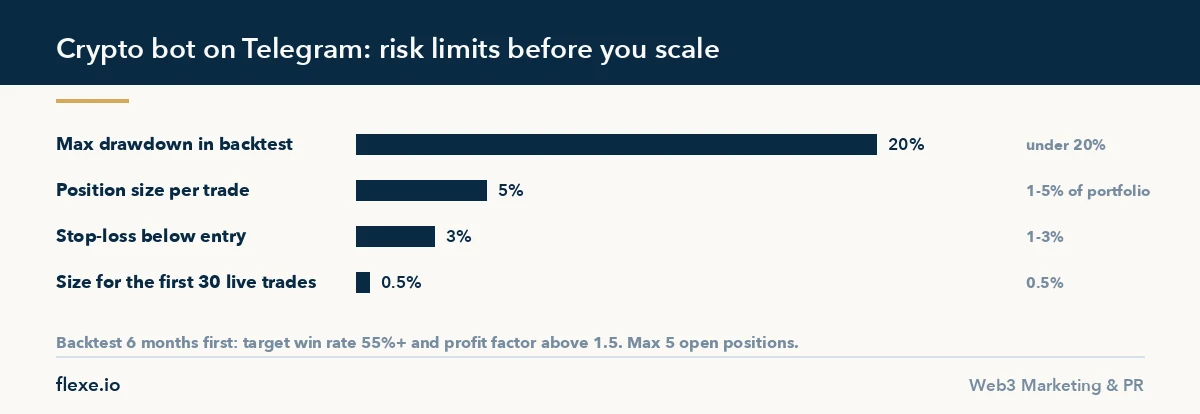
- [ ] Set non-negotiable risk parameters: Stop-loss percentage (typically 1% to 3% below entry), maximum position size (typically 1% to 5% of portfolio per trade), max concurrent positions (e.g., no more than 5 open at once).
- [ ] Generate secure API keys: Create restricted API keys from your exchange (trading only, no withdrawal), restricted to your server IP. Store them in environment variables, never in code. Rotate quarterly.
- [ ] Configure Telegram connection: Get bot token from @BotFather on Telegram, add bot to private group or one-on-one chat, set alert preferences (entry/exit/stop-hit notifications).
- [ ] Backtest on 6 months of historical data: Run your three-signal setup on past prices, check win rate (target 55%+), max drawdown (target under 20%), and profit factor (target above 1.5). If below targets, adjust parameters or try different signals.
- [ ] Paper trade (simulate) for 2 weeks: Run your bot on real market prices with fake money. Confirm backtest results match live behavior. If not, debug before deploying real capital.
- [ ] Deploy live with 0.5% position sizing: Start small. Execute 30 real trades with tiny position sizes. Track actual win rate vs. backtest. Scale to 1% to 5% sizing only after 30 trades of proof.
- [ ] Monitor and iterate monthly: After 100 live trades, analyze: Did I hit expected win rate? What pairs performed best? What broke my rules? Did Telegram alerts trigger correctly? Adjust parameters based on data.
- [ ] Document and communicate ROI to stakeholders: If managing funds for others, send monthly reports: trades executed, win rate, profit/loss, max drawdown, what changed this month. Transparency builds trust for scaling.
Integration with Content and Community
Your crypto bot works best inside a project with an active community and steady content. A bot launched into a quiet channel gets a spike of starts and then silence; a bot launched into a community that already asks for the feature gets repeat users. Better community signal plus better bot execution gives the bot a reason to exist. FLEXE.io helps Web3 projects build that audience, with placements across 800+ media outlets and a database of 11,859 KOLs on X, so the launch reaches people who will use the bot. DM us on Telegram: https://t.me/flexe_io_agency
What to take from this
A crypto bot on Telegram is not a replacement for trading skill; it amplifies the skill you already have. The best traders use bots to execute tested strategies faster and more consistently than manual trading allows. The chat window is the easy part. The hard parts are rules that survive several market regimes, keys that cannot withdraw, wallets that hold only trading money and a review habit that catches drift before it becomes a loss.
The path forward is clear: start small (0.5% to 1% position sizing), backtest thoroughly (6 months of historical data minimum), paper trade before going live (2 weeks), and iterate monthly based on results. Your crypto bot will execute 24/7 without emotion, revenge trading or exhaustion, if you have given it a profitable strategy to execute.
The traders who do well with bots in 2026 are not the ones with the most automation. They are the ones who wrote their rules down, tested them on historical data, kept custody risk small and read their logs every month. Start with one pair, one strategy and approval mode, and let the evidence decide what to automate next.
Telegram Bots for Crypto Projects: Build or Buy?
Almost every crypto project ends up with a Telegram bot. The decision that matters is whether it does one job well or five badly.
- Buy for moderation. Anti-scam, anti-spam and impersonation detection are solved problems, and building them yourself wastes engineering on something available off the shelf.
- Build for anything touching your product. Balance checks, claim status, alerts on your own contracts. These are the reasons someone opens the bot twice.
- Never request wallet signatures. Legitimate bots read public data. The moment yours asks for a signature you have trained your community to accept the exact request drainers use.
- Measure weekly returning users. Total starts measure your announcement. Returns measure whether the bot was worth keeping.
Communities are the line item that decides whether a launch holds. We run community management with round-the-clock moderation, AMA sessions when a project needs explaining rather than announcing, and audience building for channels starting from zero.
Related Guides
Adjacent topics covered in more depth elsewhere on this site.
- Experiential Marketing for Trading Platforms
- Best Telegram Crypto Signals & How to Use Them for Maximum…
- Telegram Crypto Mining Bots in 2026
- 15 Best Telegram Crypto Bots + Marketing Guide (2026)
- Crypto on Facebook in 2026
Building an audience and keeping it are separate jobs. Crypto community growth runs on verified task completions and reports retention thirty days after the campaign, not on the day it ends.
Frequently Asked Questions
Is a crypto bot on Telegram legal?
Yes, using a crypto bot for trading on your own account is legal in almost all jurisdictions. You’re automating trading decisions, not manipulating markets. However, check your local regulations and exchange terms of service. Some jurisdictions restrict certain trading strategies; most don’t restrict bots themselves. If you’re managing other people’s money, consult a lawyer about fund management licensing.
Can a crypto bot eliminate trading losses?
No. A crypto bot executes your rules consistently, but bad rules still lose money. If you only win 40% of trades and risk 2% per trade, your bot will compound losses perfectly. The bot’s job is to execute a profitable strategy consistently, not to create profitability from nowhere. Backtest extensively before deployment.
How much do crypto bots cost?
Alert-only setups can be cheap, for example TradingView webhook alerts relayed by your own Telegram bot. On 10 November 2026, 3Commas listed plans from $15 a month and Cryptohopper from $29 a month on monthly billing, with no free plan on either pricing page. Custom bots on n8n or Make add platform fees plus developer time.
What’s the difference between a crypto bot on Telegram and a trading algorithm?
A crypto bot on Telegram wraps a trading algorithm in a user interface (Telegram messaging). The algorithm is the logic: the rules that decide when to buy and sell. The Telegram integration is the communication layer, which tells you what the bot did and lets you approve or stop it. Most trading algorithms run on servers without any interface; adding Telegram makes them accessible and easy to monitor.
Can I run multiple crypto bots simultaneously on one account?
Yes, but carefully. Multiple bots on the same exchange account create position conflicts: bot A might buy at 42,000 while bot B sells at 42,050, killing both. The fix is to assign each bot different trading pairs or time periods, or run them on separate subaccounts. Track total portfolio risk across all bots by adding up their max drawdown scenarios.
How often should I adjust my crypto bot’s rules?
Monitor monthly, adjust quarterly. After 100 live trades, analyze win rate, max drawdown and profitability. If performance has slipped 10%+ from the backtest, something changed in the market, so investigate before you trade on. Don’t tweak after every losing trade, which invites curve-fitting. Do adjust when you have 100+ trades of evidence that a parameter no longer works.
What happens if my crypto bot fails or the exchange goes down?
Your bot depends on exchange APIs. If the exchange has downtime, your bot can’t trade. If your bot crashes, open positions remain open but new trading stops. Mitigate: use exchanges with 99.9%+ uptime, set tight stops so crashes don’t blow up positions, keep critical positions manual or use exchange-level stops as backup.
Should a crypto project build or buy a Telegram bot?
Buy for moderation, since anti-scam and impersonation detection are solved problems. Build for anything touching your product, such as balance checks, claim status or contract alerts, because those are the reasons someone opens the bot twice. Either way, give the bot only the permissions it needs and never let it hold user keys it does not need.
What makes a Telegram bot get used?
One job done instantly. Bots that do five things get used for none. Pick the single action people repeat daily, such as a balance check or a claim status, and make the entry a deep link that opens with the action pre-filled. Then cut every extra step between the start button and that result.
Is it safe to connect a wallet to a Telegram bot?
Bots that only read public data never need a signature. The moment such a bot asks you to sign a transaction, treat it as a drainer regardless of who runs it. Trading bots that hold a wallet for you are a custody risk: in October 2026 nine Bloom users lost about $953,000 in one attack. Fund any bot wallet with trading money only.
How do you measure whether a bot is working?
Weekly returning users. Total starts measure your announcement; returns measure whether the bot was worth keeping. Track the share of last week’s users who came back, the completed core actions per user and how many people blocked the bot after a broadcast. A falling return rate is the earliest sign that the bot does too much or too little.
How often should a bot send notifications?
Rarely and usefully. One relevant message a week keeps people subscribed, while daily announcements train them to mute, and a muted bot is functionally deleted. Trading bots are the exception: fills, stops and errors should arrive at once, because those messages carry money. Everything else can wait for a weekly digest.
What are the growth hacks that actually work?
Deep links as the entry point, referral codes built into whatever the bot returns so sharing is automatic, and stating plainly what the bot can and cannot access. The last one removes the main reason people never press start. Announce the bot inside an existing community first, where early users report bugs before a wider launch.