The two platforms attract different people and fail in different ways, and the choice is usually made on habit rather than on what the project actually needs the room to do. Both can host a working crypto community. Only one is a good fit for any given project at any given stage.
How they differ where it matters
| Telegram | Discord | |
|---|---|---|
| Shape | One flowing conversation | Many parallel channels |
| Joining | One tap, no account setup | Account, then a verification gate |
| At scale | Becomes unreadable | Stays navigable if structured |
| Announcements | Reach everyone by default | Reach whoever opted into the role |
| Moderation tools | Basic, bot-dependent | Granular roles and permissions |
| Main attack | Unsolicited direct messages | Compromised admin accounts, fake links |
| Suits | Traders, launches, regional audiences | Products, games, builders, support |
| Searchable history | Poor in practice | Good, and worth keeping |
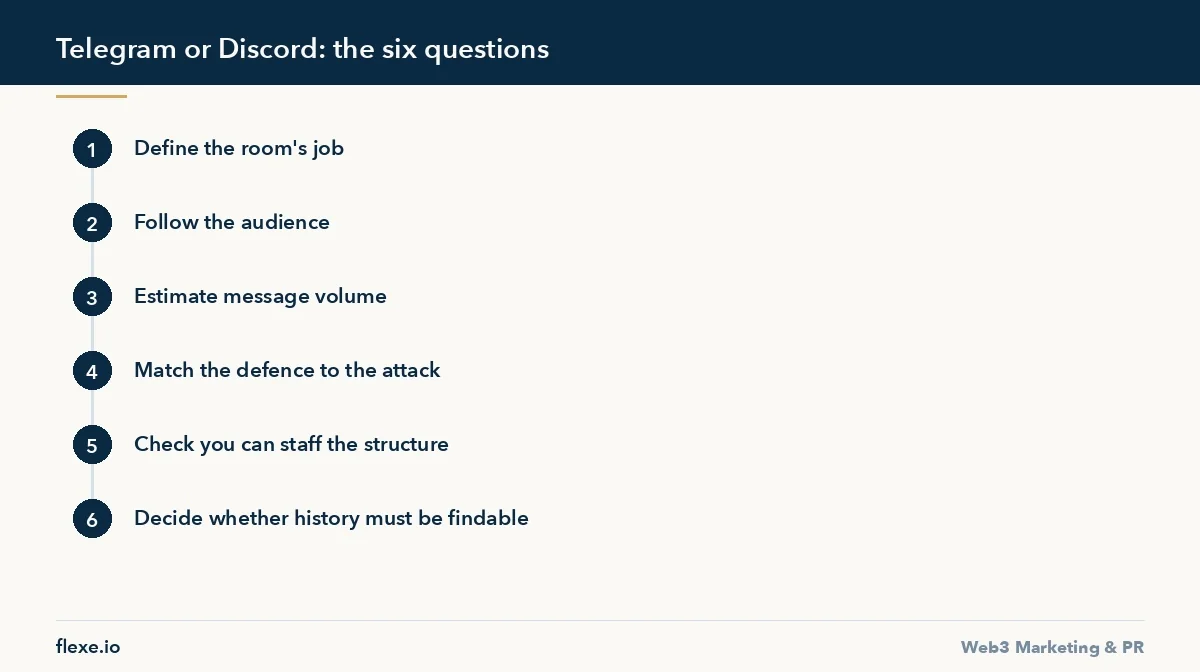
1. What does the room have to do?
If it exists to carry announcements to as many people as possible and to be loud during a launch, Telegram wins on both counts: everyone receives the message and nobody has to configure anything to be in the room.
If it exists to support a product, separate beginners from builders, run structured help and keep a searchable record of how things were solved, Telegram’s single flowing conversation actively works against you and Discord’s channel structure is the reason it exists.
2. Where is your audience already?
Trading, launch and regional crypto audiences live on Telegram, and in several markets it is the default messenger rather than a crypto tool. Gaming, NFT and developer audiences skew to Discord.
Fighting this costs more than it saves. Asking a trading audience to create an account and pass a verification gate loses a large share of them at the door, and asking a builder audience to follow a technical discussion inside one scrolling channel loses the discussion.
3. How many people will be talking at once?
Telegram is comfortable while the conversation is one conversation. Past that point messages scroll faster than anyone reads, questions go unanswered because they vanish, and the room becomes a place people mute rather than visit.
Discord degrades more slowly because the traffic splits across channels, but only if the structure was set before the growth arrived. Adding channels to an already chaotic server does not recover it.
4. Which failure can you actually defend against?
On Telegram the dominant attack is a direct message from an account impersonating the team, and the defence is largely social: a permanently pinned statement that the team never messages first, repeated often enough that members expect it.
On Discord the dominant attack is a compromised privileged account posting a link into a channel everyone trusts. The defence is technical: restricted permissions, enforced two-factor authentication on every moderation role, and a bot removing wallet addresses posted by non-admins. That setup is in how to moderate a crypto Discord without burning out.
5. Can you staff the structure you are choosing?
A Discord with twelve channels needs someone watching twelve channels, and the ones nobody watches are where the damaging messages sit unnoticed. Structure is a staffing commitment, not a layout decision.
A small team is usually better served by one Telegram group they can actually read, plus an announcements channel nobody can post in. The room configuration that survives is in how to build a Telegram group from zero.
6. Do you need the history to be findable later?
Discord’s channel history functions as an informal knowledge base: the answer to a recurring question stays where people can find it, and moderators can point to it instead of retyping it.
Telegram history exists but is not practically searchable at volume, which means the same questions get answered repeatedly and the load never falls. For a support-heavy product that difference compounds every month.
Running both
Plenty of projects do, and it works when each has a stated job: Telegram for announcements and the fast conversation, Discord for support, builders and anything that needs to be found again.
It fails when both are general-purpose rooms with the same conversation, because the team then moderates two rooms and members pick one and miss half of what is said. Two rooms with one job each is manageable. Two rooms with no jobs is twice the work for less than one room’s result.
Staffing, moderation coverage and retention across either platform are on our crypto community management page.