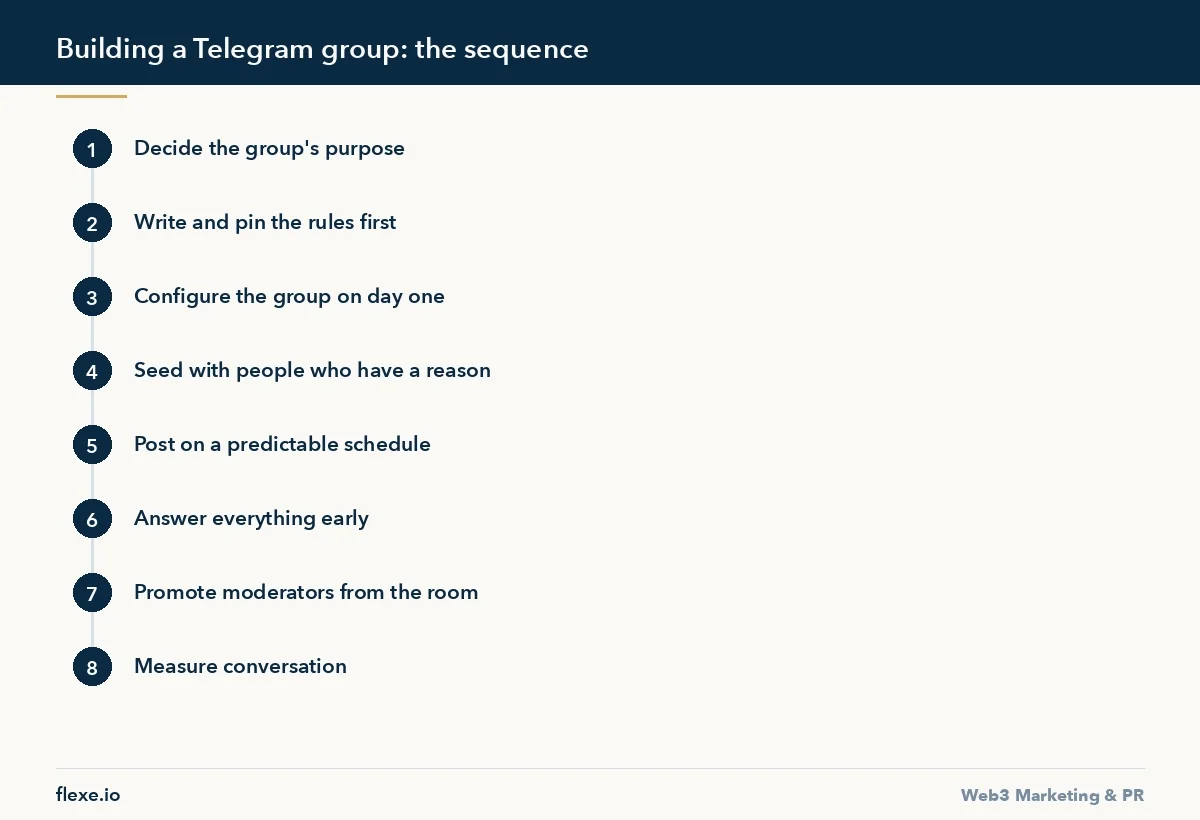
To build a crypto Telegram group, you create it in the app, decide what it is for, pin the rules, configure it against spam, seed it with people who have a reason to be there, post on a schedule, answer everything and measure conversation rather than membership. The first lesson in how to build a crypto Telegram group is that an empty one is worse than none, because it is public evidence that nobody cares yet.
The instinct is to fill it, and the market will happily sell you ten thousand members who will never speak. That purchase makes the problem permanent rather than solving it. Building a group that works is slower and mostly consists of decisions made before the first invite goes out.
What you need before you start
- A primary purpose: support, discussion or announcements, chosen before anything else.
- Written rules: what is not allowed, what happens when it occurs, and who decides.
- A short admin list with roles that make sense, published where members can check it.
- Bots for the mechanical work: an entry check, a spam filter and a logging bot.
- A first invite list: testers, early users, people who have asked questions and anyone who has written about the project.
How to build a crypto Telegram group step by step
1. Create the group
Open Telegram, tap the pencil icon, choose New Group, add at least one contact as the first member, then type a group name and confirm. That takes a minute and gives you an empty private group. Leave the photo, description and pinned message for step 3, and do not invite anyone else yet.
2. Decide what it is for
A support channel, a discussion group and an announcement feed are three different products with different rules. Trying to be all of them produces a room where a support question, a price argument and an official update sit in the same scroll and none of them get read. Pick the primary purpose and structure around it. If you are still choosing the platform, see Telegram or Discord for crypto.
Best setup: an announcements channel that nobody can post in, plus one discussion group, is the arrangement that fails least often.
3. Set the rules and configure the group before anyone joins
Write what is not allowed, what happens when it occurs, and who decides. Pin it. Rules written after the first serious incident always look like they were written about a specific person, and they are always contested. The rules that matter in crypto groups are narrow: no unsolicited direct messages, no contract addresses posted by anyone but admins, no price talk if you have decided against it, and a clear statement that the team will never message first. That last line prevents more losses than any moderation tool.
Then configure it on day one: slow mode on, an entry check against bots, media restricted for new members, and an admin list with roles that make sense. Restricting new accounts from posting links for their first period removes most of the spam that would otherwise arrive. Set the group photo, description and pinned message before inviting anyone.
Check: a visitor forms a judgement in about eight seconds, and half of that is whether the room looks maintained.
4. Seed with people who have a reason to be there
The first fifty members set the tone permanently. Invite testers, early users, people who have already asked questions, and anyone who has written about the project. Twenty people talking is a community. Two thousand silent members is a graveyard with a large number attached. Do not announce the group broadly until there is visible conversation in it, because a first-time visitor to a silent room does not come back.
5. Give people something to do besides wait
A group with no activity between announcements dies between announcements. Post something on a predictable schedule: a development update, a question, a walkthrough of a decision, an explanation of something in the space that is not about you. Live formats help too, see how to run a Telegram AMA. Predictability matters more than volume: a weekly update that always arrives beats sporadic bursts, because it gives members a reason to open the channel rather than mute it.
6. Answer everything early on
In the first months, respond to every question, including the ones already in the pinned message. The visible pattern of a team that replies is what converts a member into a participant, and it is the behaviour most projects stop too soon. Answer critics in the room rather than removing them. A group where dissent disappears reads as managed, and the members you want are the ones who notice.
7. Recruit moderators from the room
The people already answering other members’ questions are the ones to promote. They know the project, they have standing with the group, and they were doing the work before anyone asked. Give them written escalation rules and coverage across time zones. The unmoderated overnight hours are when scam accounts operate, precisely because nobody is watching. The full moderation setup is in how to moderate a crypto Discord, and the mechanics carry over.
8. Protect members from impersonation
Impersonation is the threat that costs members money, and it starts as soon as the room has traffic worth stealing. Admin display names and usernames get copied within days. Publish the admin usernames in the pinned message, keep the admin list short enough that anyone can read it, and repeat that nobody from the team opens a private conversation first. When a member reports a fake admin, ask for the username, remove that account, report it, and post the username in the room so the next person recognises it.
The other pattern is the cloned group: a near-identical name, the same photo, and your own announcements copied into it. Search the project name periodically, and link to the group from one place on the site and from the pinned message, so there is a single chain anyone can verify.
9. Measure conversation, not membership
Track daily active posters, how many distinct people post in a week, and how many questions get an answer within an hour. Those numbers describe whether the room is alive. Member count describes how many people once clicked join.
In the communities we run, the ratio of weekly posters to total members is the figure that predicts whether a launch announcement will produce any action at all.
What to check every week
| Metric | What it tells you | Warning sign |
|---|---|---|
| Daily active posters | Whether the room is alive day to day | The same few accounts carry every conversation |
| Distinct posters per week | How many people actually take part | Falling while joins rise |
| Questions answered within an hour | Whether members get help | Questions left unanswered past an hour |
| Joins against leaves | Whether new members stay | Joins rising, posters falling |
| Bans and removals | Spam and rule pressure on the room | Enforcement that varies by who broke the rule |
| Reactions to the last announcement | What a launch post will do | Few distinct accounts reacted, replied or clicked |
| Weekly posters to total members | Whether a launch announcement produces action | Membership growing with no conversation |
Numbers moving in opposite directions are the interesting case: joins rising while distinct posters fall means the room is filling with people who will never speak. Read the scroll as well as the counts. Whether new members get a reply from anyone other than an admin, and whether the questions have changed since last month, tell you something no dashboard reports.
Running the group once it is live
Bots that earn their admin rights
An entry check, a spam filter and a logging bot cover most of what a group needs, and each one takes permissions you are handing to code somebody else operates. Read the permission list, grant the narrowest set that still works, and record who runs each bot and how to reach them when it breaks during a launch. Review the list on a schedule: an abandoned bot with posting rights is a way into the room. Automation does not replace answering; a room where the only fast reply is a canned message reads as unstaffed, so keep the replies people remember human.
Moderation that leaves a record
Keep a private log channel where every mute, ban and warning is recorded with the username, the rule and the admin who acted. Publish the ladder: a warning, then a mute of stated length, then removal, with one route of appeal to a named admin, and answer appeals even when the answer is no. Inconsistent enforcement produces more complaints than strict enforcement ever does. Decide in advance what happens when a large holder breaks the rules, because a room that visibly exempts big wallets stops being worth moderating.
Responding to a rumour in the room
When a rumour starts, speed beats polish. Post inside the same hour: what you know, what you do not know yet, and when the next update will come. A careful statement drafted for hours is read as confirmation. Do not lock the group; slow mode, temporary limits on links and media, and more admins in the room handle the noise, while a locked room moves the discussion somewhere you cannot see. Update the pinned message with each fact and the time it was added, and post the same wording to the announcement channel. Two slightly different versions of the same statement create a second rumour about which of them is real.
Staffing moderators across the week
Write the shifts down, cover the overnight hours, and have each moderator leave a short handover note. Put the terms in writing even for volunteers: expected hours, how fast a question should get an answer, what they are paid and when, and what they may not repeat outside the room. Unpaid moderators drift away without telling anyone, so say what happens then. When a moderator leaves, remove the rights the same day, change shared bot tokens, and read the admin list afterwards. Standing rights held by people who have gone is a common way a group is taken over.
Splitting by language and moving from a dead group
Split when another language already crowds out the main conversation and you have a moderator who speaks it. Each regional group needs translated rules, its own pinned message and announcements at the same time as the main room, or it becomes a rumour mill. Fold a quiet regional room back rather than leaving it up, because an abandoned official group is a target for whoever wants to take over the name. When replacing a dead group, announce the new one in the old room, pin the link, and keep the old room read-only rather than deleting it, because deleting it hands the name to whoever registers it next. Leave a pinned message there pointing at the new link for as long as the project exists, and update the link on the site and in the profiles you control.
Common mistakes
The costliest mistake is buying members. They do not just fail to help: they push the engagement ratio down permanently, they hide whether real growth is happening, and they are visible to anyone who compares member count against message volume, which includes every exchange and every serious investor. Removing them later is not practical at scale, so the number stays as a permanent asterisk on every metric the project reports.
- Announcing the group broadly before there is visible conversation in it.
- Writing the rules after the first serious incident.
- Removing critics instead of answering them in the room.
- Two admins giving different answers to the same question a few lines apart.
- Opening a room per market at launch and staffing none of them.
How long it takes and what it costs
The setup is a day-one job, but the work that decides the outcome runs for months. The first fifty members set the tone, every question needs an answer in the first months, and the questions about night cover, scams, the contract address and rule breaks all get asked in the first week, so write the answers into the pinned message once rather than improvising them five times by four different admins, and keep a longer internal version for whoever is on shift.
The main costs are people and discipline rather than tools: moderators with written terms and shifts, and a weekly routine of checks. Starting again is usually cheaper than reviving a dead group, and the new room should not carry the old member count over as a claim. Knowing how to build a crypto Telegram group this way is slower than buying members, but it produces a number worth reporting. For teams that need the room built and staffed rather than advised on, that is what our crypto community management page covers.
Frequently Asked Questions
How many members does a crypto Telegram group need to work?
Far fewer than most teams assume. Twenty people talking regularly is a community, while two thousand silent members is a graveyard with a large number attached. The first fifty members set the tone, and the ratio of weekly posters to total members is the figure that predicts response to a launch announcement.
Is buying Telegram members ever worth it?
No. Bought members push the engagement ratio down permanently, hide whether real growth is happening, and are visible to anyone comparing member count against message volume, which includes every exchange and serious investor. Removing them later is not practical at scale, so the number stays as a permanent asterisk on every metric.
What rules does a crypto Telegram group need?
A crypto Telegram group needs a few narrow rules: no unsolicited direct messages, no contract addresses posted by anyone but admins, a stated position on price talk, and a clear line that the team will never message first. Write and pin them before anyone joins, together with what happens when a rule is broken and who decides.
How should a new Telegram group be seeded?
Seed it with testers, early users, people who have already asked questions and anyone who has written about the project. Set the photo, description and pinned message first, and do not announce the group broadly until there is visible conversation in it, because a first-time visitor to a silent room does not come back.
How do you stop scammers impersonating admins?
Publish the admin usernames in the pinned message, keep the admin list short, and repeat that nobody from the team opens a private conversation first. When a member reports a fake admin, remove and report the account and post its username in the room. Cover the overnight hours, when scam accounts operate because nobody is watching.